


OpenAI is taking the “oops” out of AI art, letting you circle your mistakes like a disappointed art director instead of rewriting your prompt for the fifth time.
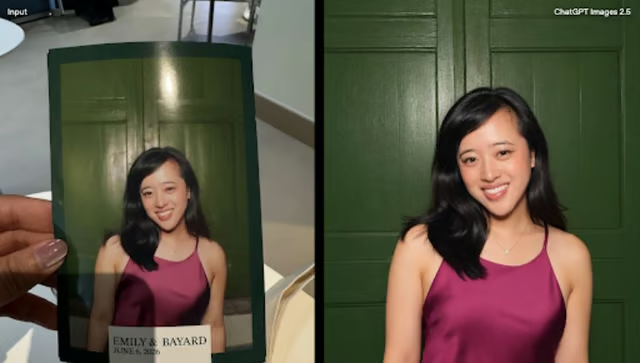
ChatGPT Images 2.5, a new version of the image model built into ChatGPT, launched on Tuesday. The company says it delivers sharper details, more natural lighting and richer textures, while doing a better job holding onto the actual likeness of people, pets and objects pulled from reference photos.
Generation is also up to 50% faster than the previous version, Images 2.0.
ChatGPT Images 2.5 at a glance
OpenAI’s update combines faster generation with new ways to create, edit, and refine images without relying on prompts alone.
| Image quality | Sharper details, more natural lighting, richer textures, and better reference-photo fidelity |
| Speed | Up to 50% lower generation latency than Images 2.0 |
| Editing | More targeted changes and better consistency across multiple edits |
| Creative controls | Sketch, templates, image comments, and prompt sharing |
| API models | Flare for faster everyday/high-volume use; Sunburst for higher-precision creative work |
Editing that actually listens
A recurring complaint with AI image tools has been that asking for one small change often scrambles the whole picture. OpenAI says Images 2.5 is built to edit only what you ask for — swapping a background, a product, or a line of text — while leaving everything else alone, even across multiple rounds of edits in a long conversation.
Axios, which got early access, tested this by having the model design a tattoo, revise it based on notes, and iterate a logo through several rounds without losing the original concept.
Draw it instead of describing it
The update adds a feature called Sketch, letting users doodle directly in ChatGPT — the layout of a room, the shape of an outfit — and have that rough drawing guide the final image. Type “@Sketch” to pull it up.
OpenAI also added templates for common formats like posters and merchandise, the ability to leave comments directly on images to target edits, and an option to share the exact prompt behind an image so others can remix it with their own photos.
For developers
OpenAI is also releasing two new models through its API: GPT-Image-2.5 Flare, aimed at high-volume, everyday use like social content and product photos at lower latency, and GPT-Image-2.5 Sunburst, a slower but more precise option for polished campaign work. OpenAI says it’s keeping its existing safety checks in place, along with C2PA metadata and invisible watermarking to help identify AI-made images.
More must-read AI coverage
- SS&C Intralinks DealCentre AI vs. Datasite: Which platform is built for the future of dealmaking?
- SS&C Intralinks FundCentre AI vs. Juniper Square: Which platform better supports modern private markets fund managers?
- Why Data, Not Models, Determines AI Success
- The Rise of the AI-Native Factory: How Physical AI Is Transforming Manufacturing
Why ChatGPT Images 2.5 matters
OpenAI is trying to make AI image generation feel less like typing a magic spell into a box and more like actually making something. Sketch and comment-based editing tools shift the interaction from “describe until it’s right” to “point and adjust,” lowering the skill floor for getting a usable result.
That’s a meaningful shift for small businesses and creators who don’t want to become prompt-engineering experts just to get a decent flyer or product shot.
Adele Li, OpenAI’s product lead on images, told Axios the goal is to keep people engaged in the creative process rather than being passive: “The sketch tool and these templates are kind of an attempt to make people more engaged in the process of creation, rather than them being a passive force.”
She added, “I don’t want to be able to see ChatGPT in the world. I want people to be able to generate and express their own individualism.”
The model is rolling out to all ChatGPT, ChatGPT Work, and Codex users on desktop, mobile, and web.
Also read: Canva has shipped 100-plus Visual Suite updates in 2026, targeting tool-switching, rework, and workflow friction for creative teams.