


AI voice assistants are getting closer to real conversation.
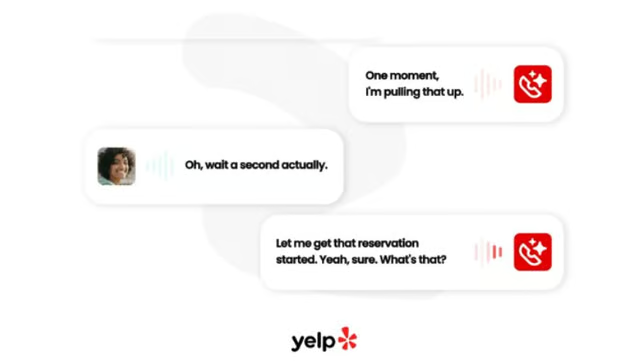
OpenAI’s GPT-Live-1, now available to developers through its API, can listen and speak at the same time, allowing voice agents to handle interruptions, pauses, and changing directions without relying on a strict listen-then-answer pattern.
That matters for businesses building customer-service, sales, and support agents because the voice layer can stay conversational while connected models and backend tools handle more complex work.
That gives developers a way to build voice agents with more natural turn-taking, including the ability to listen during speech, respond to interruptions, and continue interacting while other tools or models handle the underlying task.
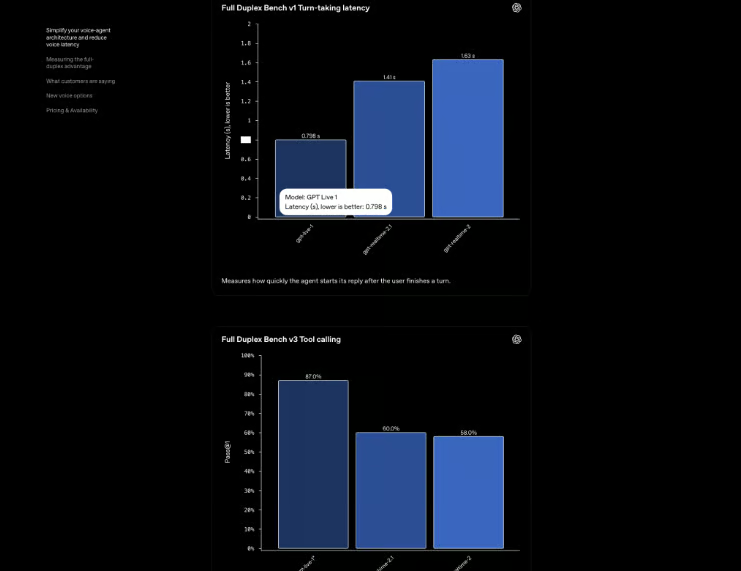
The difference shows up in OpenAI’s reported benchmarks. The company says GPT-Live-1 had a 0.798-second turn-taking latency in the company’s Full Duplex Bench and 87% tool-calling accuracy.
Where GPT-Live-1 could actually be useful
Because GPT-Live-1 is fully interactive, OpenAI pitches the tool as a building block for voice agents that can do more than talk. Developers can integrate it into their own applications and connect the voice layer to backend systems, tools, and business data.
That opens up use cases across customer support, sales, reservations, and other business workflows.
A sales agent, for example, could speak with a prospect while retrieving product information or passing a complex request to another model. In another example, a support agent could hold a conversation while backend systems handle the task and report back to it, with the voice model notifying the customer of the problem’s status.
The API therefore shifts voice AI from a standalone feature to an interface for broader AI agents. And as OpenAI increasingly pushes AI deployment into business workflows, GPT-Live-1 gives companies a way to put that interaction directly where their customers already are.
A plausible unintended use case: fraud
AI-powered scams and cyberattacks are already a thing.
Now, with an AI voice model that doesn’t just speak but handles back-and-forth conversations the way GPT-Live-1 does, attackers can have something AI voice deepfakes have traditionally lacked: real-time situational awareness.
A system that can listen continuously, respond to interruptions, and adapt its answers in real time gives attackers a more flexible alternative to the scripted robocalls and prerecorded messages of the past. For instance, an impromptu question from a fraud target can be passed to the background model and resurfaced back to the target.
In theory, attackers could combine similar real-time voice capabilities with automation tools to run more adaptive impersonation, fake-support, or social-engineering calls at scale.
The risk is not that GPT-Live-1 has been shown to power these scams, but that the barrier to building convincing automated voice interactions is falling. And when a familiar voice can no longer reliably prove who is on the other end of a call, businesses and consumers may need stronger ways to verify identity.
Pricing and availability
OpenAI has made GPT-Live-1 available through its API platform, giving developers access to the model’s real-time voice capabilities for $0.05 per minute.
Backend reasoning models, tool calls, and other components used alongside GPT-Live-1 can incur separate charges, so the final cost depends on how you build the application.
More must-read AI coverage
- SS&C Intralinks DealCentre AI vs. Datasite: Which platform is built for the future of dealmaking?
- SS&C Intralinks FundCentre AI vs. Juniper Square: Which platform better supports modern private markets fund managers?
- Why Data, Not Models, Determines AI Success
- The Rise of the AI-Native Factory: How Physical AI Is Transforming Manufacturing
Voice AI could change how people and businesses interact with software
GPT-Live-1 pushes voice AI closer to becoming an interface for real work rather than simply a way to ask questions.
For businesses, that could mean faster customer-service interactions, voice-based sales workflows, reservations, scheduling, and support without forcing users through menus or forms. But deploying those systems also raises questions about disclosure, authentication, error handling, and when a human should take over.
As voice agents gain the ability to hold fluid conversations and trigger real actions, the challenge shifts from making them sound convincing to making sure users can trust what happens next.
Let us teach you How to Talk to AI for free! Try our six-minute course at The Neuron Academy and learn a few simple ways to write better prompts and get more useful results from AI, or browse our other AI course for free for seven days. Check out all the lessons here →