


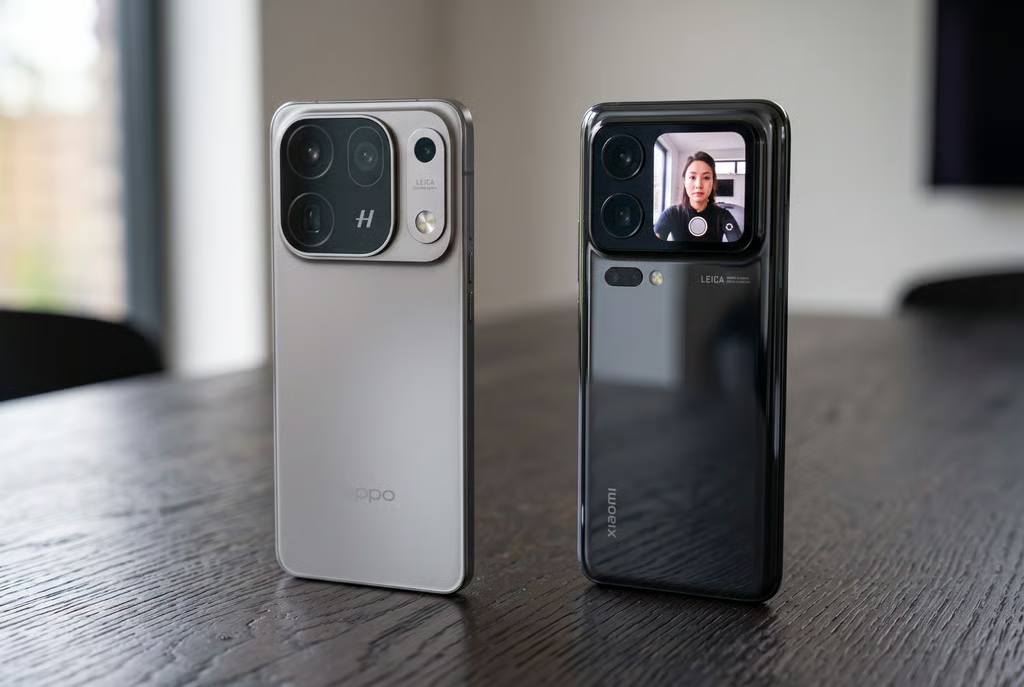
Choosing between the OPPO Find X10 Pro Max and Xiaomi 18 Pro Max starts with how you take photos — and where you plan to buy.
OPPO emphasizes three 200MP rear cameras, while Xiaomi adds a rear display and advertises a larger battery in its Chinese configuration. Regional differences in hardware, software, and pricing make the buying decision more complicated than the specifications suggest.
This comparison examines manufacturer specifications and published reporting to explain the trade-offs. Camera quality, battery endurance, and sustained performance should be judged separately from advertised specifications.
- OPPO vs. Xiaomi: Key specifications at a glance
- Design and displays: Familiar flagship vs. a second screen
- Cameras: OPPO’s three 200MP sensors face Xiaomi’s Leica system
- Performance: Snapdragon vs. MediaTek
- Battery capacity, charging, and ecosystem software
- Storage, connectivity and everyday features
- Price and availability: the cheapest option depends on where you live
- Which Phone Should You Buy?
- What matters before you buy
OPPO vs. Xiaomi: Key specifications at a glance
| Feature | OPPO Find X10 Pro Max | Xiaomi 18 Pro Max |
|---|---|---|
| Main display | 6.78-inch AMOLED | 6.9-inch AMOLED |
| Refresh rate | Up to 120Hz adaptive; 144Hz in supported games | Up to 120Hz |
| Advertised brightness | 2,000 nits in high-brightness mode | Up to 4,000 nits peak; measurement differs |
| Processor | MediaTek Dimensity 9600 Pro, 2nm | Snapdragon 8 Elite Extreme Gen 6, 2nm |
| Main camera | 200MP, f/1.5 | 200MP, f/1.67 |
| Ultrawide camera | 200MP, 124-degree field of view | 50MP, 102-degree field of view |
| Telephoto camera | 200MP, 3x optical zoom | 200MP, 3.2x optical zoom |
| Front camera | 50MP | 50MP |
| Battery | 8,000mAh on the global specification page; 7,150mAh in the UK | 8,500mAh |
| Wired charging | Up to 80W | Up to 100W |
| Wireless charging | Up to 50W | Up to 50W |
| Reverse charging | 10W | 27W wired reverse charging; wireless reverse charging supported |
| Rear display | None | 2.9-inch AMOLED |
| Operating system | ColorOS 17 | HyperOS 4 |
| Starting China price | 6,799 yuan (about US$1,019) | 6,999 yuan (about US$1,049) |
Design and displays: Familiar flagship vs. a second screen
Both phones are large devices built for people who want plenty of screen space, but Xiaomi does more with its rear panel.
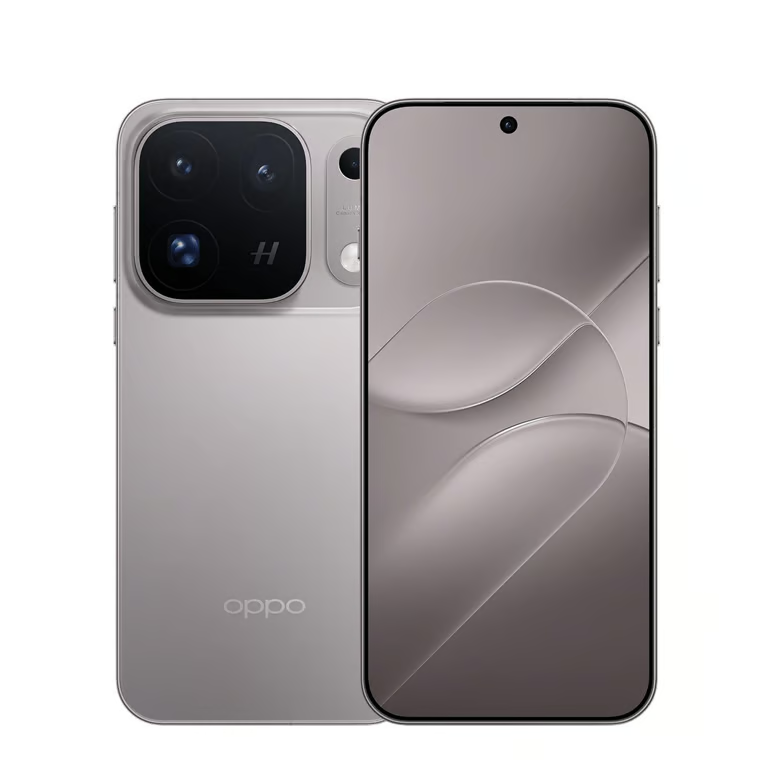
OPPO’s Find X10 Pro Max measures about 161.32 millimeters tall, 76.57 mm wide and 8.40 mm thick. The global listing gives weights of 233 grams in Luna White and 235 grams in Titanium Grey; its UK listing gives 226 grams and 228 grams, respectively. Its 6.78-inch AMOLED display has a resolution of 2,772 × 1,272 pixels, a 120Hz adaptive refresh rate that can reach 144Hz in supported gaming scenarios, and a typical high-brightness-mode rating of 2,000 nits.
The high refresh rate should appeal to gamers and anyone who appreciates smooth scrolling. Its 450 pixels per inch also gives OPPO a higher pixel density than Xiaomi’s listed 419 ppi, although that difference alone does not determine which screen looks better.
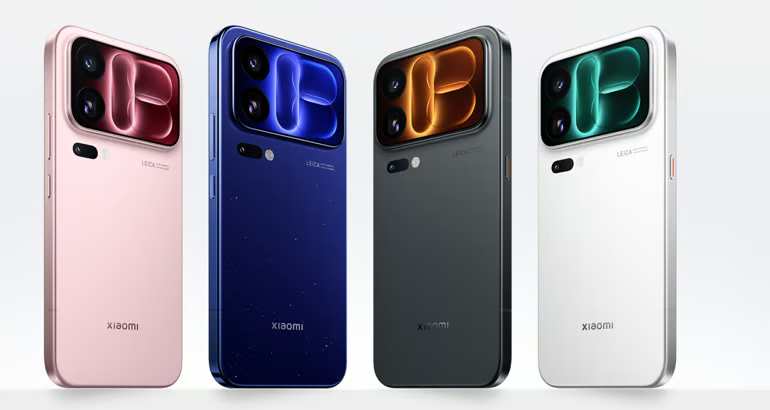
Xiaomi’s 6.9-inch display offers more room for reading, watching videos and working across apps. The device has a peak brightness of up to 4,000 nits and a refresh rate of up to 120Hz. Xiaomi also adds a 2.9-inch AMOLED display to the back of the phone, with touch controls and support for notifications, calls and other information.
That rear screen is more than a novelty for people who take lots of photos. It lets users frame selfies with the main camera system, check incoming calls while the phone lies face-down and view selected information without turning on the larger display.
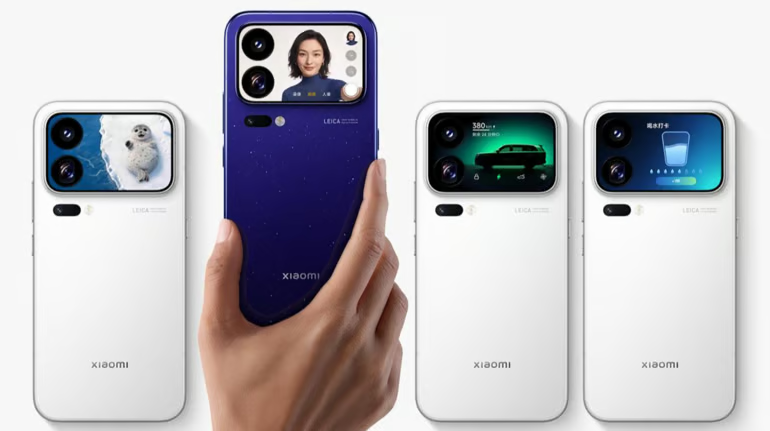
The extra screen could also make the phone more appealing to creators who record themselves. Instead of relying entirely on a front-facing camera, they can use the rear cameras and monitor their framing on the smaller display.
There is a practical catch: the rear screen adds another interface to manage, and its usefulness depends on whether you actually want those shortcuts. Buyers who prefer a conventional phone may get more value from OPPO’s simpler layout.
Display verdict: Xiaomi wins on screen size and versatility, while OPPO offers a higher maximum refresh rate in supported games and greater pixel density. Xiaomi’s rear screen is the more distinctive feature, but its value depends on your habits.
Cameras: OPPO’s three 200MP sensors face Xiaomi’s Leica system
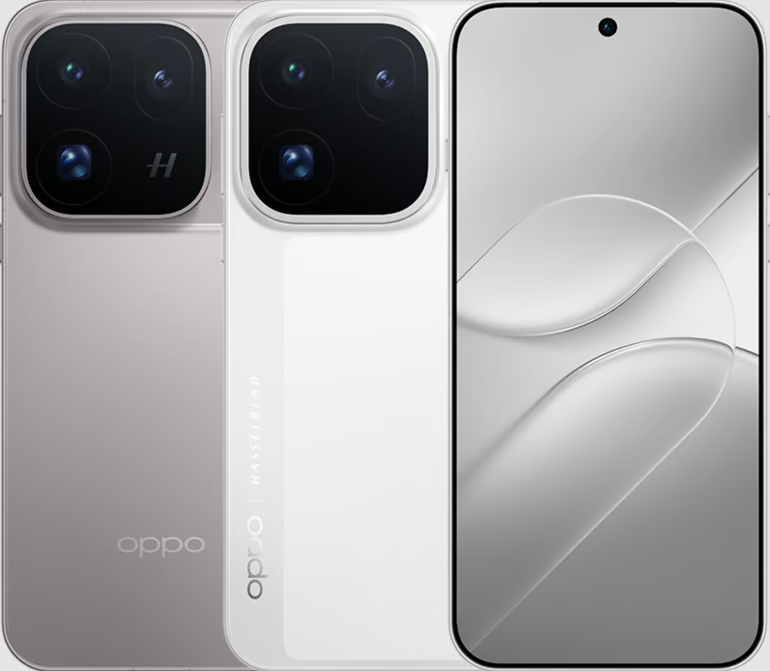
Camera hardware is where OPPO makes its strongest case. OPPO delivers a world first: a uniform triple 200-megapixel rear setup.
- Main camera: 200MP, 1/1.3-inch sensor, f/1.5 aperture, 24mm equivalent focal length, dual-axis optical image stabilization.
- Telephoto camera: 200MP periscope, 1/1.56-inch sensor, f/2.1 aperture, 3x optical zoom (70mm equivalent), with macro focusing down to 10 centimeters.
- Ultrawide camera: 200MP, 1/1.56-inch sensor, f/2.2 aperture, wide 124-degree field of view.
OPPO supports this setup with a 24-channel spectral color sensor, Hasselblad color tuning, and Master shooting modes. The company says its color-sensing system helps improve color reproduction across photos and video. For videographers, it supports full-sensor Open Gate recording in addition to standard 8K at 30 fps and 4K at up to 120 fps. OPPO also offers an optional Hasselblad teleconverter kit for longer-distance photography.
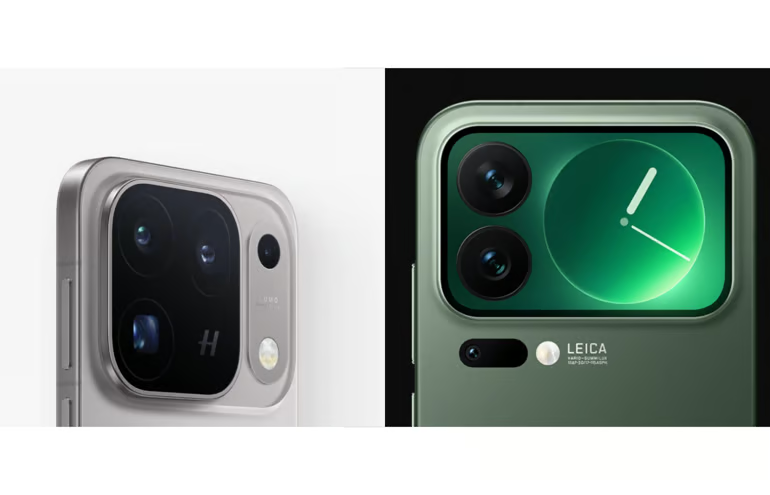
Xiaomi counters with its Leica partnership and a specialized optical arrangement.
- Main camera: 200MP, larger 1/1.28-inch Light Hunter 960L sensor, f/1.67 aperture, backed by a 1G+6P Leica Summilux lens featuring anti-glare MgF₂ and anti-ghosting ALD/PVD/SWC coatings.
- Telephoto camera: 200MP periscope, 1/1.56-inch sensor, f/2.4 aperture, 3.2x optical zoom (75mm equivalent), with a floating dual-lens design capable of 12-centimeter macro focus.
- Ultrawide camera: 50MP, 1/2.88-inch sensor, f/2.4 aperture, 102-degree field of view with 5-centimeter macro capabilities.
While Xiaomi holds a slight sensor-size lead on its primary shooter, its 50MP ultrawide is physically much smaller than OPPO’s 1/1.56-inch, 200MP ultrawide module. However, Xiaomi holds a distinct practical edge: the rear 2.9-inch display lets users frame photos and video of themselves using the 200MP main camera rather than relying on the 50MP front-facing sensor.
Camera verdict: OPPO is the stronger choice on paper for ultrawide photography and consistent resolution across the rear camera system. Xiaomi offers a compelling alternative with a slightly longer optical zoom, a larger main sensor and the rear display.
Performance: Snapdragon vs. MediaTek
Both phones use flagship processors built on a 2-nanometer manufacturing process, but they come from different chipmakers.
The Xiaomi 18 Pro Max runs Qualcomm’s Snapdragon 8 Elite Extreme Gen 6, with Oryon CPU cores clocked at up to 5GHz and an Adreno 850 GPU. Xiaomi also uses a 5,513-square-millimeter vapor chamber to help control heat during demanding tasks.
OPPO uses MediaTek’s Dimensity 9600 Pro, paired with an Arm Mali G2-Ultra GPU.
The early results reported by Memeburn suggest Xiaomi has an advantage in CPU performance. Its cited Geekbench results put the Snapdragon at approximately 3,582 in single-core testing and 12,247 in multi-core testing, compared with around 3,242 and 11,132 for the Dimensity 9600 Pro.
Graphics performance is less straightforward. Memeburn reports that the MediaTek chip wins at least one demanding ray-tracing test, suggesting the Snapdragon’s CPU lead does not automatically translate into a win in every game.
For ordinary tasks such as messaging, browsing, video streaming and switching between apps, both phones have flagship-class hardware. The cited benchmark results favor Xiaomi for CPU performance, but they do not establish which phone maintains better gaming performance over time.
Performance verdict: The reported CPU scores favor Xiaomi. Gaming performance remains less clear without comparable device-level testing of frame rates, temperatures, and throttling.
Battery capacity, charging, and ecosystem software
Battery specifications require particular care because regional versions differ.
Xiaomi advertises an 8,500mAh battery, 100W wired charging, and 50W wireless charging for its Chinese model. These figures describe capacity and maximum charging power, rather than measured battery life or charging time.
OPPO’s global specification page lists an 8,000mAh battery with up to 80W wired and 50W wireless charging. Its UK specification page lists a smaller 7,150mAh battery with the same maximum charging ratings. Buyers should check the exact regional model and compatible charger before comparing the two.
On the software front, both run Android 17 under proprietary interfaces:
- OPPO ColorOS 17: Check the regional feature list before buying. OPPO’s UK product page highlights AI Mind Pilot, OSee visual assistance, and Touch to Share transfers with Apple devices.
- Xiaomi HyperOS 4: Confirm that the advertised AI assistant and cross-device functions support your language, region, applications, and existing devices before treating them as a reason to buy.
Battery verdict: Xiaomi’s Chinese model has the higher advertised battery capacity and maximum wired charging power. OPPO still offers a large battery and fast wireless charging, but regional battery differences make checking the precise model especially important.
Software verdict: Choose based on the functions available on the model you can purchase locally. Broad promises of AI assistance or Apple-device integration are less useful than confirmation that the specific workflow you need is supported.
Storage, connectivity and everyday features
The two phones are closely matched on core flagship connectivity, but there are a few details worth checking before buying.
| Feature | OPPO Find X10 Pro Max | Xiaomi 18 Pro Max |
|---|---|---|
| Starting configuration in the referenced market | 12GB/512GB in the UK; China configurations differ | 12GB/256GB |
| Higher storage options | Market-dependent; UK listing shows 12GB/512GB only | Up to 16GB/1TB |
| Storage expansion | No memory card slot | No memory card slot |
| Wi-Fi | Wi-Fi 7 | Wi-Fi 7 |
| Bluetooth | 6.2 | 6.0 |
| Wired connection | USB-C, USB 3.2 Gen 1 | USB-C, USB 3.2 Gen 1 |
| Fingerprint security | Under-display ultrasonic sensor | 3D ultrasonic sensor |
Price and availability: the cheapest option depends on where you live
The listed China starting prices are 6,799 yuan (about US$1,019) for OPPO and 6,999 yuan (about US$1,049) for Xiaomi, a difference of 200 yuan (about US$30). Compare matching RAM and storage configurations before treating that starting-price gap as a measure of value.
For UK buyers, the OPPO Find X10 Pro Max starts at £1,499 (about US$2,005), with no planned US release. Xiaomi has confirmed the 18 Pro series will launch globally this year, though pricing outside China remains unknown.
Which Phone Should You Buy?
Choose the OPPO Find X10 Pro Max if …
- You regularly take ultrawide photos and want a high-resolution sensor across all three rear cameras.
- You value Hasselblad shooting modes and the option of an external teleconverter.
- You prefer a conventional flagship design without a secondary rear screen.
- The exact OPPO configuration you are considering costs less than the comparable Xiaomi model.
Choose the Xiaomi 18 Pro Max if …
- You want the larger listed battery and faster 100W wired charging.
- You take frequent selfies or vlogs and would use the rear display as a viewfinder.
- You prioritize the reported CPU benchmark advantage, while recognizing that sustained performance still needs comparable testing.
- You have confirmed that Xiaomi’s cross-device features support the Apple devices and applications you already use.
What matters before you buy
OPPO’s camera hardware makes it worth shortlisting if ultrawide photography is a priority. Xiaomi’s rear display offers a different practical attraction for people who frequently photograph or record themselves. Neither advantage establishes a universal winner: processing, moving-subject performance, stabilization, and low-light results require comparable image samples.
Battery decisions also need more than the largest capacity figure. Compare the regional models you can actually purchase, then look for endurance and charging tests conducted under similar conditions. Check whether reaching the advertised charging power requires a particular adapter and cable, especially if you plan to reuse existing accessories.
For professionals using either phone for work, software support deserves as much attention as cameras. Before buying, verify the security-update commitment, Android upgrade policy, work-profile support, and compatibility with your employer’s device-management requirements. Treat advertised AI and cross-device features as purchase benefits only after confirming their regional availability and required accounts or applications.
Finally, compare the full cost of ownership. A lower China price may become less attractive after shipping, taxes, warranty limitations, and potential repair costs. If importing, check the exact model’s network compatibility and access to the services you need. A locally supported configuration that meets your daily requirements may offer better value than a more impressive specification sheet.
Read more: Before committing to a phone for several years, consider how the OnePlus Nord 6’s security support and Android upgrade commitments differ — and why both matter when assessing long-term value.