


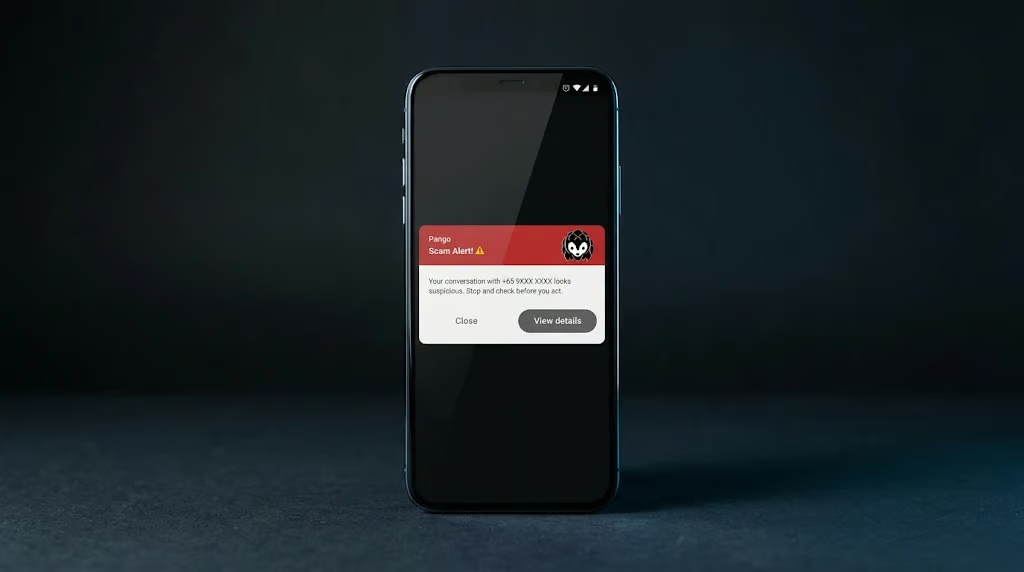
Scammers don’t always need to break into bank accounts. Sometimes, they just need to persuade someone to send the money. Singapore’s new AI-powered app looks for suspicious conversations before those requests lead to costly mistakes.
The Government Technology Agency (GovTech) launched AntiScam Pango on Nov. 4, 2026. Developed with support from Google DeepMind, the free Android beta examines incoming WhatsApp, Telegram, and SMS notifications for potential scams, including those involving previously unreported senders.
Victims initiated their own money transfers in 80.8% of Singapore’s reported scam cases during the first half of 2026, according to Singapore Police Force data. Pango targets suspicious exchanges that may lead to those payments, although its real-world effectiveness remains unproven.
How Pango detects suspicious conversations
Pango doesn’t need a sender’s number to appear on a scam blacklist. With notification access enabled, it evaluates successive message alerts together, looking for suspicious patterns as conversations develop.
According to GovTech’s launch announcement, its AI runs directly on the phone and looks for scam patterns relevant to Singapore. These include conversations that move from casual greetings to requests for money.
In a GovTech demonstration, a WhatsApp conversation starts with small talk before turning into an investment pitch and a registration fee. Pango flags the exchange as suspicious and warns the recipient against sending money. Users can then verify the sender, report the exchange, or continue messaging.
WhatsApp began testing its own on-device AI scam alerts for messages from unknown senders in August 2026. Pango covers notifications from multiple messaging services rather than operating exclusively within WhatsApp.
Singapore’s existing ScamShield app blocks known scam calls, filters suspicious SMS messages, and checks user-submitted content. Pango adds automatic monitoring of incoming notifications without requiring users to submit each suspicious exchange.
Android compatibility and detection limits
Pango is available through Google Play for Android 12 or newer devices with at least 6GB RAM. Its official compatibility guidance confirms English-only detection, leaving potential gaps for messages written in Chinese, Malay, Tamil, or other languages used in Singapore. Users unsure which version their phone runs can check their Android version before installation.
There is no iPhone version because iOS does not offer comparable third-party notification access. GovTech is exploring alternatives but has announced no release date.
Pango requires permission to read notifications and issue alerts. Contact access and full-screen warnings are optional. According to GovTech’s privacy documentation, message analysis occurs on the phone rather than on government servers. Users can voluntarily submit scam reports, while optional aggregate statistics and standard app analytics are handled separately.
The app cannot inspect complete chat histories, block messages, or prevent payments. Muted conversations and messages received while users are viewing a chat may escape detection. False alarms are possible, and GovTech’s launch materials do not provide detection-accuracy or false-positive rates.
For additional protection against account compromise, WhatsApp’s security updates include stronger two-step verification and expanded passkey support. Businesses handling payment requests through messaging apps should also maintain independent verification procedures.
GovTech recommends using Pango alongside ScamShield and may eventually combine their capabilities, although no timeline has been announced. An unexpected payment request still warrants a separate check with the sender, even when neither app raises an alert.
Read more: Google’s new scam-call protections for older Android phones address malicious requests for sensitive app permissions, complementing Pango’s focus on suspicious messages.