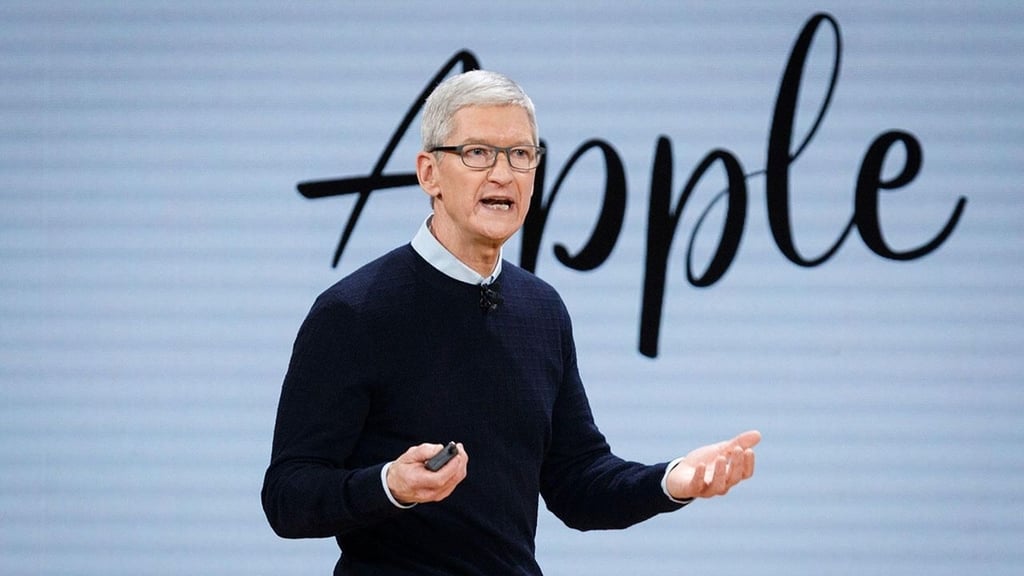
Apple CEO Tim Cook. Image: John Gress Media Inc, Shutterstock / John Gress Media Inc
What’s cooking at Apple? A report from the FT suggests a succession plan is intensifying.

Two weeks after turning 65, Apple CEO Tim Cook is again at the center of speculation about when he might step away from the company he has led for more than 14 years.
Although traditional retirement age benchmarks matter little for a CEO whose wealth and influence far exceed those norms, the timing of any departure is strategically significant for Apple, investors, and the broader tech sector.
This conversation has intensified following new reporting from the Financial Times, which cites several individuals familiar with discussions inside the company.
The fact that four reporters contributed to the relatively brief report suggests more than casual speculation. It likely represents a deliberate signal emanating from within Apple’s leadership or board, designed to gauge reaction and prepare the market psychologically.
Cook is not under internal pressure to leave. Talk of him being nudged aside, which had surfaced during Apple’s perceived lag in artificial intelligence development, receded quickly after strong quarterly earnings and the company’s resurgence in market performance.
Cook took Apple from roughly a $350 billion valuation when he succeeded Steve Jobs to around $4 trillion today, an unprecedented transformation. Only Microsoft’s Satya Nadella has delivered a comparable run, elevating his company from stagnation to renewed market dominance.
The possibility of a 2026 departure appears tied to broader legacy considerations. Apple is headed into what analysts expect to be a blockbuster holiday quarter, previewed in its most recent earnings. A retirement announcement after Apple reports in late January could allow Cook to leave at a peak moment — an appealing scenario for any long-tenured CEO.
The FT reckons Apple is unlikely to name a new CEO before its next earnings report in late January, which covers the critical holiday period. An announcement early in the year would give its new leadership team time to settle in ahead of its big annual keynote events, its developer conference in June and its iPhone launch in September.
The FT also notes that John Ternus, Apple’s senior vice-president of hardware engineering, is widely seen as Cook’s most likely successor, although no final decisions have been made.
This aligns with earlier reporting by Bloomberg’s Mark Gurman, who described Ternus as the most probable heir. The structural puzzle became clearer this year when Apple COO Jeff Williams, long seen as next in line, announced his retirement. Williams, only slightly younger than Cook, had followed a similar professional arc, and his exit all but confirmed Apple’s shift toward new generational leadership.
Ternus, 15 years younger than Cook and with nearly 24 years at Apple, is a bridge between the company’s legacy and its future. His leadership of Apple’s hardware organization places him atop the company’s strongest competitive pillar, especially while Apple navigates uncertainty in AI strategy and faces cultural pressures to accelerate innovation.
If Ternus rises to the CEO role, analysts expect several possible shifts:
With Apple still defining its long-term AI posture, doubling down on integrated hardware and silicon could serve as a stabilizing strategy.
Some observers speculate that a Ternus-led Apple might revisit long-standing App Store rules — a gesture similar to Microsoft releasing Office for iPad shortly after Nadella took over, signaling a new chapter in corporate philosophy.
Many of Apple’s senior leaders are nearing retirement. A new CEO could therefore oversee a sweeping generational transition, reshaping Apple’s leadership for the next decade.
Though Cook has publicly expressed his love for Apple, industry watchers increasingly suspect he may move into a role similar to executive chairman.
He may continue to guide Apple’s political and geopolitical strategy — especially in a climate shaped by shifting US-China relations.
Given Apple’s standard board retirement age of 75, Cook could remain influential for another decade, providing continuity while a new CEO gains footing.
Cook may also be strategically weighing global economic risks. With AI-driven valuations running hot and geopolitical tensions affecting supply chains and consumer sentiment, the next few years could be volatile. A downturn — unrelated to Apple itself — could make stepping away more difficult.
Executives across industries are acutely aware of transition cautionary tales. Disney’s Bob Iger resigned just as the COVID-19 pandemic hit, only to return in 2022 after his successor struggled. Iger is now aiming for a second exit in early 2026. Apple is clearly eager to avoid similar turbulence.
Apple has announced the debut of Digital ID, a new capability that allows iPhone and Apple Watch users to create a mobile identification card in Apple Wallet using information extracted directly from their US passport.


