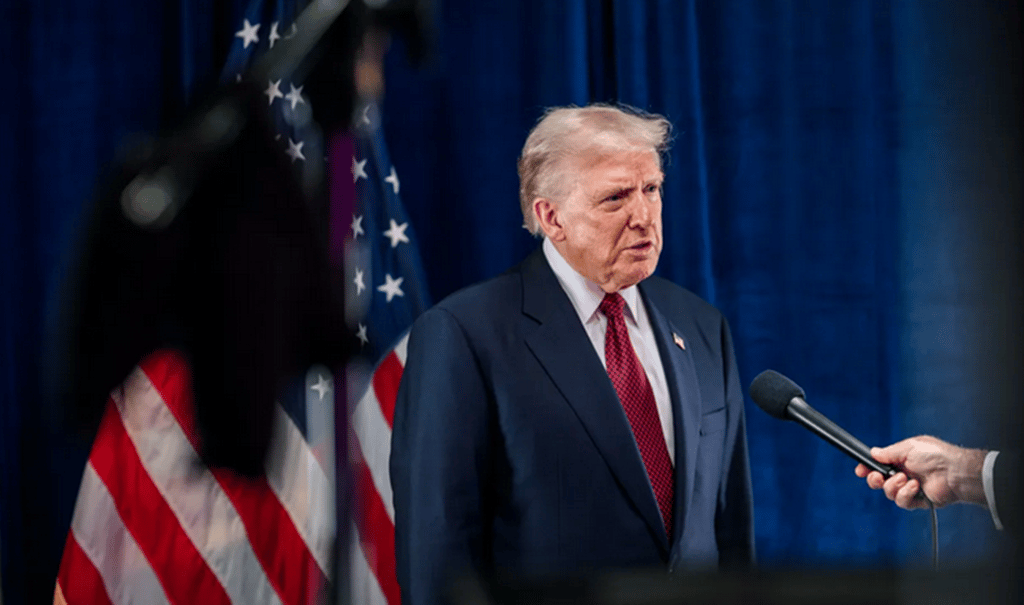
President Trump. Source: The White House
The draft includes creating a federal litigation task force and withholding certain federal funds from states.

President Donald Trump appears to be preparing an executive order aimed at weakening, or potentially nullifying, state-level laws that regulate AI.
A draft order reviewed by Reuters outlines a sweeping federal effort to challenge state restrictions viewed by the administration as obstacles to national AI policy.
The draft, titled “Eliminating State Law Obstruction of National AI Policy,” lays out a series of aggressive steps: creating a federal litigation task force, withholding certain federal funds from states with what the administration considers “onerous” AI statutes, and directing federal agencies to pursue preemption of state rules through regulatory standards and legislative recommendations.
A White House official, responding to questions about the unfinalized and “predecisional” draft, said, until announced officially, “discussion about potential executive orders is speculation.”
The order represents the clearest sign yet that the administration intends to escalate its fight against state attempts to regulate AI — especially in states where comprehensive frameworks have advanced more quickly than federal legislation.
The draft emerges amid a broader dispute over which level of government should shape the direction of American AI regulation. Republican leaders in Congress have long favored a single federal framework that would override state-by-state approaches, arguing that inconsistent rules create compliance burdens for developers and stifle national competitiveness.
This federal–state tension has grown more acute as states such as California and Colorado have advanced robust AI accountability laws focusing on transparency, bias mitigation, and safety requirements. The draft order explicitly identifies these two states as examples of regulatory approaches viewed by the administration as interfering with national economic and technological priorities.
Meanwhile, congressional Republicans are again attempting to attach a moratorium on state AI laws to the annual National Defense Authorization Act (NDAA). Trump himself backed the idea in a Tuesday social media post, saying he supports a federal standard in the NDAA or another bill.
If implemented, the executive order could dramatically reshape the balance of power between federal agencies and state governments on a technology already reshaping American life and industry.
One of the most significant components of the draft is the creation of an AI-specific litigation task force housed within the Department of Justice. According to the document, the task force would be directed to challenge state AI laws on the basis that they interfere with interstate commerce or conflict with federal rules.
Under the draft, the Commerce Department would be responsible for evaluating state AI laws and identifying those that should be referred to the litigation team. Commerce would also be required to restrict certain federal funding streams to states that maintain laws the administration deems too burdensome. This approach mirrors language in the administration’s earlier AI Action Plan, which stated that the government “should not allow AI-related Federal funding to be directed toward states with burdensome AI regulations that waste these funds.”
The funding component could have far-reaching implications: many states rely on federal dollars for research partnerships, workforce development, and AI-driven economic initiatives.
Beyond litigation and funding, the draft order also directs federal agencies to structure national standards in ways that override state laws:
This multi-agency strategy underscores the administration’s intent to create not just legal challenges but a coordinated federal regulatory environment meant to supersede state experiments.
The draft order — whether it is issued in its current form, modified, or shelved — reveals the extent to which AI regulation has become a battlefield for broader ideological debates: federal vs. state authority, growth vs. guardrails, and the rights of individuals vs. the power of industry.
State lawmakers argue that local protections are urgently needed as AI systems interact with everything from hiring processes to public benefits and consumer safety. The administration, by contrast, sees state oversight as a patchwork that could slow innovation and fragment national AI development.
If signed, the order would immediately trigger legal challenges, deepen national debates over AI accountability, and potentially reshape how the country governs one of the most transformative technologies of the century.
Microsoft, Nvidia, and Anthropic have sealed a multibillion-dollar AI pact, scaling Claude on Azure with Nvidia chips to bring frontier models to more enterprises.


