


President Donald Trump has made his proposed AI name change official.
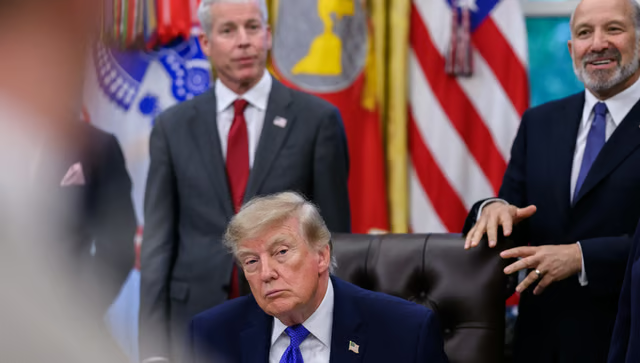
Trump signed an executive order on Sept. 29 directing executive branch agencies to replace “Artificial Intelligence” and “AI” with “Super Intelligence” and “SI” in official communications, websites, reports, policy documents, and other non-statutory materials. The order formalizes the administration’s planned change in terminology across the executive branch.
But the change is more complicated than simply hitting “find and replace” across the federal government. Existing laws do not automatically change, and the order does not require agencies to alter previously issued regulations, presidential actions, contracts, grants, or historical documents.
Meanwhile, the administration has started a 60-day process that could eventually produce a new federal definition of “Super Intelligence.”
- Trump orders federal agencies to start calling AI ‘Super Intelligence’
- What the executive order actually changes
- A new federal definition of ‘Super Intelligence’ could be next
- ‘Super Intelligence’ already means something different in tech
- Big Tech signs a separate ‘Super Intelligence’ safety accord
- What Trump’s AI rename means for businesses and everyday users
Trump orders federal agencies to start calling AI ‘Super Intelligence’
The executive order says the executive branch should use “Super Intelligence” and “SI” instead of “Artificial Intelligence” and “AI” “to the maximum extent permitted by law.”
That directive applies to new official correspondence, public communications, websites, reports, policy documents, and other non-statutory executive branch documents.
The administration argues that today’s frontier systems have moved far beyond what was envisioned when the term “artificial intelligence” was coined roughly 70 years ago.
“The extraordinary technologies being pioneered by American innovators far exceed what was envisioned when the term ‘Artificial Intelligence’ first came into use,” the order states.
Trump had already previewed the change during his Sept. 22 appearance at the United Nations General Assembly, arguing that the word “artificial” makes the technology sound fake. As TechRepublic examined, the proposed terminology immediately raised another question: “superintelligence” already has a much more specific meaning in AI research.
The executive order now makes clear that, at least initially, the administration is not limiting “Super Intelligence” to hypothetical systems smarter than humans.
Instead, for purposes of implementing the order, “SI” covers the same technologies currently encompassed by the federal statutory definition of artificial intelligence.
In practical terms, the government is changing the label before changing the underlying legal definition.
What the executive order actually changes
The immediate effect is primarily on how the executive branch talks and writes about AI.
Federal agencies are directed to begin using “Super Intelligence” and “SI” in several categories of official material, including:
- Agency websites and public communications
- Official correspondence
- Reports and policy documents
- Other non-statutory executive branch documents
The order does not require agencies to retroactively rewrite previously issued regulations, presidential actions, contracts, grants, or other historical documents.
It also does not directly require private companies such as OpenAI, Google, Anthropic, Meta, Microsoft, or Nvidia to rename their products or stop using the term “AI.” ChatGPT does not suddenly become an “SI chatbot,” for example, nor does Google have to rename Gemini because of the executive order.
The scope matters because an executive order directs the executive branch’s operations within the president’s legal authority. It does not, by itself, rewrite terminology Congress has placed in federal statutes.
That limitation explains why the order includes another, potentially more consequential, provision: the administration now wants to determine whether federal law itself should eventually adopt the new terminology.
A new federal definition of ‘Super Intelligence’ could be next
The order gives the Assistant to the President for Science and Technology 60 days to submit proposed legislative language establishing a federal definition of “Super Intelligence” and “SI.”
That proposal must assess whether the new definition should modify, expand, or supersede the existing statutory definition of artificial intelligence. It must also identify potential changes to existing laws that reference “artificial intelligence” or “AI.”
That is where the change in terminology could become more significant.
For now, the executive order explicitly borrows the existing federal definition of AI found in Title 15 of the US Code. But if the administration ultimately proposes a different definition of “Super Intelligence,” Congress would have to decide whether to incorporate that terminology into federal law.
The order also directs the science and technology adviser to recommend any additional presidential or executive actions needed to implement the proposed definition throughout the executive branch.
There is no guarantee Congress will adopt those recommendations.
Until then, the administration is effectively operating with two layers: federal statutes can continue using “artificial intelligence,” while executive branch communications increasingly use “Super Intelligence.”
‘Super Intelligence’ already means something different in tech
The terminology could create confusion outside Washington.
“Superintelligence” has long been used in AI discussions to describe a theoretical level of machine intelligence that surpasses human intellectual abilities across a broad range of areas. That is considerably different from using “Super Intelligence” as an umbrella replacement for everything currently described as AI.
The distinction has become particularly important as researchers debate whether increasingly capable frontier models could eventually reach or exceed human-level capabilities.
Earlier this month, for example, Sen. Bernie Sanders and Rep. Greg Casar were preparing legislation targeting AI “superintelligence” and advanced AI development. In that context, superintelligence refers to an exceptionally advanced category of AI rather than AI as a whole.
The Trump administration is using the same basic phrase in a different way. That could create situations in which federal agencies use “SI” to describe systems that researchers, developers, vendors, and other governments continue calling AI.
The practical consequences will depend heavily on whether the terminology remains largely confined to federal communications or eventually works its way into legislation, procurement requirements, technical standards, and other government programs.
Big Tech signs a separate ‘Super Intelligence’ safety accord
Trump’s executive order arrived alongside another AI development at the White House.
Executives from major technology companies signed a voluntary White House Accord on Super Intelligence, according to The Associated Press. The agreement involved executives from leading AI companies, including Google, Meta, OpenAI, Nvidia, Anthropic, and xAI.
The accord calls for participating companies to establish robust internal controls, empower an internal oversight team, undergo independent external audits, and create board-level oversight to review those findings.
Trump described the commitments as “morally binding,” but the accord is voluntary and not the same as federal regulation or an executive order. The executive order directs federal agencies to change terminology and starts the process of developing a potential new federal definition. The industry accord, meanwhile, asks participating companies to follow voluntary safety and oversight commitments.
The agreement arrives as major AI developers are already exploring new approaches to external oversight. TechRepublic recently reported that Google, OpenAI, and Anthropic were discussing an AI safety standards organization to establish practices for model testing, incident reporting, and independent auditing.
The new White House accord adds another industry-led approach to AI oversight, although questions remain about how voluntary commitments will be measured and enforced.
More must-read AI coverage
- SS&C Intralinks DealCentre AI vs. Datasite: Which platform is built for the future of dealmaking?
- SS&C Intralinks FundCentre AI vs. Juniper Square: Which platform better supports modern private markets fund managers?
- Why Data, Not Models, Determines AI Success
- The Rise of the AI-Native Factory: How Physical AI Is Transforming Manufacturing
What Trump’s AI rename means for businesses and everyday users
For most people using ChatGPT, Gemini, Claude, Copilot, or other AI products, very little changes immediately.
The executive order itself does not alter how those systems work, force technology companies to rename their products, or impose a new compliance framework on private businesses simply because they use AI.
The immediate effects will be most visible inside the federal government.
Businesses that sell AI products or services to federal agencies, follow federal technical guidance, or regularly work with government documents may begin encountering “Super Intelligence” and “SI” in places where “Artificial Intelligence” and “AI” previously appeared.
Organizations should therefore be careful not to assume that a federal reference to “SI” necessarily means a hypothetical human-surpassing system. Under the current executive order, it can refer to technology that federal law already defines as artificial intelligence.
The bigger issue to watch comes after the 60-day review.
If the administration proposes a materially different legal definition of Super Intelligence, or Congress begins incorporating the terminology into legislation, the change could eventually affect contracts, procurement language, compliance requirements, and technical standards.
Until that happens, the technology itself has not suddenly changed because Washington gave it a new name.
For business leaders, technology teams, federal contractors, and companies that rely on government standards or guidance, the terminology itself matters less than where it appears next. If “Super Intelligence” moves from federal communications into legislation, procurement rules, contracts, or technical standards, organizations may need to adjust everything from compliance documentation to how they classify and describe AI systems.
For now, the practical move is to recognize that “SI” in a federal document may simply mean what the rest of the industry still calls AI, and watch what emerges from the administration’s 60-day review.
Related reading: Learn more about how the G20 backed a US-led approach to AI regulation that favors existing regulators over creating new AI watchdogs.