


Ecommerce is entering a new phase where the buyer is no longer always human. Instead, AI agents are beginning to research products, compare suppliers, and even complete purchases on behalf of customers. This shift — often called agentic commerce — changes how transactions are initiated, processed, and secured.
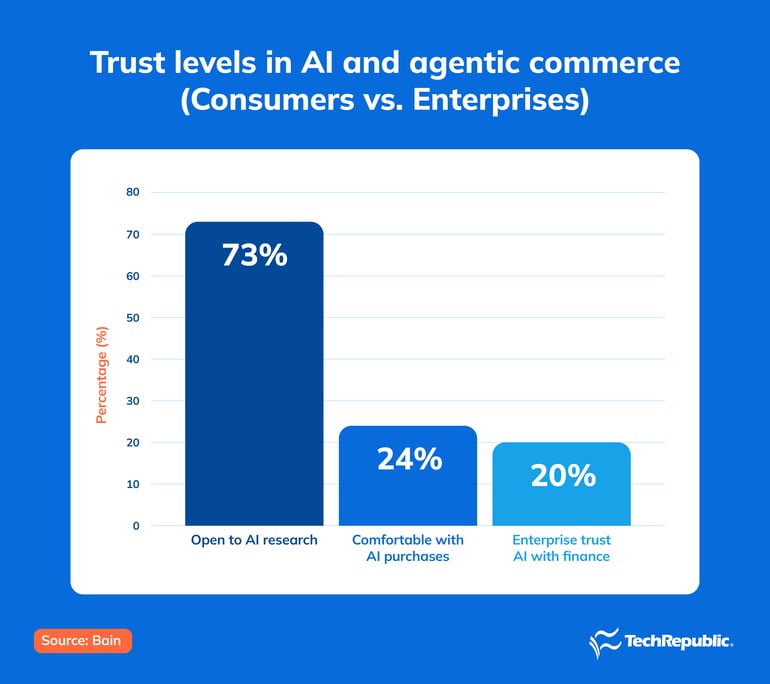
The stakes are high. A recent PwC survey found that 79% of senior executives say their companies are already using AI agents, and two-thirds report measurable productivity gains in workflows like procurement, merchandising, and customer support. Yet Bain research shows that only 24% of consumers are comfortable letting AI complete purchases, exposing a major trust gap that businesses will need to address before adoption can scale.
For CIOs, CTOs, and digital commerce leaders, the rise of agentic commerce is more than just a technical upgrade. It redefines the requirements for structured data, payment infrastructure, and governance — while also reshaping how customers interact with brands.
Key takeaways:
- Agentic commerce is still in its early stages, but adoption is accelerating. CIOs and CTOs should prepare for pilots now by ensuring structured product data and reliable APIs.
- Secure and flexible payments are critical. Tokenization, passkeys, and agent-ready APIs from Visa and Mastercard will soon set the baseline for transactions.
- Governance and trust will determine winners. Establish refund policies, liability frameworks, and monitoring systems to reassure customers and regulators before scaling.
- What is agentic commerce?
- How agentic commerce works: AI agents in action
- Agentic commerce vs. traditional ecommerce
- Benefits of agentic commerce for businesses and consumers
- Challenges and risks of agentic commerce
- Examples of agentic commerce in today’s market
- What agentic commerce means for small and mid-size businesses
- What agentic commerce means for B2B and enterprises
- The future of agentic commerce: Trends to watch
- How to prepare your business for agentic commerce
- FAQs about agentic commerce
What is agentic commerce?
Agentic commerce refers to AI agents that can manage the end-to-end buying process: from capturing intent and comparing options to executing payments and managing post-purchase tasks.
Unlike traditional ecommerce or chatbots, agentic systems are designed to act on behalf of users within defined rules and budgets. They don’t just recommend; they transact.
Example: A chatbot might answer “Yes, this part is in stock.” An agent can go further: “Order 500 filters under $200 each from an approved vendor and schedule delivery this week.”
How agentic commerce works: AI agents in action
The agentic commerce workflow can be broken into five stages:
- Intent capture: The user defines requirements, such as “Procure 200 servers under $1,200 each with 10-day delivery.”
- Reasoning: The agent compares suppliers, reviews contract terms, and validates compliance.
- API calls: It pulls data from procurement systems, supplier catalogs, and marketplaces.
- Payment execution: The transaction is completed securely using tokenized credentials or passkeys.
- Post-purchase: Agents track shipments, reconcile invoices, and initiate returns or reorders.
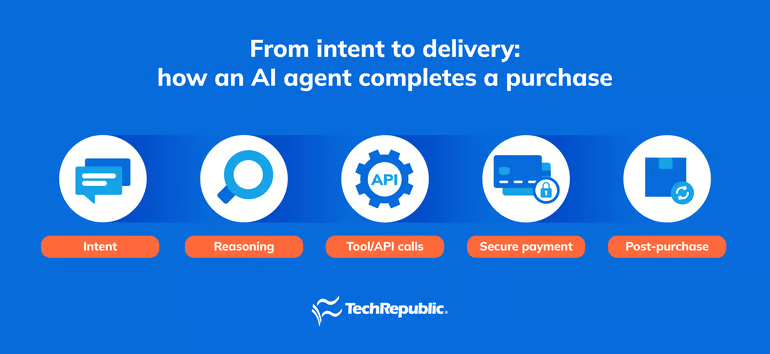
How agentic commerce works in practice
- D2C replenishment: A skincare brand’s customers regularly buy moisturizer every six months. An AI agent detects the purchase cycle, reorders automatically, and applies loyalty discounts at checkout.
- B2B procurement: A manufacturer’s maintenance system flags low inventory of industrial filters. An AI agent issues RFPs to suppliers, compares pricing and delivery terms, selects the best vendor, and places a purchase order.
- Marketplace bundling: On a wholesale marketplace, an AI agent builds a custom order of uniforms, safety gear, and replacement parts across multiple vendors, consolidating shipments to cut logistics costs.
- Contract renewal automation: For enterprise SaaS, an AI agent monitors subscription terms, negotiates renewals with usage-based pricing, and executes payments within approval thresholds.
- Cross-border sourcing: A procurement agent for a retailer needs office chairs under $150 per unit. The AI agent scans international supplier catalogs, calculates duties and shipping, and secures the order from the best-fit vendor.
Agentic commerce vs. traditional ecommerce
The critical difference between agentic and traditional commerce is that in agentic commerce, the buyer is code. The buyer — AI agents — read structured product data and APIs, not marketing copy or site navigation. They decide on what they can find, not on how marketing copy makes them feel.
| Decision-making | Buyer-driven | Assisted | AI-driven |
| Purchase execution | Manual | Limited | Autonomous |
| Data dependency | Optional | Partial | Essential |
| Oversight | High | Medium | Configurable |
Example: A chatbot might confirm “Yes, that part is in stock.” An AI agent, by contrast, can source quotes, select a supplier, and complete the order within pre-set budget limits.
Benefits of agentic commerce for businesses and consumers
Agentic commerce is still in its early stages, but the advantages are already visible across both consumer and enterprise use cases. By allowing AI agents to automate discovery, comparison, and purchasing tasks, businesses can reduce operational friction while customers gain faster, more personalized shopping experiences. These benefits span efficiency, revenue, and long-term cost savings, making early adoption a strategic move rather than an experimental one
- Efficiency: Agentic commerce automates repetitive tasks like comparing vendors, filling purchase forms, and tracking order status; this dramatically reduces manual effort and shortens procurement cycles. For example, clean, structured data allows AI agents to query inventory and pricing directly, cutting lead time in product discovery and decision-making.
- Personalization: Agents can incorporate user history, contract terms, and budget constraints to surface options that are a closer fit; this means less time sifting through unsuitable choices and more relevant suggestions. Businesses that maintain strong product metadata and enforce clear attribute schemas gain an edge, since agents prefer well-specified listings.
- Reduced friction: Routine flows like subscription renewals, reorder of consumables, or bundled purchases are much smoother as agents handle the trigger, selection, and checkout steps. Customers no longer need to monitor stock manually or remember renewal dates, and businesses benefit from more consistent repeat orders. Analyst reports from Bain show that 73% of consumers are open to AI assisting with product research and comparison, signaling demand for smoother purchase journeys.
- Revenue growth: As top-of-funnel engagement improves — because agents make discovery easier and faster — businesses can capture sales that might otherwise be lost due to choice overload or decision fatigue. With the majority of consumers saying they’d consider AI for research and comparison, early adopters are likely to see lift in conversion metrics simply by being visible to agents.
- Cost savings: Automating backend operations like order processing, supplier communication, or tracking frees up human resources for strategic tasks and reduces operational overhead. Investments in tools that manage catalog data and listings at scale reduce redundancies and errors, which cuts cost per order.
Challenges and risks of agentic commerce
Agentic commerce offers efficiency and scale, but it also introduces new risks that businesses must address before adoption can move beyond pilots. Unlike traditional ecommerce, where human buyers interact directly with storefronts, agents operate autonomously on structured data and APIs. That shift changes the threat landscape: trust, security, governance, and even brand loyalty are at risk.
- Trust gaps: According to the Bain study, only 24% of US consumers say they’re comfortable letting AI make purchases today, even though 72% have used AI tools in some form. This gap shows that consumers need clear liability frameworks, transparent agent behavior, and brand credibility before they’ll delegate transactional authority to AI agents.
- Security exposures: Agents depend on data sources, feeds, and external APIs that can be manipulated. Data poisoning (maliciously altering product data or feeds) and prompt injection are real threats because they can skew agent decision-making or cause errant orders.
- Governance demands: Enterprises must define rules over what agents can do — permissions, approval thresholds, audit logs. According to Genesys research, 35% of CX leaders admit they have little or no formal governance policies in place, even while many believe they’re ready to deploy agentic AI. That mismatch can lead to oversight gaps.
- Brand loyalty erosion: When agents skip UI/UX journeys and marketing touchpoints, the way customers discover, trust, and interact with brands can shift. Consumers may increasingly pick suppliers based on data reliability rather than brand experience or visual storefronts. This means brands that invest heavily in UX without ensuring data accuracy and transparency could lose ground.
Examples of agentic commerce in today’s market
Despite these risks, companies aren’t waiting on the sidelines. Early pilots across retail, payments, and B2B show how agentic commerce is already taking shape. Agentic commerce is moving from concept to real deployment across industries. Early pilots show how AI agents are reshaping shopping, payments, and procurement.
Retail and ecommerce agents
In retail, agentic commerce is changing how customers discover and buy products. From embedded assistants to AI-driven pricing, these tools are streamlining the path from search to checkout.
- Amazon “Buy for Me”: Amazon’s beta feature lets its AI assistant purchase from third-party websites while keeping the user inside the Amazon app. This deepens customer stickiness by consolidating transactions under Amazon’s umbrella.
- Perplexity “Buy with Pro”: Perplexity’s Pro plan enables users in the U.S. to use a one-click checkout (“Buy with Pro”) for select merchants using stored shipping and billing details, plus free shipping on those orders. It also adds “Snap to Shop,” a visual search tool that lets users buy items spotted through photos. These features streamline shopping by collapsing discovery and checkout into fewer steps.
- Dynamic pricing engines and price-tag automation: Retailers like Walmart are implementing digital shelf labels (DSLs) to update pricing for over 120,000 items per store in minutes — what used to take associates two days now happens via mobile app in a few clicks. Walmart plans to deploy DSLs to 2,300 stores by 2026, enabling faster price updates, streamlined inventory replenishment, and improved accuracy for online order fulfillment.
Payment and financial agents
Payments are the backbone of agentic commerce. Leading providers are rolling out APIs, tokenization, and authentication tools so AI agents can transact securely and at scale.
- Mastercard Agent Pay: Mastercard recently launched Agent Pay, introducing “Agentic Tokens”, which extend its tokenization, passkeys, and secure card-on-file architecture, to support AI agents making transactions. This framework is designed for both consumer and enterprise contexts, allowing agents to transact with built-in consent, fraud protection, and authentication.
- Visa Intelligent Commerce: Visa is testing APIs that enable tokenized payments and consent-based authentication for agent transactions. These upgrades lay the groundwork for AI-driven purchasing across third-party platforms.
- PayPal Agent Toolkit: PayPal is equipping developers with a toolkit that embeds secure payments into AI agent workflows. This lowers the barrier for SMBs and startups to experiment with agent-ready checkout systems.
Business-to-business (B2B) agents
In B2B settings, agents are already being tested for procurement, logistics, and compliance tasks. These deployments highlight how automation can cut costs and speed up complex workflows.
- Automated procurement with Siemens + SAP Ariba: Siemens Energy has migrated to SAP Ariba for sourcing and procurement, enabling AI agents to streamline vendor onboarding, compare bids, and generate purchase orders. This reduces procurement cycle times and improves supplier collaboration.
- Supply chain optimization at Maersk: Maersk is piloting NavAssist, an AI agent that adjusts freight routes in real time based on traffic, weather, and port conditions. This improves delivery reliability while reducing logistics costs.
- Compliance workflows in finance: Enterprises in banking and insurance are testing AI agents that compile transaction data and generate audit-ready reports. This reduces compliance costs while improving data accuracy and oversight.
Customer experience agents
Customer-facing use cases show how agents can drive engagement and reduce service overhead. By intervening at key moments, they improve conversion rates and resolve issues more efficiently.
- Proactive engagement: AI agents can detect when customers are about to abandon their carts and offer tailored promotions. With 73% of consumers open to AI-assisted product research, according to the Bain research, these tools can significantly boost conversion rates.
- Autonomous service: Agents are being deployed to triage customer tickets, resolve common issues, and escalate complex cases with full context. This reduces service costs while improving resolution speed and consistency.
What agentic commerce means for small and mid-size businesses
It’s not a surprise that large enterprises are the ones piloting agentic commerce. However, it is the small and mid-sized businesses that will feel the effects quickly because as mentioned earlier, AI agents are data-driven, not design-driven. Here are some things to consider for your online store in the near future:
- Agents do not “browse” storefronts. If your product feeds are incomplete or missing details like size, material, or delivery times, your catalog may never be considered. As consumers continue to explore AI-assisted product research, online stores that maintain structured and accurate data are positioned to capture this demand. Start by auditing your product feeds and making sure every listing has consistent attributes that agents can parse.
- Supporting secure rails such as tokenized credentials and passkeys will be essential so AI agents can complete checkouts. Since Visa and Mastercard are already testing these systems, those that continue to rely only on legacy payment methods may see agents bypass them for competitors that are agent-ready. Talk to your payment processor about enabling tokenization or passkey support so your store isn’t left behind.
- Consumer trust remains low, with only 24% of shoppers comfortable letting AI make purchases. As a small business, you can stand out by offering transparent refund and return policies, similar to Amazon’s A-to-Z Guarantee, which help reassure buyers if an agent places an incorrect order. Review your terms of service and make sure refunds and returns are clear, visible, and easy to execute.
- Most small businesses already use platforms like Shopify, BigCommerce, and WooCommerce, and these providers are rolling out APIs, feed integrations, and payment tools designed for agentic commerce. This means you can already adopt agentic features gradually without the need for expensive custom development. Check your platform’s app marketplace for agent-ready plugins and start testing one low-risk feature, such as auto-reorder or subscription tools.
What agentic commerce means for B2B and enterprises
For larger enterprises and B2B operators, the implications are broader because agent commerce touches as far as procurement, supply chain resilience, and compliance-heavy processes.
- Procurement cycles can be shortened when AI agents issue RFPs, compare bids, and generate purchase orders automatically. Enterprises like Siemens and SAP Ariba are piloting these use cases to reduce manual processing and speed sourcing. Start by mapping repetitive procurement tasks and testing AI-assisted bidding tools in low-risk categories.
- Supply chains are becoming more dynamic as companies like Maersk test agents that adjust freight routes in real time based on traffic, weather, or port conditions. This can improve delivery reliability and reduce costs. Work with logistics partners to evaluate agent-ready routing tools and set performance benchmarks before wider rollout.
- Compliance-heavy industries such as finance and healthcare are exploring agents that gather transaction data and produce audit-ready reports. These use cases lower compliance workloads but require strong monitoring to prevent errors or manipulated inputs. Pilot agents in non-critical compliance workflows first, while ensuring audit logs and monitoring systems are in place.
- Many B2B enterprises face fragmented product feeds spread across regions and business units. Agentic commerce requires unified, machine-readable data. Companies that invest in robust product information management (PIM) systems will have an advantage in being chosen by agents during discovery. Audit your product data systems and evaluate PIM solutions that can consolidate and standardize feeds across divisions.
- Enterprises must also address trust and liability frameworks. With multimillion-dollar transactions at stake, it will not be enough to offer refunds. Clear contracts, approval thresholds, and audit trails must be in place before granting agents authority to transact. Review governance policies with legal and compliance teams to set liability rules and approval thresholds before scaling agent use.
What's hot at TechRepublic
- Blackpoint Cyber vs. Arctic Wolf: Which MDR Solution is Right for You?
- Why AWS Sellers Choose Deepgram Over Other Voice AI Tools
- SS&C Intralinks DealCentre AI vs. Datasite: Which platform is built for the future of dealmaking?
- SS&C Intralinks FundCentre AI vs. Juniper Square: Which platform better supports modern private markets fund managers?
- Verito vs. Rightworks: Which IT Provider Is Best for Your Firm?
The future of agentic commerce: Trends to watch
Agentic commerce is still new, but adoption is already accelerating. At the same time, consumer trust lags Enterprises show similar hesitation, with just 20% trusting AI to manage financial transactions, according to Bain research.
This widening gap between enthusiasm and trust is shaping how agentic commerce will roll out over the next three to five years.
Discovery bots and semi-autonomous workflows come first
The earliest use cases focus on research and lightweight transactions. Companies are deploying AI agents to monitor product categories, compare vendors, and surface best-fit options.
Among executives already using AI, 66% report measurable productivity gains — many in workflows like merchandising, supply chain, and customer support, according to PwC research. This phase lays the groundwork for wider automation without requiring full financial autonomy.
Semi-autonomous transactions expand in scope
As confidence grows, agents will begin to handle recurring purchases such as subscriptions, renewals, or consumables under predefined rules. For enterprises, this means smoothing procurement renewals, automatically replenishing stock, and renegotiating simple contracts. These semi-autonomous flows balance efficiency with human oversight, allowing teams to offload routine tasks while retaining approval over larger or riskier purchases.
Full autonomy emerges in complex, multi-supplier contexts
Longer-term, agents will take on higher-stakes transactions. They will negotiate contracts, manage multi-vendor sourcing, and orchestrate complex logistics chains. In this stage, governance and data integrity become critical. PwC’s analysis of agentic AI indicates that, unless organizations adopt clear audit trails, liability frameworks, and minimal privilege policies, they could face financial errors, trust erosion, or even regulatory repercussions.
Here’s a forecast chart showing the staged adoption of agentic commerce — from discovery bots in 2025 to semi-autonomous transactions by 2027 and full autonomy by 2030.
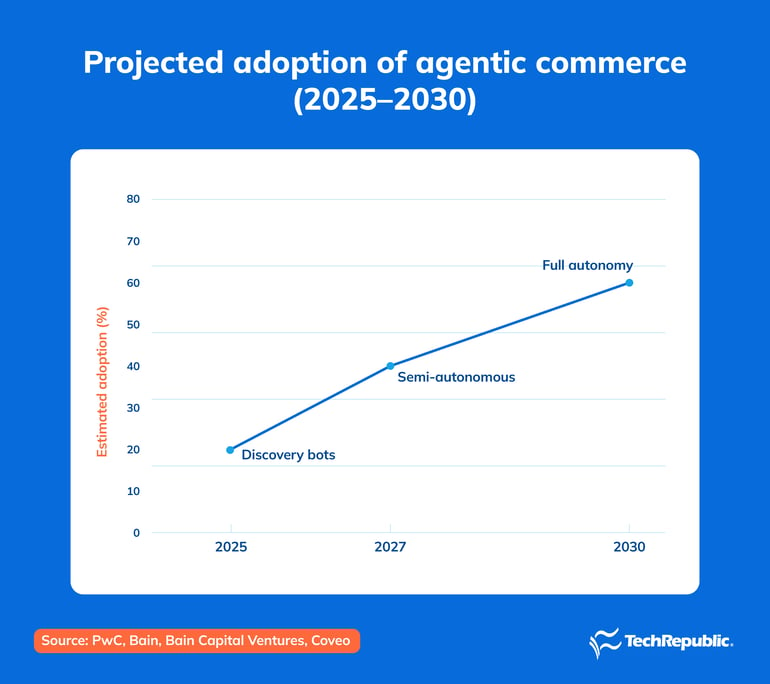
- Discovery bots (2025): Bain and Coveo both describe the first stage of agentic commerce as discovery and comparison, where AI agents help shoppers research products but do not complete purchases. This is consistent with today’s pilots, such as Amazon’s Buy for Me and Perplexity’s Buy with Pro.
- Semi-autonomous transactions (2027): PwC found that senior executives report measurable productivity improvements in workflows like merchandising, supply chain, and customer support. These semi-automated flows (renewals, reorders, subscriptions) are expected to expand as trust frameworks solidify.
- Full autonomy (2030): Bain Capital Ventures projects that commerce-tech spending will surpass $400 billion by the early 2030s, driven in part by agent-ready infrastructure. PwC and Bain frame the endpoint of this maturity curve as “the buyer is the algorithm,” where agents negotiate contracts, coordinate logistics, and complete multi-supplier transactions without human intervention.
Investment and infrastructure scale up
To support this progression, enterprises are investing heavily. According to PwC, 88% of senior executives plan to increase AI-related budgets in the next 12 months, with a focus on agentic commerce infrastructure. Expect to see rapid maturity in APIs, unified product feeds, real-time inventory systems, and payment rails built on tokenization and passkeys.
Governance becomes the decisive factor
Even with stronger infrastructure, adoption will depend on trust. Bain research shows consumers remain wary of autonomous checkouts. Enterprises that set transparent refund policies, approval thresholds, and liability frameworks will be positioned to lead. Without these guardrails, adoption risks stalling despite technical readiness.
How to prepare your business for agentic commerce
Agentic commerce is still emerging, but preparing now ensures your systems are discoverable by AI agents and secure enough for autonomous transactions. Both SMBs and enterprises can take phased steps.
Step 1: Clean and structure your product data
Agents depend on structured, machine-readable feeds, not storefront design. Standardize attributes such as size, specs, price, and delivery times across your catalog. Keep inventory and pricing updates in real time. Bain research shows 73% of consumers are open to AI-assisted research, which means clean data is the foundation for capturing agent-driven discovery.
Example: Without size and material attributes, an AI agent sourcing “ergonomic mesh chair under $200” might skip your product entirely.
Step 2: Upgrade payment infrastructure
Agents need secure ways to complete checkouts. Adopt processors and gateways that support tokenization (replacing card numbers with secure tokens) and passkeys (password-free authentication). Visa and Mastercard are piloting agent-ready APIs, and businesses that do not support these rails risk being bypassed.
Step 3: Implement governance and security
Before granting agents purchasing authority, set strict guardrails.
- Define permissions for what agents can access.
- Establish approval thresholds for high-value orders.
- Apply rate limits to control spending and frequency.
- Test in sandbox environments before going live.
- Monitor activity with dashboards and maintain an incident playbook.
This matters because Bain notes that while many enterprises are piloting AI, only about one in five are comfortable letting AI handle finance-related decisions and transactions, underscoring the governance and liability gap.
Step 4: Experiment with agent-friendly tools
Start small. Add plugins or apps that expose structured data, enable auto-reordering, or integrate conversational shopping agents. For SMBs, Shopify and BigCommerce already provide tools like product feed helpers and AI-powered assistants. For enterprises, platforms like Salesforce Agentforce and SAP Ariba offer deeper workflow integration.
Track metrics like agent-assisted conversions, agent-referred sessions, and chargeback rates to measure performance.
Step 5: Build trust with customers
Consumer trust remains the biggest hurdle. Publish clear refund, return, and liability policies so customers know they are protected if an agent places an incorrect order. This transparency will help close the trust gap and encourage adoption.
Step 6: Plan for scale
As agents become mainstream, prepare your systems for higher volumes of automated queries and transactions. Ensure API uptime, optimize catalog latency, and implement monitoring to catch anomalies. Enterprises should explore product information management (PIM) systems to unify fragmented catalogs across regions and divisions.
FAQs about agentic commerce
How do AI shopping agents work in ecommerce?
AI shopping agents analyze structured product data, compare options across vendors, and make purchases on behalf of customers or businesses. They use APIs to access catalogs and payments, then execute transactions securely with tokens or passkeys. Post-purchase, they can track shipments or manage returns automatically.
What are the benefits of AI agents for ecommerce?
AI agents reduce friction by automating routine purchases, personalizing recommendations, and streamlining payments. For businesses, they lower procurement cycle times, improve conversion rates, and increase visibility in marketplaces — provided product data and APIs are optimized for machine readability.
What risks come with agentic shopping?
The main risks include consumer trust gaps, payment fraud, and errors from incomplete data. Bain research shows only 24% of consumers are comfortable letting AI make purchases, so businesses must ensure strong governance, audit logs, and transparent refund policies to build confidence in agentic shopping.
How can small and mid-size businesses prepare for agentic commerce?
SMBs can start by cleaning product feeds, enabling structured data, and expanding accepted payment methods like digital wallets and passkeys. Platforms like Shopify and BigCommerce already offer apps and APIs that make it easier to experiment with AI agents without major IT investment.