


Imports from China have long been a backbone of US retail and manufacturing supply chains. But in 2025, sweeping tariff hikes, the rollback of de minimis exemptions, and volatile shipping costs are forcing businesses to rethink whether importing from China is still profitable.
For small businesses and tech buyers alike, the answer depends on how landed costs are calculated, which product categories hold margin potential, and how well importers adapt to trade policy shifts. This article addresses these concerns and more.
Key takeaways:
- The US imported $462.6 billion worth of goods from China in 2024, but this year, it is projected that tariffs and de minimis rollbacks will have an effect on import profitability.
- Profitability now depends on landed cost — including tariffs, freight, and compliance fees — not just supplier price.
- Emerging categories, such as eco-friendly packaging, wellness gear, and smart accessories, offer growth opportunities despite trade pressures.
- Small businesses face sharper challenges from MOQs, tariff volatility, and cash flow strain compared to larger importers.
- Importing from China is still viable in 2025, but only for companies that carefully calculate margins and diversify sourcing strategies.
Looking for suppliers to start your importing journey? Explore verified manufacturers on Alibaba and compare product categories, pricing, and minimum order quantities. Visit Alibaba for more information.
- The current state of importing from China in 2025
- Key factors that affect profitability in 2025
- 2025 China import trends and emerging product categories
- Profitable items to import from China
- How to evaluate if a product is worth importing
- How to import from China: Step-by-step guide
- Tips for maximizing profit when importing from China
- Is importing from China still worth it for small businesses?
- FAQs
The current state of importing from China in 2025
China has long been a dominant supplier to the US market. In 2024, the U.S. imported about $462.6 billion worth of goods from China, making it one of America’s top import sources. But starting in 2025, the Trump administration began to fulfill campaign promises by imposing sweeping tariff hikes and revoking long-standing trade exemptions. (See: TechRepublic’s coverage of Trump’s tariff plan and its impact on prices, jobs, economy.)
Between early 2025 and mid-year, trade policy oscillated: new tariffs were announced, some were briefly paused, and tariff exemptions (especially the de minimis policy) were rolled back. Meanwhile, major retailers and trade groups have publicly voiced concerns. The National Retail Federation warned that cargo volumes will likely fall significantly as cost and regulatory risk pushes companies to pull back.
That volatility is reshaping import patterns. In June 2025, U.S. ocean imports from China dropped by 28.3% year-over-year as tariffs took effect. Cargo volume in major U.S. ports is forecast to decline 5.6 % for the year versus 2024, reflecting the drag from new trade policy. For many U.S. importers, the question is no longer if profit margins will be squeezed, but by how much and how fast they can respond.
What this means for US consumers, small businesses, and tech buyers
As tariffs expand and exemptions roll back, the ripple effects of higher costs are spreading across the economy. Importers face pressure to adapt quickly, but the outcomes differ depending on whether you’re a consumer, a small business owner, or a corporate buyer managing supply chains.
For consumers:
- Higher prices on everyday goods: Over half of U.S. firms say they plan to raise prices in 2025, passing costs downstream.
- Fewer choices on store shelves: Some retailers are cutting SKUs or delaying shipments to manage tariff uncertainty.
For small business owners:
- Margins under pressure: Tariffs, customs brokerage, and the end of de minimis add costs that erode 5-10% profit buffers.
- Tighter cash flow: Businesses are holding more safety stock to avoid disruptions, which ties up capital.
- Restructuring risk: Some small importers have already scaled back or downsized to stay afloat.
For tech buyers and larger organizations:
- Supply chain fragmentation: Shifting sourcing to multiple countries adds coordination costs and inefficiencies.
- Rising landed costs: Complex compliance and shifting tariffs make forecasting difficult.
- Strategic uncertainty: Tech companies reliant on Chinese components must plan for sudden policy changes that can disrupt delivery timelines.
Key factors that affect profitability in 2025
Tariffs often take center stage in conversations about importing from China, but they are actually only one piece of the profitability puzzle. Shipping rates, currency fluctuations, supplier pricing, and hidden operational costs all contribute to the final landed cost of goods. These conditions typically rise and fall with market cycles, but in 2025, the volatility has been sharper. Here’s what is happening now and why it matters.
Shipping and logistics costs
Container rates from China to the U.S. have surged despite some tariff relief, driven by port congestion and demand spikes. After a tariff pause, spot rates for 40-foot containers rose steeply. Freightos reports persistent delays and rate volatility as global shipping routes recalibrate. For tech buyers relying on tight lead times, this means higher buffer costs or risking stockouts.
Tariffs and trade policies
As mentioned, the U.S. has layered in new tariffs this year. In March 2025, additional duties were imposed, raising many tariffs to 20%. Moreover, the de minimis exemption for Chinese imports was revoked, so even low-value parcels now face customs treatment.
Some Section 301 exclusions (for things like semiconductors or batteries) have been extended into summer this year, but those come with limitations. These shifting policies force importers to reclassify goods, recalculate landed costs often, and build in buffer risk.
Currency exchange rates and margin pressure
Fluctuations between the U.S. dollar and Chinese yuan amplify margin uncertainty. A weakening dollar helps importers, but the opposite scenario — yuan strength — squeezes profit buffers already under strain. Importers now need to model FX risk explicitly into their costing and hedging strategies, rather than treating it as a secondary factor.
Supplier pricing, quality, and reliability trends
Facing higher energy costs, material costs, and regulatory tightening, Chinese suppliers are passing more input costs downstream. Some are automating operations, others are narrowing SKUs or raising minimum orders. Quality control and consistency remain concerns, especially for complex electronics. Tech buyers must insist on tighter quality checks, longer warranties, and fallback suppliers to manage risk.
Hidden costs importers often overlook
Even beyond tariffs, importers face a stack of less visible expenses that can undermine profitability:
- Customs brokerage and compliance: Misclassification or poor documentation can trigger penalties with stricter scrutiny.
- Inspection, testing, and returns: More products now require third-party lab testing or audits, adding time and cost.
- Inventory holding and buffer stock: Delays force many importers to keep extra inventory as insurance, tying up capital. The cost of delay alone has been estimated to reduce output by 7.3% and raise prices by ~1.8%.
- Logistics fragmentation: Splitting sourcing or routing through secondary markets increases handling, transit, and coordination costs.
- Policy reversal risk: Sudden tariff hikes or rule changes (e.g., reinstating new duties) can upend margins mid-year if not anticipated.
2025 China import trends and emerging product categories
Import demand from China is changing, especially when it comes to which categories remain profitable. Rather than simply chasing low-cost goods, importers are looking at product types that balance resilience, margin potential, and shipping efficiency. The following categories highlight where momentum is building and which niches are positioned to outperform despite volatility.
- Sustainable and eco-friendly items: As consumer and regulatory pressure grows around climate and carbon intensity, products like biodegradable packaging, recycled materials, and low-emission goods are seeing higher interest. (For example, the proposed “Foreign Pollution Fee Act” would impose import fees tied to pollution intensity.)
- Smart devices, wearables, and connected home goods: Despite tariff volatility, tech companies have secured exemptions for key electronics. In April 2025, the U.S. excluded smartphones, laptops, and other electronics from some reciprocal tariffs, affording breathing room to tech importers.
- Health, fitness, and wellness imports: Products like smart scales, wearable health monitors, portable fitness gear, and eco-friendly wellness accessories are in demand as consumers double down on self-care.
- Niche categories gaining traction in US markets: Items such as modular robotics kits, artisanal home décor, sustainable pet products, and custom 3D-printed accessories are becoming more visible. Their lower volumes and unique designs help them avoid the worst tariff or shipping hit.
Note: These categories represent where new demand is building in 2025, reflecting changing consumer preferences and the impact of trade policy. They are not yet the core of U.S. imports, but they show where growth and opportunity are headed.
Profitable items to import from China
While emerging categories show where demand is headed, there are also well-established imports that continue to deliver consistent margins. These products have long been staples in U.S. supply chains, and despite tariff pressure, they remain profitable for importers who manage costs and logistics carefully. The categories below represent proven opportunities rather than experimental bets.
(per unit landed) | ||||
|---|---|---|---|---|
| Consumer electronics and smart accessories | Smart plugs, sensors, chargers, wearables | Sensitive to tariffs; strong volume demand | ||
| Home improvement and décor | LED fixtures, modular shelves, décor | Lightweight but bulk packaging can increase freight costs | ||
| Fitness and wellness | Bands, massage guns, skincare tech | Compact products offset shipping costs | ||
| Eco-friendly packaging and sustainable goods | Recycled/compostable containers, utensils | High demand from retailers with ESG goals | ||
| Fashion accessories and lightweight goods | Jewelry, eyewear, phone cases, small leather goods | Lightweight goods = lower freight cost, higher markup potential | ||
| *Landed cost estimates include product cost, average ocean freight allocation, and tariffs where applicable. | ||||
Electronics remain the top import from China: in 2024, the U.S. imported about $127.06 billion worth of electrical and electronic equipment. With component exemptions and supply chain dominance, niche accessories (smart plugs, mini sensors, wearables) remain strong bets. Meanwhile, recycled packaging, compostable materials, plant-based utensils, and eco-friendly storage containers are rising in appeal due to CPG sustainability goals.
The rest of the evergreen profitable items remain popular because they’re lightweight, which mitigates shipping cost penalties and allows for higher markup potential.
What's hot at TechRepublic
- Blackpoint Cyber vs. Arctic Wolf: Which MDR Solution is Right for You?
- Why AWS Sellers Choose Deepgram Over Other Voice AI Tools
- SS&C Intralinks DealCentre AI vs. Datasite: Which platform is built for the future of dealmaking?
- SS&C Intralinks FundCentre AI vs. Juniper Square: Which platform better supports modern private markets fund managers?
- Verito vs. Rightworks: Which IT Provider Is Best for Your Firm?
How to evaluate if a product is worth importing
Choosing the right product goes beyond finding the lowest supplier price. Weigh demand, margin potential, and risk before committing capital. Here is a simple framework and some upfront calculations to help determine whether a product is worth pursuing.
Using a profitability framework (demand × margin × risk)
- Demand: Examine current U.S. consumer trends and market data. Is the product category growing or declining?
- Margin: Factor in landed cost (supplier price + shipping + tariffs + compliance fees) against expected selling price.
- Risk: Consider regulatory complexity, quality control, shipping delays, and volatility in tariffs or currency exchange.
A product with strong demand and healthy margins but high risk might still be viable if you have the resources to manage compliance and logistics.
This framework helps importers quickly assess whether a product is realistic given their size and resources.
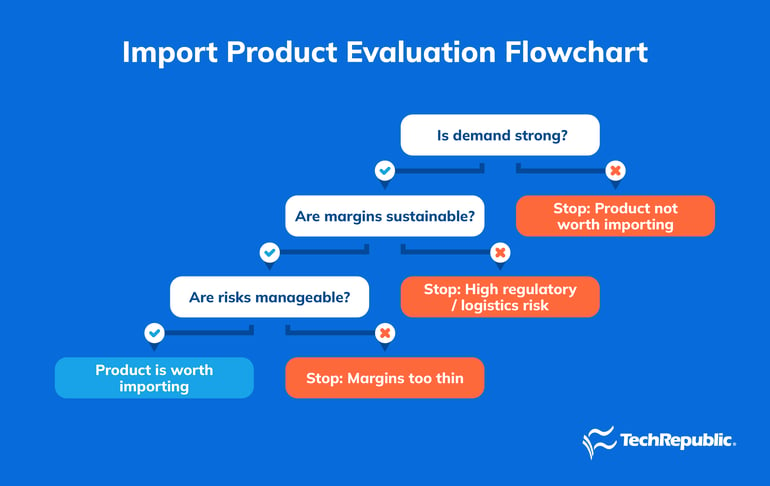
Sample landed cost formula and margin calculation
Landed cost is the total expense of getting a product from the supplier’s factory to your warehouse in the US. It includes the product price, freight, tariffs and duties, insurance, customs brokerage, and local handling fees.
Formula: Landed Cost = Product Price + Shipping + Tariffs/Duties + Customs & Brokerage + Insurance + Warehousing
TIP: Check tariffs before you import
Tariff rates vary widely by product category, and they change often. Importers should always confirm current rates using official sources before finalizing orders.
- USITC DataWeb – search US import data and tariff details
- CustomsMobile – check Harmonized Tariff Schedule (HTS) codes and rulings
- US Customs and Border Protection (CBP) – compliance, duties, and importer requirements
Example: importing leggings from China
Leggings fall under HTS code 6104.63.2026, with a 28.2% tariff rate on imports from China. If you order 1,000 units at $4 each:
- Supplier price: $4.00
- Freight & insurance per unit: $1.20
- Tariffs (28.2% of $5.20): $1.46
- Customs, handling, warehousing: $0.80
- Total landed cost = $7.46 per unit
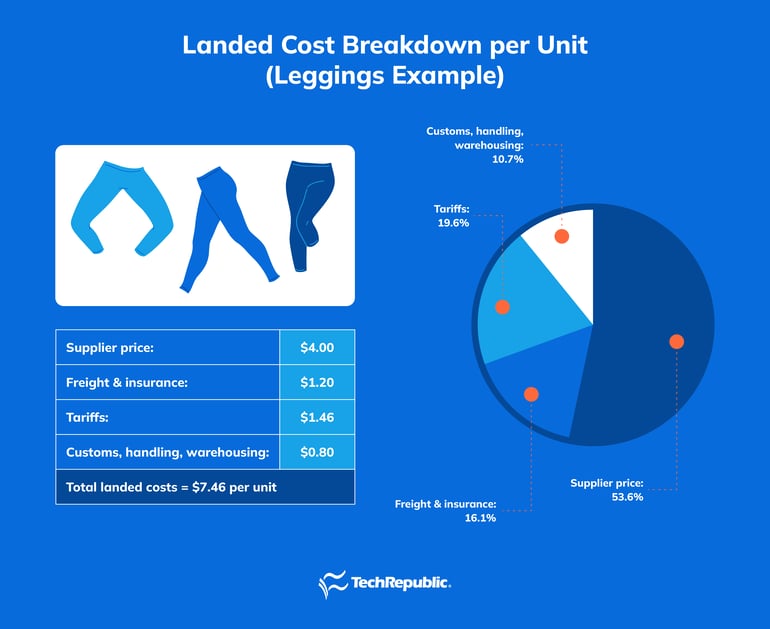
If sold at $15 retail, the gross margin is roughly 50%. But if tariffs rise or shipping costs spike, that buffer shrinks quickly, showing how sensitive profitability is to these variables.
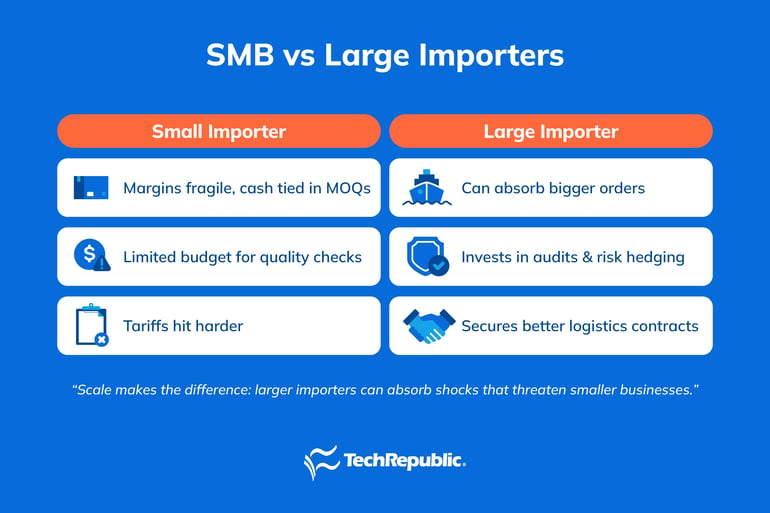
For small importers, high minimum order quantities can tie up cash, quality control checks are harder to fund, and tariff spikes cut deeper into margins. They also rely heavily on freight forwarders, which limits bargaining power. Larger importers, by contrast, can absorb bigger orders, invest in third-party audits, hedge against tariff volatility, and secure better logistics contracts, making them more resilient when costs rise.
This shows why the same product can be profitable for a larger company but risky for a small business.
How to import from China: Step-by-step guide
Importing from China in 2025 comes down to careful planning. Follow these steps to move from product selection to customs clearance with fewer surprises.
1. Identify profitable products with market research
Start with high-demand categories that align with consumer trends. Use tools like U.S. import data, Google Trends, or Amazon Best Sellers to validate demand. Apply the framework:
Profitability = Demand × (Selling Price − Landed Cost) − Risk
This helps filter out products that look cheap but are margin-negative after tariffs and freight.
2. Check licensing requirements and regulations
Confirm whether your product needs an import license, FDA approval (for food, cosmetics, medical devices), FCC compliance (for electronics), or other certifications. Missing this step can lead to customs holds and fines.
3. Find and vet reliable suppliers
Use platforms like Alibaba, Global Sources, or trade fairs, but always vet suppliers:
- Request business licenses and factory audits
- Ask for references or case studies
- Verify they can meet U.S. compliance standards (e.g., safety certifications, labeling)
How to find suppliers
Finding the right supplier is often the most decisive step in a successful import strategy. Beyond cost, importers must evaluate reliability, compliance, and communication.
- Online platforms: Sites like Alibaba, Made-in-China, and Global Sources provide access to thousands of suppliers but require careful vetting. Always check trade history, customer reviews, and third-party audits.
- Trade shows and expos: Events such as the Canton Fair in Guangzhou offer direct access to manufacturers, product demos, and relationship building.
- Sourcing agents: Local agents in China can bridge the language and regulatory gap, helping verify factories and negotiate terms.
- Due diligence: Verify business licenses, request certifications, and consider third-party inspections to avoid fraud and ensure compliance with US import standards.
Ready to connect with suppliers? Browse Alibaba’s supplier directory to compare verified manufacturers, check product categories, and request quotes directly.
4. Request samples and confirm quality
Order samples before committing to bulk orders. Use third-party inspection agencies in China to verify factory processes, product quality, and packaging compliance.
5. Negotiate pricing, minimums, and lead times
Confirm MOQ (minimum order quantity), unit price, and lead time. Negotiate on:
- Payment terms (e.g., 30% deposit, 70% on shipment)
- Price adjustments for larger orders
- Delivery schedules aligned with shipping availability
6. Arrange shipping and customs clearance
Decide between FOB (Free on Board) and CIF (Cost, Insurance, and Freight) terms. Work with a freight forwarder to book ocean or air freight. Prepare a commercial invoice, packing list, and bill of lading. Customs brokerage ensures duties are paid and HS codes are classified correctly.
7. Calculate landed cost and set pricing
This is where profitability becomes clear. Landed cost includes the product price, shipping, tariffs and duties, customs fees, insurance, and warehousing. Once calculated, it determines how much markup is needed to maintain margins.
For a detailed example using apparel imports, see the How to evaluate if a product is worth importing section, where we walk through landed cost and selling price calculations.
Tips for maximizing profit when importing from China
Even in a volatile trade environment, importers can take steps to protect margins and improve profitability. These strategies help offset higher tariffs, shipping costs, and compliance risks.
- Consolidate shipments to reduce freight costs: Instead of shipping multiple small orders, combine them into fewer, larger shipments. Freight forwarders often provide better container rates for consolidated cargo, and importers can avoid repeated customs clearance fees.
- Leverage freight forwarders for smoother logistics: Experienced freight forwarders help navigate customs paperwork, HS code classification, and duty calculation. They also have access to bulk shipping rates and can suggest alternative routes when port congestion or tariffs disrupt supply chains.
- Diversify your sourcing beyond China for risk management: Shifting part of production to countries like Vietnam, Mexico, or India reduces exposure to U.S.-China tariff swings. This doesn’t always replace China’s scale, but even partial diversification can create leverage in negotiations and continuity during trade disputes.
- Build long-term supplier relationships for better pricing: Reliable suppliers are more likely to offer favorable payment terms, lower minimum order quantities, and priority during peak seasons. Importers who invest in long-term partnerships often benefit from consistent quality and cost savings over time.
Is importing from China still worth it for small businesses?
For small businesses, the decision to import from China is less about finding the cheapest supplier and more about survival under tighter margins. Unlike large corporations, SMBs can’t spread risk across dozens of suppliers or hedge tariff exposure.
The reality check: A single tariff hike or customs delay can erase profits on a small shipment. Minimum order quantities tie up scarce capital, and inventory costs hit SMBs harder than large importers. By contrast, big-box retailers can absorb shocks that would cripple a smaller operation. For example, a $20,000 shipment might lose $3,000 in margin from a 15% tariff hike — a manageable setback for a retailer importing $5 million, but a major blow for a small business.
Where opportunities remain: Some small importers still succeed by targeting lightweight, high-margin products. Boutique retailers, for instance, have leaned into eco-friendly accessories and specialty fitness gear that consumers will pay a premium for. By focusing on niches and keeping volumes modest but profitable, SMBs can compete without clashing directly with larger players.
The challenges ahead: Tariff volatility, compliance costs, and cash flow strain make importing riskier at small scale. Testing, certification, and customs brokerage fees weigh heavier per unit, and even minor policy shifts can derail profitability. Many SMBs are responding by cutting inventory, delaying launches, or diversifying sourcing beyond China.
In short, importing from China can still be worth it for small businesses — but only when margins are modeled conservatively, products are chosen for resilience, and logistics are managed with reliable freight partners. Without that discipline, the risks can outweigh the rewards.
FAQs
Do I need a license to import from China?
Most consumer goods don’t require a special license to import into the US, but certain categories — such as food, cosmetics, medical devices, or telecom equipment — need approvals from agencies like the FDA or FCC. Importers always need an IRS/EIN number to clear shipments through customs.
What is the easiest item to import from China?
Lightweight, non-regulated products such as fashion accessories, phone cases, and home décor are among the easiest to import. They typically face fewer compliance hurdles and have lower shipping costs compared to electronics or regulated goods.
How do tariffs affect items imported from China?
Tariffs increase landed cost directly. Apparel, electronics, and other categories all carry different duty rates, with changes in 2025 raising costs across the board. See the profitability section for current rates and examples.