


AI-linked technology exports are supporting Asia’s growth outlook, but Southeast Asia’s broader economic gains remain uneven. The latest Asian Development Bank forecasts show a modest subregional upgrade alongside widening differences among economies.
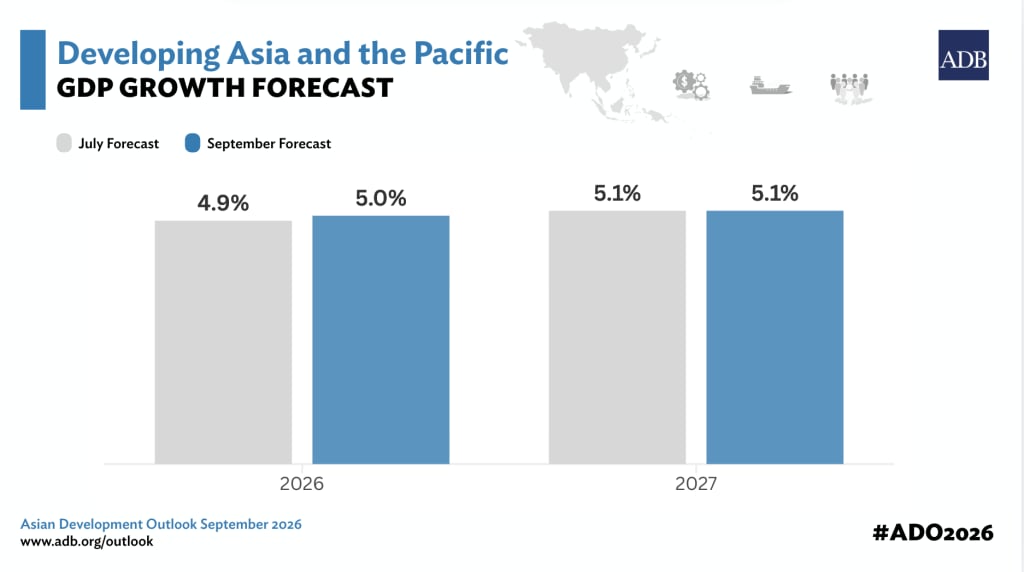
ADB raised its 2026 growth forecast for developing Southeast Asia to 4.7% from 4.6% on Sept. 23 and lifted its 2027 projection to 4.9% from 4.8%. The bank cited stronger-than-expected first-half performance in the subregion, while AI-linked technology exports are among several forces supporting growth across developing Asia and the Pacific. For companies placing AI infrastructure, suppliers, or regional operations, the aggregate forecast masks large differences in digital capacity, skills, costs, and investment conditions.
Growth gains split by market
ADB’s September economic outlook gives Vietnam the largest upward revision, followed by Malaysia and Thailand. Indonesia is unchanged, while forecasts for the Philippines, Cambodia, Myanmar, and Brunei Darussalam were lowered. Singapore is not included in the aggregate because ADB now classifies it under advanced Asia and the Pacific.
AI infrastructure investment is also spreading across the region. In Malaysia, OpenAI reserved future capacity at two planned Firmus AI data centers, while Indonesia’s Zankore secured up to $3.1 billion for Nvidia-powered infrastructure starting in Indonesia and expanding across Southeast Asia.
The September revision reverses part of ADB’s July 2026 downgrade, when it cut the 2026 subregional forecast to 4.6% as the Middle East conflict softened external demand, disrupted supply, and increased production and commodity costs. Stronger first-half performance prompted the latest increase.
Inflation remains another pressure point. ADB raised its developing Southeast Asia forecast from 3.9% to 4.0% for 2026 and from 2.9% to 3.3% for 2027, with Cambodia, Malaysia, Myanmar, the Philippines, and Vietnam facing stronger price pressures from energy costs and climate-related disruptions.
The outlook still carries substantial downside risks. ADB’s Sept. 23 regional release points to further conflict escalation and a stronger El Niño, while the full outlook also flags tighter financial conditions, renewed trade policy uncertainty, and the risk of a sharp drop in AI-related equity valuations.
Infrastructure and skills shape the AI divide
Separate ADB research finds that electronics, computers, and other AI-enabling hardware account for a much larger share of trade in advanced economies in Asia and the Pacific than in most developing economies. Firms embedded in those supply chains can gain faster access to equipment and technical knowledge.
AI deployment also depends on digital infrastructure, computing and cloud access, skilled workers, innovation, and institutions. APAC data centers are already contending with denser AI systems and tighter power availability, adding another constraint for markets trying to turn investment into usable capacity.
An IMF working paper published Aug. 7 models a similar divergence. Structurally prepared advanced economies tend to adopt AI earlier, while emerging and developing economies may face delayed adoption and initial headwinds from higher capital costs. The paper reflects its authors’ research, not an official IMF forecast.
Regional GDP growth alone does not show where AI capacity will be easiest to deploy. Supplier depth, digital infrastructure, power availability, talent, and cost pressures vary sharply across Southeast Asia even as the aggregate forecast improves.
Want to learn more AI tips, tricks, and prompting techniques? Let us teach you How to Talk to AI for free! Try our six-minute course at The Neuron Academy and learn a few simple ways to write better prompts and get more useful results from AI, or browse our other AI course for free for seven days. Check out all the lessons here →