
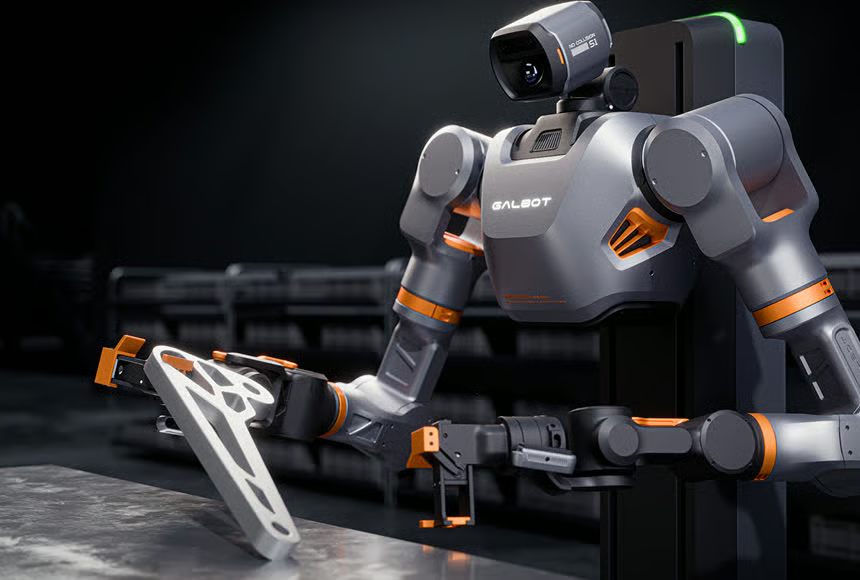


Humanoid robots are getting better at flips, dances, and carefully choreographed demonstrations. Galbot’s S1 is being built for something less glamorous: staying on the job.
The heavy-duty robot is rated for up to eight hours of operation and can autonomously swap its batteries to keep working with minimal downtime. CATL says the S1 has already been deployed on its production lines, where it handles industrial tasks including material transport and picking.
That combination matters because the humanoid robot race is beginning to move beyond what machines can demonstrate and toward a tougher question: Can they work reliably enough to become useful workers?
Galbot S1 is built for heavy factory work
Galbot, headquartered in Beijing, China, designed the S1 for industrial jobs that demand strength and endurance rather than flashy mobility.
According to CATL’s announcement of its partnership with Galbot, the robot features vision-based centimeter-level positioning and 360-degree obstacle avoidance.
Its exact payload capacity is less straightforward. CATL describes the S1 as having a dual-arm payload capacity of 50 kilograms, or about 110 pounds. Galbot’s official S1 specifications, however, list a 15-kilogram capacity per arm and 30 kilograms total, while the same product page separately advertises “up to 50KG payload.”
What the two companies agree on is endurance. CATL says its battery technology enables up to eight hours of continuous operation, while Galbot lists an eight-hour work duration for the S1.
There is an important caveat: Galbot’s technical documentation says that figure comes from laboratory testing conducted at an average speed of 60%. Actual runtime in a factory could therefore depend on the work the robot is performing.
CATL says the S1 has been deployed on its intelligent production lines and is performing what the company describes as extended autonomous operations in battery module and battery pack manufacturing.
CATL says those assignments include material handling and picking, jobs involving repetitive physical work. The company also says the S1 is intended to replace human labor in some high-intensity processes while reducing the physical workload for factory employees.
Eight hours isn’t the S1’s only trick
Battery life is one of the less dramatic limitations facing humanoid robots, but it could become one of the most important.
A robot capable of lifting and moving heavy objects isn’t especially useful if it spends large portions of the day plugged into a charger. For companies considering humanoid robots, uptime can directly affect whether deploying the machines makes economic sense.
Galbot is addressing that problem in two ways.
Alongside its eight-hour runtime rating, Galbot says the S1 supports autonomous hot-swapping of its batteries, allowing the robot to replace a battery rather than waiting for it to recharge.
Galbot markets that combination as enabling “24/7 continuous operation.” That is a manufacturer claim, not independent proof that an S1 can perform every industrial workload around the clock without interruption.
But the feature puts Galbot in interesting company.
Boston Dynamics has also designed its production Atlas robot to autonomously swap batteries. Instead of requiring a human worker to intervene whenever power runs low, both companies are developing robots capable of managing at least part of their own power needs.
That shift may be more consequential than squeezing another hour or two out of a battery.
The goal isn’t simply to build robots that last longer. It’s to build machines that require less human intervention to keep working.
Galbot is putting the S1 through more real-world tasks
The S1’s CATL deployment isn’t its only recent appearance.
At the 2026 World Artificial Intelligence Conference in Shanghai, Galbot demonstrated its robots across retail and industrial scenarios. According to coverage of Galbot’s WAIC demonstrations, the S1 was shown performing factory-oriented work including depalletizing, transporting, and restacking boxes.
The same coverage reported that the robot also demonstrated a more delicate job: identifying small screws, aligning them with holes, and fastening them with an electric screwdriver.
Those tasks illustrate a different side of the humanoid robot race.
Robots that walk, run, or perform acrobatics demonstrate impressive advances in balance and motion control. Factory work presents another challenge: machines must repeatedly recognize objects, manipulate them correctly, respond to changes around them, and perform the same task reliably hundreds or thousands of times.
Those seemingly ordinary jobs can be surprisingly difficult.
A March report from The Guardian examining China’s robotics industry and Galbot’s factory ambitions described engineers working through the complexity of teaching robots something as basic as fastening a screw.
A human worker intuitively finds the hole, aligns the screw, applies pressure, adjusts torque, and knows when to stop. A robot has to perceive and execute each part of that process reliably. That helps explain why industrial humanoid development increasingly revolves around reliability rather than spectacle.
More must-read AI coverage
- SS&C Intralinks DealCentre AI vs. Datasite: Which platform is built for the future of dealmaking?
- SS&C Intralinks FundCentre AI vs. Juniper Square: Which platform better supports modern private markets fund managers?
- Why Data, Not Models, Determines AI Success
- The Rise of the AI-Native Factory: How Physical AI Is Transforming Manufacturing
Humanoid robots are moving from prototypes to coworkers
The Galbot S1 is one example of a broader transition underway in robotics.
For years, humanoid robots were largely research machines and viral-video stars. Now manufacturers are experimenting with robots inside factories, warehouses, and other workplaces.
The appeal is straightforward.
Factories and warehouses are already designed around human workers. Shelves, tools, workstations, and assembly lines generally assume a human will interact with them. Robots capable of navigating those spaces and manipulating the same objects could potentially automate tasks without requiring companies to rebuild an entire facility around specialized machinery.
But “potentially” is still doing plenty of work. A useful industrial robot needs more than impressive hardware. It must perform jobs safely, consistently, and cheaply enough to justify the investment.
Battery life is only one part of that equation. The more significant test for Galbot will be whether robots such as the S1 can keep performing useful work after the conference demonstrations end and the cameras leave.
What this means for everyone else
You probably aren’t deciding whether to put a humanoid robot on a battery production line. But the S1 points toward a technology shift that could eventually affect workplaces far beyond manufacturing.
The important milestone isn’t simply that Galbot rates its robot for eight hours of operation. It’s that companies are designing robots around the mundane requirements of work: shifts, workloads, battery changes, maintenance, downtime, and repetitive tasks.
Autonomous battery swapping is particularly revealing. A machine that can perform a job but constantly needs a person to recharge, reset, or maintain it hasn’t fully removed the need for human intervention. Every task the robot learns to handle for itself potentially changes that equation.
For workers, increasingly autonomous robots could eventually mean fewer physically punishing or hazardous assignments in some industries. They could also reshape jobs that currently depend heavily on repetitive manual labor.
For consumers, the effects may be less visible but still significant. If humanoid robots become economical at scale, they could eventually influence manufacturing costs, product availability, warehouse operations, logistics, and retail.
None of this means the S1 is ready to replace human workers broadly. An eight-hour laboratory runtime and autonomous battery swapping don’t solve the harder problems of reliability, dexterity, safety, judgment, and cost.
But they remove two practical obstacles. And in the race to turn humanoid robots from impressive machines into everyday workers, eliminating those boring obstacles may ultimately matter more than teaching a robot another backflip.
Related reading: For more on the humanoid robot race, read how Tesla is pushing toward an Optimus launch as it works to turn the robot into a real-world product.