


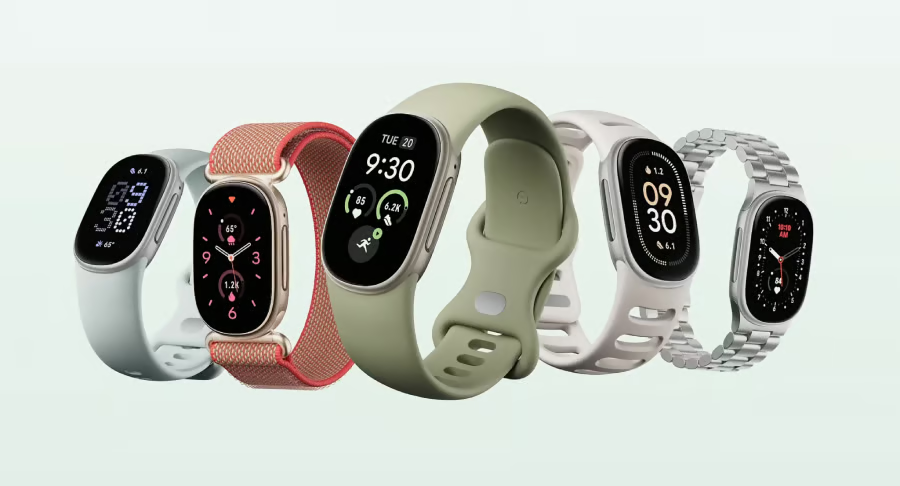
Google has finally given the Fitbit Charge 6 a successor, but the $180 Fitbit Edge isn’t a straight upgrade. Its bigger screen and replaceable battery arrive alongside a surprising omission: contactless payments.
The tracker, announced Oct. 12 and shipping Oct. 27, replaces the Charge series and sits between the screenless Fitbit Air and full-featured Pixel Watch 5. It promises improved automatic workout detection, newer health monitoring, and up to a week of battery life. For current Fitbit owners, the more useful question is whether those changes justify a purchase when a working Charge 6 already handles many everyday fitness needs.
What’s new with the Fitbit Edge?
The Fitbit Edge features a larger 1.34-inch OLED display, up from the Charge 6’s 1.04-inch screen. According to Google’s official product page, the new display is 45% larger and more than 40% brighter than its predecessor’s, potentially making workout metrics easier to read.
Workout tracking also gets an upgrade. As WIRED reported, the Edge expands its exercise modes from 40 to more than 50. Google says its improved automatic workout detection can recognize up to 100 workout types, although its real-world performance remains untested.
The new tracker also features an aluminum housing and a physical button, with Android Authority highlighting its IP68 dust resistance, 5ATM water resistance, and built-in GPS. An added altimeter allows users to track elevation changes during workouts, while a redesigned snap-in band system means existing Charge 6 straps will not be compatible.
Google rates the Edge for up to seven days of battery life, matching the Charge 6. With always-on display enabled, however, the Edge is rated for up to two days, compared with three days for Charge 6. Google also says a five-minute charge can provide up to one day of use when the battery is low.
The replaceable battery could extend the tracker’s useful life, but replacement requires tools and technical expertise. Repair options vary by region, so buyers should check local repair services and replacement-part availability before treating repairability as a reason to upgrade.
Preorders opened at $179.99, with shipments starting Oct. 27, while the Stephen Curry special edition costs $219.99 in select markets.
Fitbit Edge vs. Charge 6: Key differences
More Google coverage
- New Google Search AI Mode is ‘Total Reimagining,’ Says CEO Sundar Pichai
- In Major Ruling, Judge Finds Google ‘Willfully Acquired and Maintained Monopoly Power’ Over Digital Ad Market
- Google’s Big Bet on Nuclear Energy: ‘The Race to Power AI-Driven Data Centers is Accelerating’
- Computer History Museum Releases Original AlexNet Code: Why It Matters
Premium features raise the total cost
Google advertises upcoming Health Guardian features for tracking health changes, including insulin-resistance trends, but its Edge product page lists the features as “coming soon.” Availability varies by country and device, and the trends are intended for general wellness rather than diagnosis or treatment decisions.
Google Health Premium adds Gemini-powered coaching and additional insights, with plans starting at $9.99 per month or $99 annually. The Edge includes a three-month trial. Buyers should separate the tracker’s upfront price from the ongoing cost of coaching and check which features are available locally.
The Edge includes small and large Active Bands, so additional straps are an optional expense. Owners who want to replace their existing Charge 6 band collection should factor that cost into the upgrade.
It works with most phones running Android 11 or newer or iOS 16.4 or newer through the Google Health app. Quick message replies require an Android phone, giving iPhone users a more limited messaging experience.
Should Charge 6 owners upgrade?
The Edge improves fitness tracking, but the best choice depends on which features you use:
- Keep the Charge 6 if it still meets your needs. Both trackers promise up to seven days of battery life, and the older device retains contactless payments. Ending the Charge line does not automatically end support for existing devices.
- Consider the Edge if its larger screen or repairability solves a specific problem. Those changes may appeal to owners whose Charge 6 is difficult to read or has a deteriorating battery. Check local repair availability and wait for independent GPS and workout-detection testing before deciding whether the upgrade justifies buying another device.
- Choose a smartwatch if payments and calls matter. The Edge lacks NFC, a microphone, and a speaker, so it cannot replace a Pixel Watch for those functions.
With the Edge arriving Oct. 27, buyers can wait for real-world reviews to see whether its improved GPS and workout detection live up to Google’s claims. The larger display and replaceable battery may justify the $180 price for some users, but losing contactless payments is a notable trade-off.
For Charge 6 owners whose devices still work well, Google’s decision to discontinue the lineup is no reason to rush into an upgrade.
Also read: Need more than fitness tracking? Our guide to the 4 Best Wear OS Smartwatches for 2026 compares the Pixel Watch 5, Galaxy Watch9, OnePlus Watch 3, and Galaxy Watch Ultra2 to help you find a smartwatch that better fits your needs.