


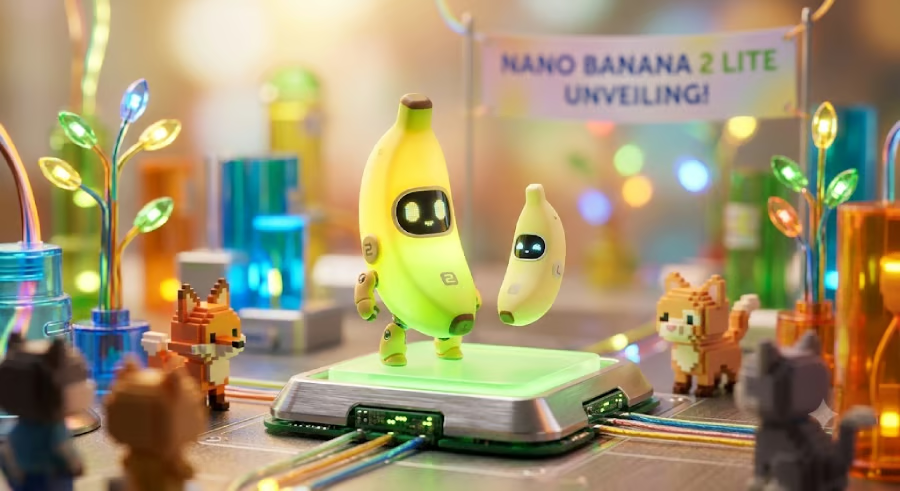
Google’s Nano Banana 2 Lite sounds like a joke hiding in a fruit bowl. But the idea behind it is serious: AI image generation is moving from flashy demos to everyday business workflows.
The new Google model, released on June 30, is built to generate images faster and more cheaply than its predecessor, giving teams a way to test visual ideas without treating every prompt like a precious final draft. That could make AI image generation practical for everything from marketing campaigns and product mockups to internal presentations and documentation.
The next stage of AI image generation may be less about who can make the most dazzling picture and more about who can make visual experimentation feel effortless. Those changes point to five bigger takeaways about where AI image generation is heading next.
1. Speed is becoming more valuable than perfection
Nano Banana 2 Lite is not being pitched as Google’s most advanced image model. It is being positioned as the fastest one.
That distinction is important. For many business users, the first AI-generated image is rarely the final one. A marketer might need 20 ad concepts. A product team might need five variations of a mockup. A sales team might need quick visuals for a deck that will change again tomorrow.
In those situations, speed can matter more than polish. A four-second image generator changes the creative workflow from “submit a prompt and wait” to “try, reject, revise, repeat.”
2. Cheap AI could change who gets to create at scale
At $0.034 per 1,000 images, Nano Banana 2 Lite points to a future in which image generation becomes inexpensive enough for routine use. That could matter for small businesses, educators, developers, internal communications teams, and anyone else who needs visuals but does not have a full creative department on standby.
The bigger shift is not just that AI can make images. It is that teams may soon treat AI visuals as disposable drafts. Generate a batch, keep the useful ones, throw out the rest, and move on.
That could make creative testing faster, but it also raises quality-control questions. Cheap output can be useful. Cheap output without standards can become visual confetti.
3. AI image generation is becoming infrastructure
Nano Banana 2 Lite is available through Google AI Studio, the Gemini API, and Google’s Gemini Enterprise Agent Platform. Google also said it replaces the original Nano Banana model, which is now considered legacy.
That availability shows that image generation is moving beyond standalone AI art tools. It is becoming something developers can plug into apps, agents, workflows, and business software. AI image generation could become a background feature inside marketing platforms, e-commerce tools, training software, support documentation, and internal productivity apps.
More must-read AI coverage
- SS&C Intralinks DealCentre AI vs. Datasite: Which platform is built for the future of dealmaking?
- SS&C Intralinks FundCentre AI vs. Juniper Square: Which platform better supports modern private markets fund managers?
- Why Data, Not Models, Determines AI Success
- The Rise of the AI-Native Factory: How Physical AI Is Transforming Manufacturing
4. Editing may matter more than generating
The flashiest AI image demos usually start with a blank prompt. But real work often starts with something that already exists.
A team may need to resize a graphic, change a background, localize a product image, create variations for different channels, or turn a rough idea into something usable. That makes iterative editing more valuable than one-shot generation.
Google framed Nano Banana 2 Lite around rapid creative iteration. It also announced broader availability for Gemini Omni Flash and showed Omni Product Studio, a demo app designed to turn static images into e-commerce videos. That points to a larger trend: AI media tools are becoming less about making a single image and more about moving content through a pipeline.
Image today. Video tomorrow. Campaign asset after lunch.
5. The best AI model may not always be the smartest one
AI companies often compete on power, realism, and benchmark performance. Nano Banana 2 Lite suggests another race is underway: which model can become useful enough, cheap enough, and fast enough to use constantly.
That could change how businesses evaluate AI tools. The right question may not be, “Which model produces the best image?” It may be, “Which model helps our team test ideas faster without breaking the budget?”
For some use cases, Google’s more powerful Nano Banana Pro may still make sense. But for everyday drafting, fast and affordable models could win more real-world adoption.
That is the quiet lesson of Nano Banana 2 Lite. The future of AI image generation may not be one perfect picture. It may take 1,000 imperfect attempts for people to find the right idea faster.
What comes next for AI image generation?
Nano Banana 2 Lite is a useful marker for where AI image generation appears to be heading: away from occasional experimentation and toward repeatable workplace use.
For businesses, the next question is not just whether an AI model can produce a convincing image. It is whether visual generation can fit cleanly into existing systems, approval processes, and brand rules. Google’s Gemini API documentation already frames image generation as something developers can build into products and workflows, not just something users access through a chat box.
That could make AI-generated visuals more common in places where custom imagery has historically been too slow or expensive to justify, including training materials, product explainers, sales enablement, and early-stage campaign planning. The value is not necessarily in replacing designers. It is in helping more teams communicate rough ideas visually before those ideas require formal creative support.
The harder part will be governance. As AI images become easier to generate inside workplace tools, companies will need clearer rules for when an image can be used, who reviews it, how it is labeled, and what happens when a generated visual looks too much like a real person, brand, product, or copyrighted work.
That is why Nano Banana 2 Lite matters beyond its name. It suggests the next phase of AI images may be less about spectacle and more about operational discipline: faster creation, broader access, and a stronger need for human review.
Related reading: Want to see another way Google is reshaping AI for everyday users? Check out our coverage of how the company’s new Google Health app brings Fitbit’s AI-powered health coach to iPhone.