


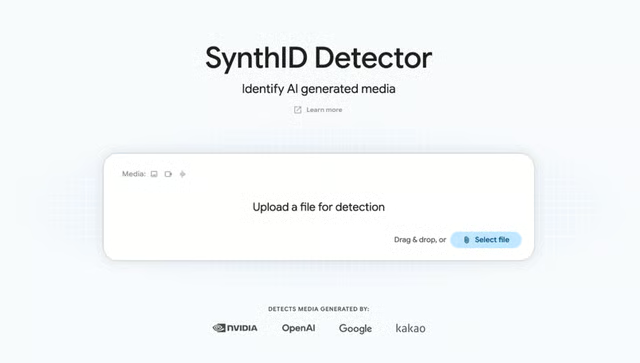
AI-generated images, videos and audio are becoming harder to distinguish from authentic content. Google is giving the public another way to check, although the results come with an important limitation.
Google has opened its SynthID Detector globally in English, allowing users to upload media and check whether it contains an invisible AI watermark. The tool was previously available to a limited group of journalists, researchers and other media professionals.
The company first introduced SynthID in 2023 as a way to embed invisible watermarks into AI-generated content. Google says it has now watermarked more than 180 billion images and videos and 240,000 years of audio.
The detector was previously tested with journalists, researchers and other media professionals. The public version can identify SynthID from Google and participating companies, including OpenAI, NVIDIA and Kakao. Apple support is expected “soon,” Google said.
The website supports 11 common image formats, three video formats, and six audio types, including JPG, PNG, WEBP, GIF, MP4, MOV, MP3, WAV and FLAC.
How SynthID Detector works
SynthID does not analyze a file and determine whether it “looks” like AI. Instead, it searches for the invisible watermark embedded by supported AI systems. Google says the marks are designed to remain detectable after common changes. For example, SynthID watermarks in audio can survive noise, MP3 compression and changes in playback speed.
The system is already available through products including Gemini, Search and Chrome, which Google says collectively handle more than 1 million verification requests daily. That makes the new website less about creating a new detection technology and more about putting an existing verification system in one place.
The catch: No watermark doesn’t mean no AI
SynthID’s biggest limitation is that it cannot identify every piece of AI-generated content.
Companies use different watermarking systems, while some AI models use no watermark at all. Open-weight models can also generate content without participating in Google’s system. Watermarks may also be removed in some circumstances.
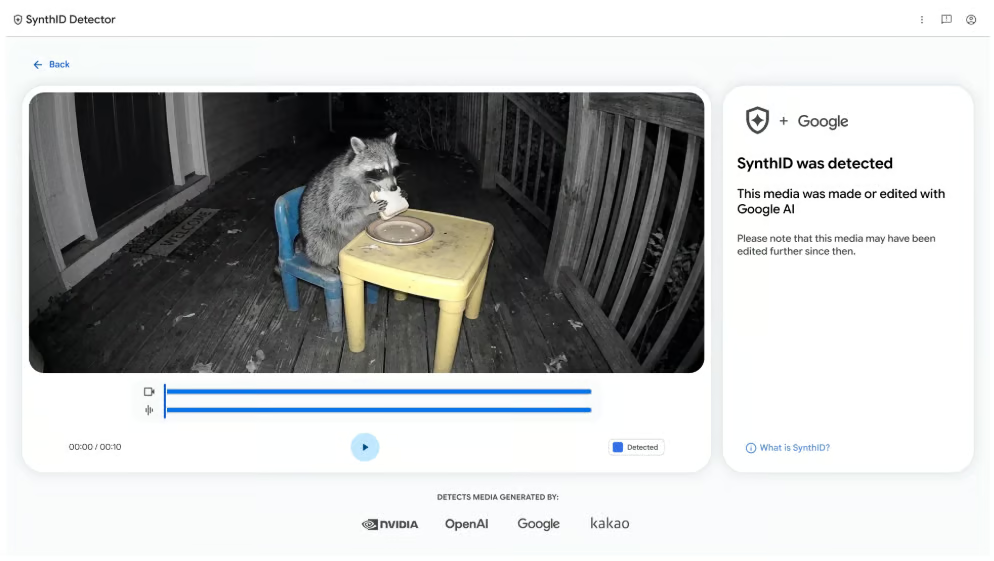
The detector also cannot tell users whether AI created an entire file or merely edited it. A positive result can therefore establish that supported AI was involved, but not necessarily explain exactly how. Google limits usage to roughly 10 checks per user each day.
The restriction is intended to make it harder for people to repeatedly test similar files while developing ways to remove SynthID.
More Google coverage
- New Google Search AI Mode is ‘Total Reimagining,’ Says CEO Sundar Pichai
- In Major Ruling, Judge Finds Google ‘Willfully Acquired and Maintained Monopoly Power’ Over Digital Ad Market
- Google’s Big Bet on Nuclear Energy: ‘The Race to Power AI-Driven Data Centers is Accelerating’
- Computer History Museum Releases Original AlexNet Code: Why It Matters
Why this could matter for verification
The useful part of SynthID is not that it promises perfect AI detection. It gives people another piece of evidence at a time when visual inspection is becoming less reliable. For journalists, publishers and researchers, that could make checking suspicious media faster. For businesses, it offers a simple way to add another verification step before publishing or acting on potentially synthetic material.
But users should treat the result as a signal, not a final verdict. A positive result does not reveal the full history of a file, while a negative result cannot rule out AI generation.
For ordinary internet users, the biggest change is convenience. Instead of relying on whether an image, video or recording simply “looks fake,” they can upload it and check whether supported AI technology left a SynthID mark.
That is particularly useful for suspicious media circulating on social networks or in messages. Still, the safest approach is to combine SynthID with other evidence, because the growing number of AI models and competing watermarking standards means no single detector can authenticate everything online.
Other news: Google’s October 2026 Pixel update patches critical security vulnerabilities and fixes issues affecting calls, keyboards, and camera orientation.