


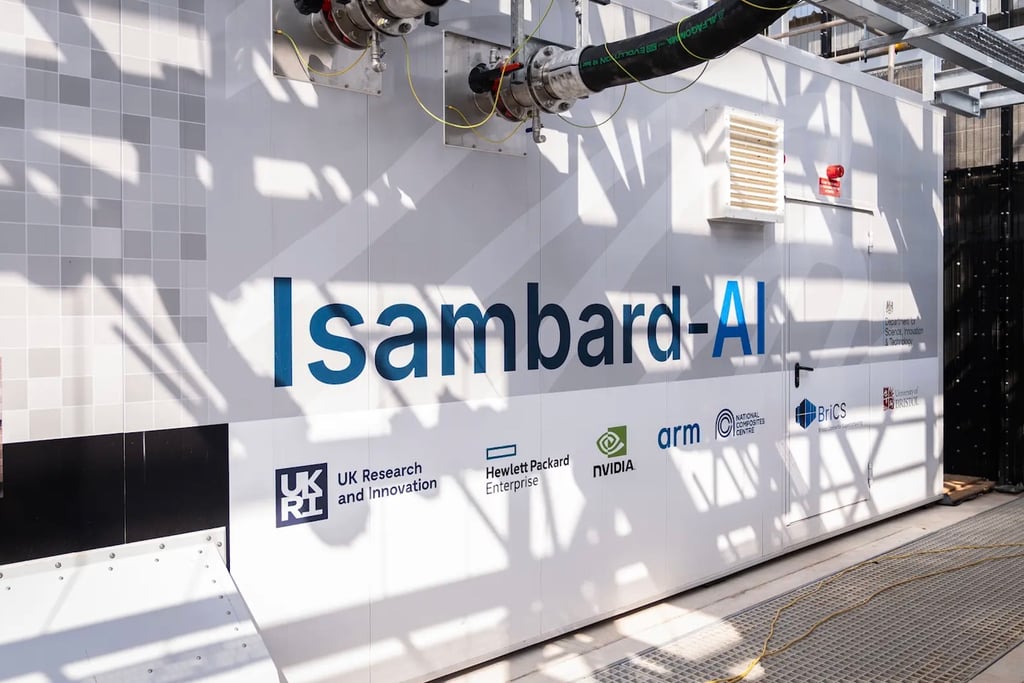
The UK’s most powerful supercomputer, Isambard-AI, is officially live at the University of Bristol. Clocking in at 100,000 times faster than a typical laptop, Isambard-AI has officially become the UK’s fastest supercomputer and is expected to rank 11th globally.
NVIDIA has supplied the facility with 5,448 GH200 Grace Hopper Superchips, enabling it to deliver 21 exaFLOPs of AI performance. An exaFLOP represents a quintillion (10¹⁸) floating‑point operations per second, whereas a typical smartphone achieves merely trillions (10¹²) of operations per second.
The Isambard-AI supercomputer, named after British engineer Isambard Kingdom Brunel, was developed by the University of Bristol in partnership with HPE and NVIDIA.
Powering models for healthcare, sustainability, and more
Isambard-AI is already powering the development of models for a number of different purposes. These purposes include:
- Early diagnosis and personalised care using NHS data.
- Inclusive language support for public services.
- Sustainable industrial material discovery.
- Real-time guidance for dementia patients via wearable camera footage.
University College London is working with Isambard-AI to develop one of the first scalable AI systems for early prostate cancer detection using MRI scans, and it could soon be rolled out across the NHS. The University of Bristol is launching new AI-focused programs for its students and training researchers on the supercomputer.
Peter Kyle, the UK’s technology secretary who officially launched the supercomputer, said in a statement: “With our AI Research Resource now fully up and running, the UK is home to the raw computational horsepower that will save lives, create jobs, and help us reach net zero ambitions faster.”
Isambard-AI is ranked fourth globally for energy efficiency, thanks to the efficient NVIDIA chips, liquid-cooling architecture, hybrid cooling towers, and the zero-carbon electricity that powers it.
UK government is determined to make the country an AI leader with its supercomputers
The government ultimately invested £225 million in Isambard-AI, despite shelving a previously earmarked £500 million originally intended for it and its sister project, Dawn at the University of Cambridge, together known as the AI Research Resource (AIRR).
Since coming into power, Prime Minister Keir Starmer has been dogged in his attempts to turn around the country’s middling reputation in tech innovation. The UK ranks third globally for AI readiness, according to research from Stanford University, trailing significantly behind the US and China. Limiting AI in the UK could have a significant economic impact, with a Microsoft report finding that adding five years to the time it takes to roll out the technology could cost over £150 billion.
As of November 2022, the UK had only 1.3% of global computing capacity, but the government aims to increase this twentyfold by 2030. With the entire AIRR now up and running, the UK’s capacity has risen to 23 AI exaFLOPs, and could reach 420 AI exaFLOPs by the start of the next decade. The country is also now back in the global top ten for public supercomputing, its best ranking since 2002.
NVIDIA is fully behind the UK’s AI ambitions
NVIDIA has been supporting British AI initiatives for several years. In June, CEO Jensen Huang unveiled a host of new UK commitments, including providing two cloud companies with thousands of its GPUs, opening a new training centre, building a platform for testing financial AI products, and supplying universities with AI research tools.
The company also signed two Memoranda of Understanding pledging to support the UK AI talent pipeline and advance university AI research, such as by expanding its Bristol AI lab elsewhere in the country.
Huang said in a statement: “The new Isambard-AI supercomputer is a vital national asset and embodies the nation’s commitment to sovereign AI infrastructure, helping scientists and developers unlock new frontiers in science.”
As Isambard-AI powers breakthroughs at scale, the UK’s AI Safety Report warns that policymakers may need to act to protect the public before risks are fully proven.