


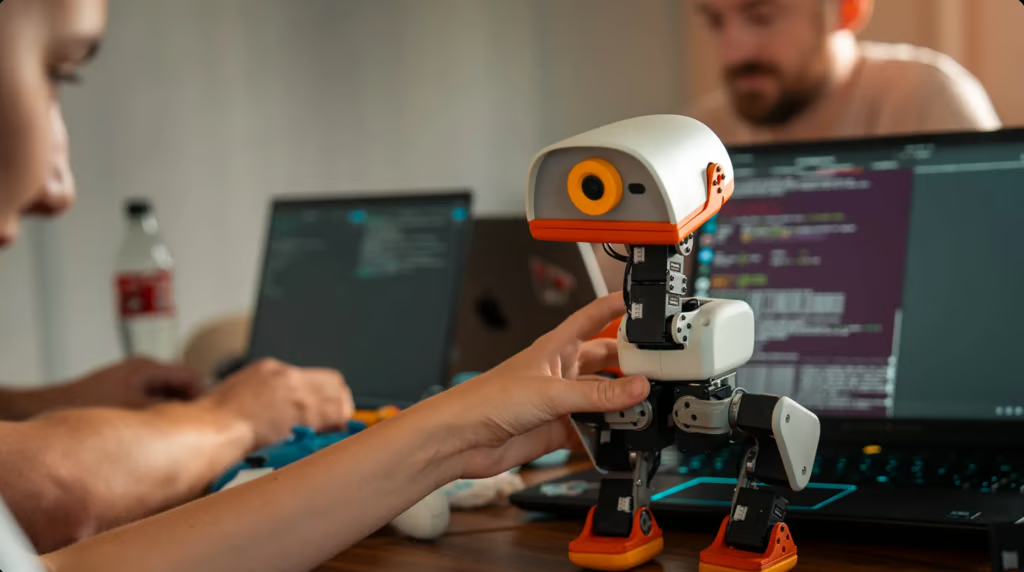
Meet Microduck, a tiny robot that can learn to walk in a virtual world before trying those moves in real life. Nvidia and Hugging Face have published a new walkthrough showing how developers can train the duck-shaped robot to walk, handle uneven ground, and recover after falling over.
The Oct. 21 demonstration uses Nvidia’s Isaac Lab and Newton simulation tools. Instead of teaching the robot every movement by hand, developers let simulated versions practice until they develop a walking strategy that can be transferred to physical hardware.
Meet Microduck, the $399 robot with 15 motors
Microduck was developed by Pollen Robotics and Hugging Face. It’s an open-source, two-legged robot designed for students, researchers, and developers experimenting with physical AI.
According to Pollen Robotics, Microduck stands just 25 centimeters tall, weighs less than 800 grams, and has 15 motors.
It also has a camera, depth sensor, two motion sensors, and an articulated beak that can pick up small objects.
Here’s what buyers should know:
- Price: $399 introductory preorder price, before taxes and shipping.
- Size: 25 centimeters tall and under 800 grams.
- Movement: Walking, crouching, turning, and recovering from falls.
- Hardware: 15 motors, a camera, depth sensor, and two inertial measurement units.
- Availability: Preorders are open, with first deliveries targeted before Christmas 2026 in North America, Europe, and the UK.
That delivery window is a target, not a guaranteed shipping date.
Microduck’s appeal goes beyond its appearance. Its open-source software gives developers a way to experiment with robot behavior without needing a full-sized humanoid.
How Nvidia taught Microduck to walk
In the technical walkthrough, Nvidia and Hugging Face explain how they trained Microduck using a method called sim-to-real.
The idea is straightforward: let the robot practice in a simulation, then transfer what it learns to the real machine.
The process has four main steps:
- Practice walking virtually. Nvidia Isaac Lab runs many simulated Microducks at once, allowing them to learn through repeated attempts.
- Make the simulation realistic. Nvidia Newton models motor delays, friction, battery changes, and the small gaps in moving joints.
- Test and save the results. Developers evaluate the walking behavior and export it as an ONNX file.
- Try it on the real duck. The file is loaded onto Microduck, which can attempt the movements it learned virtually.
The software uses 61 observation values to decide how to control 14 joints.
Nvidia and Hugging Face also showed Microduck getting back on its feet after being knocked over.
It’s a charming demonstration, but one successful recovery doesn’t tell us how often the robot can repeat the trick.
Why walking in simulation isn’t enough
A robot can look perfectly balanced on a computer screen and still fall over on a real floor.
Real motors have delays. Batteries lose charge. Floors have different amounts of grip, and moving parts develop wear.
To prepare for those differences, Nvidia changes conditions during training. Simulated Microducks encounter different surfaces, body weights, motor responses, and unexpected pushes.
This technique, called domain randomization, helps the walking software handle situations that weren’t identical to its original training environment.
Nvidia says one example using 16 GPUs reached up to 1.25 million simulation steps per second.
That doesn’t mean developers need 16 GPUs to train Microduck. The walkthrough doesn’t establish a minimum GPU configuration or provide comparable single-GPU results.
Nvidia has also expanded its Isaac ROS development tools to help developers build robotics software with AI assistance, although those tools serve a different purpose from Microduck’s walking simulation.
Can you train your own Microduck?
The software is available now, even though the physical robot is still taking preorders.
Developers can download the training tools, experiment with walking policies, and share compatible files through Hugging Face.
There’s also Microduck Arena, where developers can compare walking policies through shared challenges.
Before buying the hardware, three questions deserve attention:
- How much computing power is needed? Nvidia’s 16-GPU example demonstrates training speed, but not the minimum hardware required.
- How reliable is the walking? The published demonstration doesn’t establish how often Microduck succeeds across repeated real-world trials.
- When will orders arrive? Pollen Robotics is targeting deliveries before Christmas, but hasn’t guaranteed a shipping date.
Other robot developers face similar questions about moving from demonstrations to dependable performance. Figure AI recently reported that its humanoid robot walked 348 miles during a nine-day endurance test, although that experiment measured a different capability.
Microduck offers a smaller, less expensive way to explore physical AI. Developers can start experimenting in simulation now, then find out how well their walking policies transfer once the robot reaches buyers.
Also read: Faraday Future’s $299 mini robot is another affordable biped designed for students and developers, with a different approach to programming and availability.