


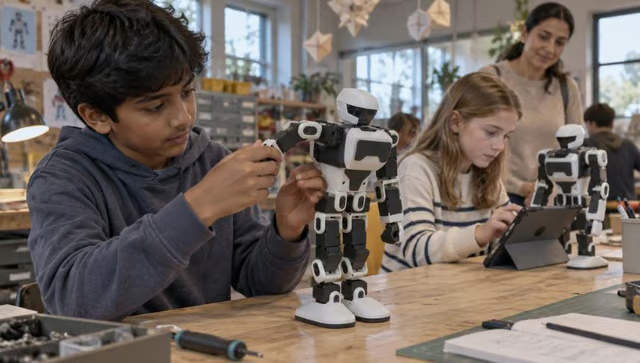
Faraday Future is making a play for affordable humanoid robotics, introducing a $2,490 robot for developers alongside a $299 mini version designed for young learners.
The company and FF EAI Robotics Ecosystem unveiled the FF Nova and Nova Mini, targeting developers, schools and students interested in embodied AI, where artificial intelligence interacts with the physical world.
Nova has 20 degrees of freedom, enabling movements such as walking, turning, waving and standing up after a fall. It also features a detachable wheeled base, LiDAR, depth sensing and voice AI for conversational interactions.
The robot costs $2,490, with a separate Developer Skills Package priced at $390. Its software platform includes an open software development kit, support for the Robot Operating System 2 (ROS 2) framework and over-the-air updates.
The companies are releasing Nova in three phases. The first is limited to 100 units for invited developers and educational institutions, with 20 available for immediate delivery. Wider access for developers and schools will follow before a full consumer launch. The companies have not announced dates for the later phases.
A smaller robot brings AI into classrooms
The launch also includes FF Nova Mini, a $299 bipedal robot designed for children ages 8 and older. Weighing less than 1 kilogram, it can walk, balance, stand up independently and perform a forward roll.
The Mini supports visual block-based programming and hands-on movement demonstrations, making it suitable for classrooms, after-school programs and home learning.
An accompanying $499 Physical AI Foundations Curriculum includes 16 live small-group classes over eight weeks. Students progress from basic robot commands to programming movements and creating their own robot dance. Buyers also receive a voucher toward the robot, although the amount depends on the company’s sales policy.
FF and FFR have also introduced the Physical AI Spark Program curriculum and a developer program built around NVIDIA’s Isaac platform. Developers can train robot behaviors in simulation before testing them on physical hardware.
Nova’s headline price makes physical AI experimentation less expensive than many advanced robotics platforms. The invitation-only opening also means interested buyers cannot assume immediate access, even if they can afford the robot. Developers will need to assess the available documentation, software support and practical capabilities before deciding whether Nova fits their projects.
What's hot at TechRepublic
- Blackpoint Cyber vs. Arctic Wolf: Which MDR Solution is Right for You?
- Why AWS Sellers Choose Deepgram Over Other Voice AI Tools
- SS&C Intralinks DealCentre AI vs. Datasite: Which platform is built for the future of dealmaking?
- SS&C Intralinks FundCentre AI vs. Juniper Square: Which platform better supports modern private markets fund managers?
- Verito vs. Rightworks: Which IT Provider Is Best for Your Firm?
Users will need more than a robot
The launch could give students a hands-on introduction to embodied AI and let developers test how software behaves in a physical environment. However, the value will depend on what users can build, how reliably the robots perform and whether the developer community produces useful applications.
That ecosystem is central to FF’s plan: the company says developers will be able to share and potentially monetize robot skills through a future Skills Store. Those opportunities remain prospective rather than guaranteed.
The launch also comes as FFR prepares to acquire Faraday Future’s robotics assets in an all-stock transaction valuing the business at approximately $200 million. The deal could consolidate the companies’ robotics operations, but execution and ecosystem growth will determine whether the low-cost hardware becomes a meaningful platform rather than simply a cheaper way to experiment with humanoid robots.
For now, Nova’s low starting price is its clearest selling point. Whether it becomes a useful development platform will depend on how well the company delivers the software, support and broader ecosystem behind the hardware.
Other news: Google’s Pixel 11 introduces Rambler, a Gemini-powered voice typing feature that removes filler words, fixes grammar, and turns spoken thoughts into polished text.