


Imagine this common scenario many software developers face:
As a software developer, you confidently predict that a new feature will take a mere 1 hour to build. However, once you dive into the work, you uncover unexpected complexities, dependencies, or integration hurdles that dramatically balloon the actual effort. Instead of a single hour, the task consumes a staggering 12 hours of your time.
Suddenly, the carefully planned sprint timeline is thrown off course. Your team’s velocity tanks, and stakeholders begin asking tough questions. The worst part? You’re now on the hook, not just for the delayed feature, but for explaining in detail what went wrong with the initial estimation.
This challenge is precisely what pushes agile teams away from rigid time estimates toward story points—a relative measure of effort, complexity, risk, and uncertainty. This shifts the focus from “how long” to “how big,” enabling quicker, more consistent estimation and a shared understanding of work magnitude.
 See how effortless story points can beBuild faster, estimate smarter, and keep every sprint on track with Jira. From planning poker to burndown charts, Jira gives agile teams the tools they need to estimate work, stay aligned, and deliver with confidence. |
Okay, but what are story points exactly?
Story points are subjective units of effort that do not correlate with any measure of time. Instead, they’re based entirely on what the team agrees makes sense.
Here’s an example: Say an Agile team agrees to have 24 story points in each sprint. Can they make it 35? Sure. How about 16? No problem. The number of story points doesn’t really matter—the crucial thing is the team’s consensus.
For this illustration, let’s stick with the 24-point sprint. During sprint planning, the team reviews the backlogs and estimates the effort required to complete each task. A simple task may only need 1 story point. A more complex task may need 6 story points. If a single task is so large that everyone agrees it would take the whole sprint to complete, then it gets 24 points.
But what if the team got the wrong estimate? Not a big deal.
Remember that Agile is built on iterative principles. If the estimate was inaccurate in the first sprint, the team can fix it in subsequent sprints and develop sharper estimates over time.
Why not use time estimates instead?
The natural tendency of some project managers is to estimate in terms of time. After all, a sprint is time-constrained, so why estimate effort instead?
There are several reasons for this, but the main reason is to maintain simplicity and velocity. Time estimates may vary depending on a person’s experience, knowledge, and ability. When several people estimate time differently, it may lead to prolonged debate. Story points, on the other hand, are quicker and simpler to estimate.
How to estimate story points
One method for estimating is called “planning poker” (sometimes also called “pointing poker” or “Scrum poker”). It’s quick, simple, and engaging for everyone on the team.
Here are the steps of planning poker:
- Distribute a set of cards to each team member: Everyone gets the same set of cards with different numbers. The recommended numbers in the cards are 0, 1, 2, 3, 5, 8, 13, 20, 40, and 100. Note that the poker cards can be either physical or digital. There are several apps for poker planning, such as Agile Poker for Jira.
- Read the task out loud: The moderator (either the product owner or product manager) explains the task (or the story) to the team.
- Discuss the task: Several pointers to focus on including how to handle the work, people requirements, the required skill, and potential blockers.
- Pick a card: Each individual picks the card that represents their estimate of effort. The cards are then shown simultaneously. (It’s common to have a lot of variations in the estimates.)
- Deliberate until consensus: If everyone picks the same card the first time, then the team can move on to the next task. If the numbers do not match, each person should explain their rationale until an agreement is reached. (Again, it is important to note that the team should not spend too much time estimating.)
Another method for estimation, called “fist-to-five,” uses visual gestures to signal either agreement or disagreement with a point estimate.
Here’s how fist-to-five works:
- Read the task out loud: The moderator (either the product owner or product manager) explains his/her plan of work.
- Pick a hand signal: The team members then respond by raising their hands. A fist (or zero fingers raised) means total opposition, while five fingers raised means complete agreement.
- Discuss if needed: If all team members raise three or more fingers, the work can continue as planned. However, if any member raises fewer than three, a further discussion is needed. If all team members raise fewer than three fingers, a major shift might be required.
Here’s a more detailed breakdown of each hand signal:
- Closed fist: I fully oppose the idea.
- One finger: I have major concerns.
- Two fingers: I have some minor issues.
- Three fingers: I do not fully agree, but I am okay to continue without further discussion.
- Four fingers: I think it is a good idea and will work for it.
- Five fingers: It is a great idea, and I am willing to take the lead!
The aim of fist-to-five is to encourage team members to speak up and collaborate in a simple way. Some people are too reluctant to speak, while others are too dominating. By using hand signals instead, everyone has an equal chance to express their thinking independently.
More project management coverage
- Best AI Project Management Tools
- Best Project Management Software
- Best Free Project Management Software
- Project Manager Resume Template (Free Download)
What are the benefits of using story points?
Here are the main advantages of story points estimation:
Flexibility
Unlike time estimation, story points do not have to be precise. The goal is to have a reasonable estimate without spending too much time on the details, so it is absolutely acceptable for the team to make mistakes. Agile encourages iteration and learning over time.
Collaboration
Speed is important, but a healthy discussion is critical as well. The Agile method emphasizes team interaction and consensus, so there should be no one who is too dominant or too quiet. Everyone’s perspective is valuable to the team.
Easy tracking
Once set and agreed, story points are easy to track and measure. For example, if task A has 4 story points, completing it means the team achieves 4 story points. It continues until the team reaches the sprint’s total story points goal.
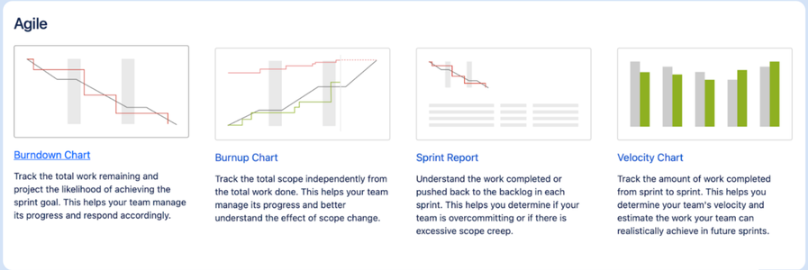
Even better, some Agile software provides features to easily measure story points. Jira, for instance, has some powerful tools to track your team’s progress. Some key story point metrics that can be monitored by using Jira are:
- Burndown chart: Shows the remaining story points in the sprint and whether the team is on track
- Velocity chart: Displays the number of story points completed across multiple sprints, helping to forecast how much work the team can take on
- Sprint report: Summarizes plan vs. actual work. It highlights completed tasks, carry over tasks, and possible blockers
Figure 1 shows the above metrics in charts.
What are the drawbacks of using story points?
Like almost anything in this world, story points aren’t perfect. Some drawbacks of story points are:
Subjectivity
Story points are inherently subjective, and different team members may interpret them very differently. It takes time to calibrate and achieve consistent story-point estimation.
Risk of misuse
As story points are subjective, there is a risk that the team may manipulate them. For example, the team may inflate the size of story points for a simple, small task to give the impression that they are working productively.
External clarity
Stakeholders outside the team often prefer time-based units (hours, days) because they operate under fixed budgets and deadlines and cannot easily translate story points into concrete release dates or cost. Issues like story point inflation and inter-team variance further diminish their value for cross-team comparison and individual accountability. This usually causes mistrust and increases the need for time-based tracking.
Story points best practices
There are several ways to optimize the use of story points:
Combine story points with other metrics
While story points are valuable for estimation, they should be used in conjunction with productivity metrics like throughput and time. Throughput measures the number of tasks completed within a specific timeframe, such as a sprint. Including time as a productivity measure is essential because it is a widely understood metric for external parties, such as stakeholders and clients.
Focus on shipping valuable products
At the end of the day, the main purpose of Agile is to deliver valuable products to customers and clients efficiently. Use story points and other metrics to get started quickly, then jump right into the real work. Iterate and learn along the way to become even more efficient.