



Shopping for a surprise gift? Google AI Mode now lets you ask for ideas without having the conversation show up in your Search history or shape future recommendations.
Google announced temporary threads on Nov. 17 and says they’re rolling out globally on desktop and mobile browsers in every language AI Mode supports.
The feature brings a privacy option already available in the standalone Gemini app into Google’s conversational search experience.
How temporary threads work
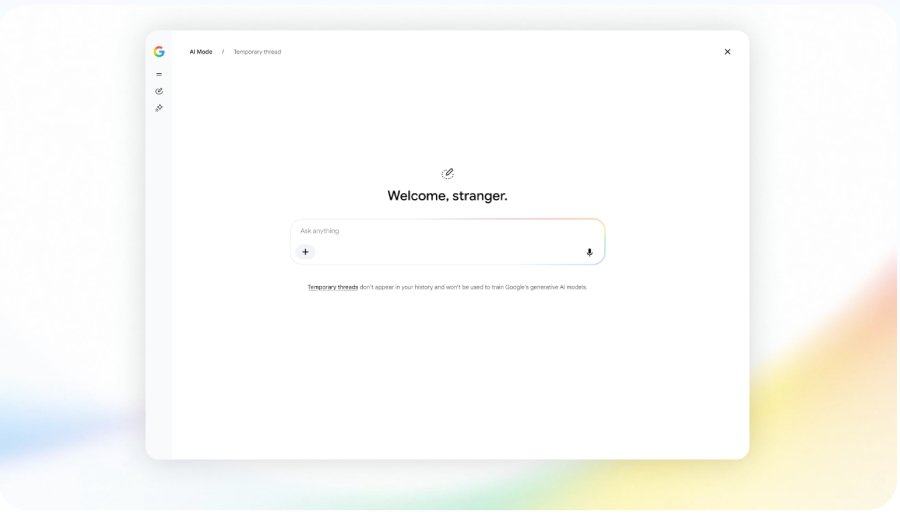
Users can start a temporary conversation by selecting the temporary threads icon in the upper-right corner of AI Mode. There is no need to change existing privacy settings or navigate account menus.
Once activated, the session operates separately from the user’s account. Google says this means:
- AI Mode will not use previous preferences to personalize responses.
- Conversations will not influence future recommendations.
- Threads will not appear in the user’s visible Search history.
- Closing a thread ends the temporary session and returns users to regular searching.
The feature is designed for one-off queries that users might not want associated with their usual search activity. Google says temporary threads are rolling out globally on desktop and mobile browsers across all languages supported by AI Mode.
Temporary does not mean immediately deleted
There is an important privacy caveat users should understand: disappearing from Search history does not necessarily mean a conversation has been erased from Google’s servers.
According to Android Headlines, a recent Google help-center update extended the retention period for temporary Gemini chats from 72 hours to approximately two months—a policy privacy watchers note likely sets the standard for AI Mode as well.
Google retains these conversations to generate responses, process feedback, and protect users. Temporary chats are not used to train its AI models.
There are additional privacy considerations. Some conversations may undergo human review for safety purposes after being separated from account information. Reviewed conversations can reportedly be retained for up to three years. Workplace and school accounts may also have different retention requirements.
More Google coverage
- New Google Search AI Mode is ‘Total Reimagining,’ Says CEO Sundar Pichai
- In Major Ruling, Judge Finds Google ‘Willfully Acquired and Maintained Monopoly Power’ Over Digital Ad Market
- Google’s Big Bet on Nuclear Energy: ‘The Race to Power AI-Driven Data Centers is Accelerating’
- Computer History Museum Releases Original AlexNet Code: Why It Matters
Google’s privacy push meets its personalization ambitions
The timing of this release is interesting. Google has been making AI Mode increasingly personal, including introducing Personal Intelligence, which allows Search to draw on information from Gmail and Google Photos to provide more tailored answers.
That approach makes temporary threads particularly useful. The more an AI assistant learns about someone’s interests, the more important it becomes to give that person control over which conversations shape its understanding of them.
It also helps Google address a weakness in conversational search. Users who are uncomfortable discussing sensitive subjects with an assistant connected to their regular search activity have another reason to try AI Mode.
However, the roughly two-month retention window means Google is offering separation from personalization and visible history, not immediate deletion. Users handling particularly sensitive information should understand that distinction before sharing details.
What this means for users
For everyday users, temporary threads offer three practical benefits:
- More private research: Explore personal subjects without having them appear in regular Search history.
- Cleaner recommendations: One-off interests won’t influence the recommendations Google makes in future sessions.
- More control: Switch between temporary and personalized conversations without changing account settings.
The feature also makes AI Mode more practical for people who regularly switch between casual questions and searches they would rather keep separate from their usual interests.
Still, users should avoid treating temporary threads as a guarantee of complete anonymity or immediate data deletion. Google is giving people more control over their AI conversations, but understanding what happens to those conversations after they disappear remains just as important.
A temporary thread works best when the question has a clear endpoint. If you’re comparing two gifts and expect to decide in one sitting, it’s a good fit.
If you’re narrowing down a laptop shortlist over a week, a regular thread is more useful. You can come back to your original criteria and follow-up questions without rebuilding the comparison each time.
Think about who needs the answer, too. Google disables built-in sharing for temporary threads and their responses, so a regular thread is a better starting point if you expect to send the conversation to someone else.
The choice comes down to whether you need the answer now or a conversation you can pick up and share later.
Get more useful answers from AI with a few simple changes to your prompts. Start with The Neuron Academy’s free six-minute course, How to Talk to AI, or explore all courses with seven days of free access.