


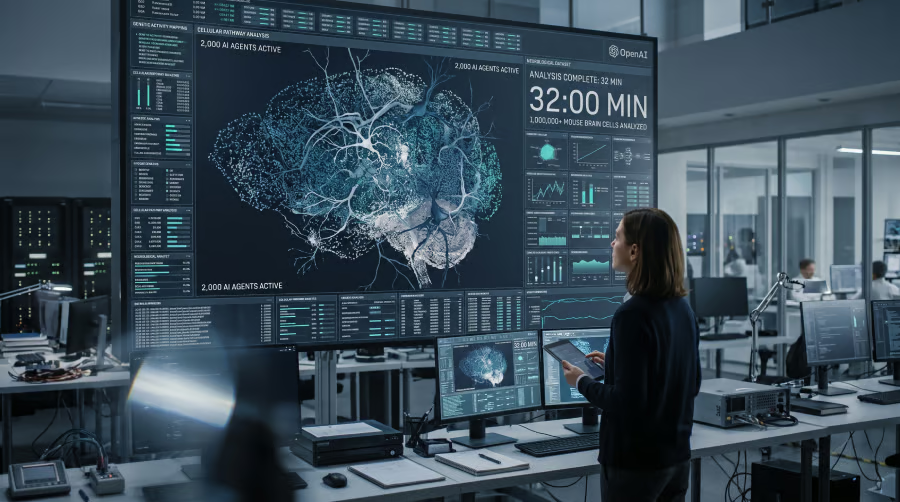
Nearly 2,000 AI agents spent 32 minutes investigating genetic changes across millions of mouse brain cells, producing possible leads for neurological disease research.
OpenAI, PerturbAI, and Scripps Research used the agents to analyze an existing dataset covering 7.7 million mouse brain-cell nuclei. The project generated interpretations linking gene disruptions to changes in cellular activity, including findings involving genes associated with rare neurological disorders.
The results suggest that AI could dramatically accelerate the analysis of complex biological datasets. But generating scientific hypotheses is not the same as validating them, and the proposed disease connections still require laboratory investigation.
Researchers gave each AI agent a separate gene investigation
Data came from a whole-brain CRISPR atlas containing measurements from 7.7 million mouse brain-cell nuclei. Using CRISPR, a gene-editing technique, scientists had disrupted 1,947 disease-associated genes to observe how different types of cells responded.
Powered by GPT-Rosalind, individual AI agents investigated one gene disruption apiece. Each examined changes in cellular activity and consulted published studies for possible explanations.
Findings were assembled into a searchable catalog connecting each genetic change with its effects and supporting publications. OpenAI estimated that comparable manual review, conducted sequentially, could take months to a year. Publicly available code and research materials allow other scientists to inspect the framework.
AI identifies possible links to neurological diseases
Two findings involved genes associated with rare neurological disorders:
- DCTN1 and Perry syndrome. Disrupting this gene increased activity among genes involved in cholesterol production in some mouse brain cells. Researchers proposed examining whether impaired cholesterol transport inside neurons could contribute to their degeneration. Perry syndrome is a rare neurological disorder with Parkinson-like symptoms.
- TSC1, TSC2 and tuberous sclerosis. Several neuron types responded similarly when either gene was disrupted. In the cerebellum, which helps coordinate movement, interfering with Tsc2 changed dozens of genes involved in nerve-cell communication, whereas Tsc1 had little comparable effect. Tuberous sclerosis is a genetic disorder that can cause seizures.
Scientists also compared the distributed approach with reports prepared by a single AI agent. At the largest tested workload, the combined system cited more than 700 scientific references, versus 11 in the standalone analysis.
When experts evaluated the reports without knowing which AI system produced them, they preferred the multi-agent interpretations 75% of the time.
Expert ratings measured the quality of the reports, without establishing that any proposed disease mechanism was correct. Published as a preprint, the findings offer leads that could eventually inform AI-assisted drug discovery.
More must-read AI coverage
- SS&C Intralinks DealCentre AI vs. Datasite: Which platform is built for the future of dealmaking?
- SS&C Intralinks FundCentre AI vs. Juniper Square: Which platform better supports modern private markets fund managers?
- Why Data, Not Models, Determines AI Success
- The Rise of the AI-Native Factory: How Physical AI Is Transforming Manufacturing
Faster AI analysis could change what scientists investigate next
University laboratories and biotechnology companies could eventually face more AI-generated hypotheses than they have the resources to test. Producing scientific leads within minutes increases the number of experiments worth considering, but laboratory testing still consumes time and funding. Choosing which discoveries to pursue could become one of the most consequential decisions after the automated analysis ends.
Research organizations incorporating automated laboratory systems and scientific AI platforms could benefit from identifying more possible disease mechanisms. However, a report supported by hundreds of scientific references can still propose an explanation that fails in the laboratory.
How often AI-generated findings survive independent experiments would reveal more about the technology’s contribution than the volume of reports produced.
Patients and caregivers following Perry syndrome or tuberous sclerosis research can look to subsequent studies for evidence of medical relevance. If scientists reproduce similar gene effects in human cells, they would have a better foundation for investigating the diseases.
Any potential treatment remains several stages of research and testing away. The experiment demonstrates how quickly AI can generate scientific leads, not how quickly those leads can become medical breakthroughs.
From analyzing millions of brain cells to answering everyday questions, AI is being used for a remarkable range of tasks. Learn how to communicate with these tools more effectively through our free six-minute How to Talk to AI course, then explore other Neuron Academy courses free for seven days. Check out all the lessons here →