Discussion Locked
Chris Mosby at myITforum.com
0 helpful
576 replies
Closed to new repliesThis discussion is closed. It stays readable, but it takes no new replies.
This is page 3 of the discussion. Read the opening post

After Hours
This is page 3 of the discussion. Read the opening post
by mozbe
This is probably related to the other viruses\Trojans that I talked about yesterday, as it still uses the HLOADER_EXE.EXE and HLEADER_DLL.DLL to let the virus propagate further.
F-Secure Computer Virus Information Pages: Bagle.EK
F-Secure Virus Descriptions : Bagle.EK
NAME: Bagle.EK
ALIAS: W32/Mitglieder.CV, Email-Worm.Win32.Bagle.ek
Summary
This Bagle-related downloader appeared on November 3rd, 2005. The dropper for the downloader DLL was spammed in e-mails to a large amount of people as 5.EXE. As in all previous cases, the dropper was sent inside a ZIP archive. This dropper and downloader are quite similar to the variant that appeared on November 1st:
http://www.f-secure.com/v-descs/bagle_ee.shtml
by mozbe
Symantec Security Response has published a removal tool to clean infections of Trojan.Lodear.B and Trojan.Lodav.A. Version 1.0.0 of the tool can be obtained by visiting: Symantec Security Response - Trojan.Lodear Removal Tool
Trojan.Lodav.A appears to use the antiav_exe.exe and antiav_dll.dll dropper files that is also listed in the description of WORM_BAGLE.BQ [Trend Micro].
Looks like we are finally starting to get a handle on things here.
by mozbe
Looks like we have another piece of the puzzle here, with this latest virus\Trojan outbreak. It looks like this variant is *installed by Bagle.EI [F-Secure] and Bagle.EK [F-Secure]
Once executed, Trojan.Lodear.C performs the following actions:
Note: %System% is a variable that refers to the System folder. By default this is C:\Windows\System (Windows 95/98/Me), C:\Winnt\System32 (Windows NT/2000), or C:\Windows\System32 (Windows XP).
"auto__hloader__key" = "%System%\hloader_exe.exe"
to the registry subkeys:
HKEY_LOCAL_MACHINE\SOFTWARE\Microsoft\Windows\CurrentVersion\Runso that it runs every time Windows starts.
%System%\hleader_dll.dll
%Windir%\exefld
Note: %Windir% is a variable that refers to the Windows installation folder. By default, this is C:\Windows or C:\Winnt.
The Trojan appears to have been spammed to users via an email which contained a .zip file attachment. The .zip file contains a copy of the Trojan with one of the following file names:
*Correction by Blogger
by mozbe
Symantec has updated their Mytob removal tool to include the following:
November 2, 2005: Published version 1.30.0, which supports removal of W32Mytob.LO@mm.
To date this cleaner now covers the following:
You can download this tool here: Symantec Security Response - W32.Mytob@mm Removal Tool
by mozbe
SANS - Internet Storm Center - Cooperative Cyber Threat Monitor And Alert System
Handler's Diary November 3rd 2005
New DNS modifying malcode (NEW)
Published: 2005-11-03,
Last Updated: 2005-11-03 21:27:43 UTC by Dan Goldberg (Version: 1)
Imagine a malware specimen that modifies your DNS server settings and then disappears. After which all DNS queries from your machine are now sent to a malicious DNS server instead of your chosen server. A DNS server that is under the control of someone who wants to steal something from you? That is exactly what was reported to us today by Dan Hubbard at Websense. A full report is available here.
It is likely that this is just the beginning. Today's target is paypal tomorrows could be anything.
Changing a hosts DNS server is more powerful and flexible than modifying its host file. It is possible for the "attacker" to then make any DNS entry they want and never have to visit the target host again, providing a central place to work on all the "attackers" compromised hosts.
One strategy to thwart this is to run internal DNS servers and limit outbound UDP port 53 traffic to only hosts that need it and then only to trusted DNS server addresses such as you ISPs DNS servers (if you trust them).
Of course the executable that generates this is currenly being circulated by email supposedly from PayPal. I expect this to change soon and show up in copycat format on other emails and over web delivery also.
Dan Goldberg
MADJiC Consulting, Inc
dan at madjic dot net
by mozbe
Looks like we already have a description from Trend Micro in relation to the DNS modifying malcode that the Internet Storm Center reported yesterday. Lets all be on the look out.
Details:
This Trojan may arrive on an affected system as an attachment to email messages, which may be downloaded by affected users without knowledge of its malicious content.
Upon execution, it sets the system's DNS server to 193.{blocked}.227.218 from a user-defined value. The said routine allows a remote malicious user to display a fake login console once the Web site www.paypal.com is accessed by the user.
Below is an image sample of the DNS change it makes to the affected system:

This Trojan affects systems running on Windows 95, 98, ME, NT, 2000, XP, and Server 2003.
by mozbe
SANS - Internet Storm Center - Cooperative Cyber Threat Monitor And Alert
System
Handler's Diary November 4th 2005
F-Prot Anti-Virus Scanning Engine Bypass (NEW)
Published: 2005-11-04,
Last Updated: 2005-11-04 18:24:26 UTC by Robert Danford (Version: 2(click to highlight changes))
An vulnerability has been reported in some versions of F-Prot Anti-Virus. The advisory is referenced below. Exploit code is reported to be available. Though it doesn't look like it would be difficult to create a zip file with a version header value greater than 15.
http://securitytracker.com/alerts/2005/Nov/1015148.html
Update:
Full information can be found here: (Thanks Thierry)
http://thierry.sniff-em.com/research/fprot.html
Reportedly Vulnerable Versions/Platforms:
TBD
Vendors and users need to be really careful about making assumptions their networks are secure based upon a single application. Diversity and layers are a goodness.
Other recent bypass issues:
WebRoot Desktop Firewall:
http://secwatch.org/advisories/1011804
Sophos:
http://www.securitytracker.com/alerts/2005/Oct/1015025.html
Symantec:
http://www.securitytracker.com/alerts/2005/Oct/1015027.html
Kaspersky:
http://www.securitytracker.com/alerts/2005/Oct/1015024.html
Zone-Alarm:
http://www.net-security.org/vulnerability.php?id=20275
http://download.zonelabs.com/bin/free/securityAlert/35.html
by mozbe
Good news for computer users everywhere…
CNN.com - FBI agents bust 'Botmaster' - Nov 4, 2005
FBI agents bust 'Botmaster'
LOS ANGELES, California (Reuters) -- A 20-year-old man accused of using thousands of hijacked computers, or "bot nets," to damage systems and send massive amounts of spam across the Internet was arrested on Thursday in what authorities called the first such prosecution of its kind.
Jeanson James Ancheta, who prosecutors say was a well-known member of the "Botmaster Underground" -- or the secret network of computer hackers skilled at bot attacks -- was taken into custody after being lured to FBI offices in Los Angeles, said U.S. Attorney's spokesman Thom Mrozek.
A bot is a program that surreptitiously installs itself on a computer and allows the hacker to control the computer. A bot net is a network of such robot computers, which can harness their collective power to do considerable damage or send out huge quantities of spam.
Mrozek said the prosecution was unique because, unlike in previous cases, Ancheta was accused of profiting from his attacks -- by selling access to his "bot nets" to other hackers and planting adware -- software that causes ads to pop up -- into infected computers.
"Normally what we see in these cases, where people set up these bot systems to do, say, denial of service attacks, they are not doing it for profit, they are doing it for bragging rights," he said. "This is the first case in the nation that we're aware of where the guy was using various bot nets in order to make money for himself."
Ancheta has been indicted on a 17-count federal indictment that charges him with conspiracy, attempted transmission of code to a protected computer, transmission of code to a government computer, accessing a protected computer to commit fraud and money laundering.
Ancheta, who was expected to make an initial court appearance late on Thursday or Friday, faces a maximum term of 50 years in prison if convicted on all counts, though federal sentencing guidelines typically call for lesser penalties.
Prosecutors did not name the companies that they said paid Ancheta and said the firms did not know any laws were broken.
Mrozek said Ancheta, who lives in the Los Angeles suburb of Downey, was thought to have made nearly $60,000 from the planted adware, using the money to pay for servers to carry out additional attacks, computer equipment and a BMW.
He said Ancheta was taken into custody after FBI agents called him into their offices to pick up computer equipment that had been seized in an earlier raid.
Among the computers he attacked, Mrozek said, were some at the Weapons Division of the U.S. Naval Air Warfare Center in China Lake, California and at the U.S. Department of Defense.
by mozbe
by mozbe
Now this is pretty cool. I remember doing a research project in High School on an “acoustic lens” that I had imagined that could be used in a weapon to take down planes (since I wouldn’t make it as a pilot). I think my parents still have that thing somewhere….
Cruise ship 'used sonic weapon'
Tuesday, November 8, 2005; Posted: 7:22 a.m. EST (12:22 GMT)
MAHE, Seychelles (AP) -- The crew of a cruise ship attacked by pirates off the coast of Somalia used a sonic weapon to help ward off the attackers, the Miami-based Seabourn Cruise Line said Monday.
The device blasts earsplitting noise in a directed beam.
The Seabourn Spirit escaped Saturday's attack also by shifting to high speed and changing course, the cruise line said.
The sonic device, known as a Long Range Acoustic Device, or LRAD, is a so-called "non-lethal weapon" developed for the military after the 2000 attack on the USS Cole in Yemen as a way to keep operators of small boats from approaching U.S. warships.
Makers of the device compare its shrill tone to that of smoke detectors, only much louder.
Read the rest of the article here: CNN.com - Cruise ship 'used sonic weapon' - Nov 8, 2005
by mozbe
We can’t promote freedom abroad, if we abandon it at home.
I don’t remember who said that first, but it is true now more than ever.
Church: Anti-war sermon imperils tax status
Officials say IRS has warned church over pre-election message
Monday, November 7, 2005; Posted: 9:30 p.m. EST (02:30 GMT)
LOS ANGELES, California (AP) -- The Internal Revenue Service has warned a prominent liberal church it could lose its tax-exempt status because of an anti-war sermon a guest preacher gave on the eve of the 2004 presidential election, church officials say.
The Rev. George F. Regas did not urge parishioners at All Saints Episcopal Church in Pasadena to support either President Bush or John Kerry, but he was critical of the Iraq war and Bush's tax cuts.
The IRS warned the church in June that its tax-exempt status was in jeopardy because such organizations are prohibited from intervening in political campaigns and elections.
Read the rest of the article here: CNN.com - Church: Anti-war sermon imperils tax status - Nov 7, 2005
by mozbe
SANS - Internet Storm Center - Cooperative Cyber Threat Monitor And Alert System
XML RPC worm - New Variant (NEW)
Published: 2005-11-08,
Last Updated: 2005-11-08 17:48:02 UTC by Patrick Nolan (Version: 2(click to highlight changes))
We are receiving reports of malware that's an apparent relative of the lupii worm. The reported variant is named "listen". Ivan Macalintal, Senior Threat Analyst, Trend Micro Inc., sent us the following information;
"LISTEN has a size of 443,364 bytes, but basically it still does the same thing.
MD5 Hashes (as compared with the previous LUPII variants):
5b1176a690feaa128bc83ad278b19ba8 *listen
df0e169930103b504081aa1994be870d *lupii
c9cd7949a358434bfdd8d8f002c7996b *lupii2
Additional information on "listen" has been submitted us by a contributor who wishes to remain anonymous. "Listen" is retrieved from 24.224.2.174.
Thanks very much both of you!
We'll post other details as they develop.
Additional information on "listen" has been submitted us by a contributor who wishes to remain anonymous. "Listen" is retrieved from 24.224.2.174.
Thanks very much both of you!
We'll post other details as they develop.
by mozbe
SANS - Internet Storm Center - Cooperative Cyber Threat Monitor And Alert System
Handler's Diary November 9th 2005
Microsoft SUS not playing well (NEW)
Published: 2005-11-09,
Last Updated: 2005-11-09 14:46:26 UTC by Tony Carothers (Version: 1)
We've had a busy last ~12 hours. Reports are coming in that Microsoft's SUS is not updating correctly, causing a lot of readers to have to manually roll out patches. If anybody has found this to not be the case, or found a way to kick SUS into gear, please send us a note, and I'll get it out to the rest of the world :-)
by mozbe
Gosh, this just really breaks my heart….NOT!!!!
Michael Jackson May Not Live in U.S. Again - Yahoo! News
Michael Jackson will come back to the United States, but it's unlikely the King of Pop would ever make it his home again, says his father.
"He'll come back to visit, but not to stay, not to live," Joseph Jackson told The Associated Press in a recent interview.
Jackson said his son, who was acquitted in June of child molestation, has received lots of threats in the United States. The superstar now lives in Bahrain and his lawyers have said that he no longer considers his Neverland Ranch in California as his home.
"They didn't treat him right here. I know if I was him, I wouldn't come back," his father said.
However, the elder Jackson said he expects Michael to return to his music career — and hopes it would include a reunion with his brothers.
"I'm trying to motivate them to go ahead and do this record," he said of his other sons. "They want to do it, but they're too slow. They'd rather do it with Michael."
Michael Jackson is working on a charity single for hurricane relief with stars such as R. Kelly and Snoop Dogg.
by mozbe
SANS - Internet Storm Center - Cooperative Cyber Threat Monitor And Alert System
Handler's Diary November 9th 2005
Phpbb include vuln scanning, via Google, generating new IRC botnet (NEW)
Published: 2005-11-09,
Last Updated: 2005-11-09 21:12:24 UTC by Patrick Nolan (Version: 2(click to highlight changes))
We have received two reports of systems being exploited via a phpbb include vulnerability and a "new" IRC bot is installed. Please update your files now. Phpbb forum support guru "techiemicheal" points out that "running update_to_latest.php on their install only updates the database (and is clearly stated in the documentation), files need to be updated seperately for which there are several methods".
Micheal also notes "- In past bots, the bots would run as an "SSL'ed Apache. This one is a bit different;
my \$processo = '/usr/local/firewall'".
The new IRC bot scans for vulnerable systems using Google, when successful it announces that "oopz and sirh0t and Aleks g0t pwned u!", and has UDP flooding and UDP/ICMP/TCP scanning capabilities.
Responsible parties have been notified and acknowledged the issues.
Thanks Micheal, Reg, and anonymous!
strings;
xxxxxxxxxxxxxxx
#Shellbot by sirh0t & oopz a.k.a zer-0-day and Aleks PRIVATE!
#VERY FAST SPREADING!!!! NO JOKING
xxxxxxxxxxxxxxx
my \$processo = '/usr/local/firewall';
xxxxxxxxxxxxxxx
servidor='forum.unixirc.pl'
porta='81'
xxxxxxxxxxxxxxx
} } else {
if (\$funcarg =~ /^portscan (.*)/) {
use IO::Socket; \$hostip=\"\$1\";
use IO::Handle; @portas=(\"21\",\"23\",\"25\",\"80\",\"113\",\"135\",\"445\",\"1
use Socket;0\",\"6660\",\"6661\",\"6662\",\"6663\",\"6665\",\"6666\",\"6667\",\"
use IO::Select;,\"7000\",\"8080\");
by mozbe
No info on this yet, but it looks like it is related to MS05–053. More details as they come in.
TROJ_EMFSPLOIT.A - Description and solution
by mozbe
POC is out for MS05–053 exploits, the clock is ticking…
Description:
This is Trend Micro's detection for a proof-of-concept Trojan that exploits the following vulnerability:
Users are advised to download the latest Microsoft patches to avoid infection.
Upon execution, this Trojan causes EXPLORER.EXE of affected machines to crash. Thus, users are no longer able to view the graphical interface of Windows.
The aforementioned process is the Windows Program Manager or Windows Explorer. It manages the Windows Graphical Shell including the Start menu, taskbar, desktop, and File Manager.
Go here for full info: TROJ_EMFSPLOIT.A - Description and solution
by mozbe
SANS - Internet Storm Center - Cooperative Cyber Threat Monitor And Alert System
Handler's Diary November 10th 2005
Problems with Bloodhound.Exploit.45 pattern in Symantec AV (NEW)
Published: 2005-11-10,
Last Updated: 2005-11-10 02:08:48 UTC by Bojan Zdrnja (Version: 1)
We have several reports of issues with the latest definition files for Symantec AV (11/9/2005 rev. 25 at the time of writing), which added Bloodhound.Exploit.45 pattern. This definition should detect files which are exploiting MS05-053 vulnerability (Graphic Rendering Engine Vulnerability and the Windows Metafile Vulnerability).
As it turns out, this pattern seems to be generating a lot of false positives in almost any EMF files, certainly those generated by Excel (and it turn this prevents Excel from functioning properly).
The workaround at the moment is to exclude EMF files from scanning.
Let us know if you experience similar problems or have better workarounds.
by mozbe
SANS - Internet Storm Center - Cooperative Cyber Threat Monitor And Alert System
Handler's Diary November 10th 2005
Problems with Bloodhound.Exploit.45 pattern in Symantec AV (NEW)
Published: 2005-11-10,
Last Updated: 2005-11-10 02:08:48 UTC by Bojan Zdrnja (Version: 1)
We have several reports of issues with the latest definition files for Symantec AV (11/9/2005 rev. 25 at the time of writing), which added Bloodhound.Exploit.45 pattern. This definition should detect files which are exploiting MS05-053 vulnerability (Graphic Rendering Engine Vulnerability and the Windows Metafile Vulnerability).
As it turns out, this pattern seems to be generating a lot of false positives in almost any EMF files, certainly those generated by Excel (and it turn this prevents Excel from functioning properly).
The workaround at the moment is to exclude EMF files from scanning.
Let us know if you experience similar problems or have better workarounds.
by mozbe
Summary
=======
The following bulletins have undergone a minor revision increment.
Please see the appropriate bulletin for more details.
* MS05-050
Bulletin Information:
=====================
* MS05-050
- http://www.microsoft.com/technet/security/bulletin/ms05-050.mspx
- Reason for Revision: Bulletin updated the following: Microsoft has also been made aware that when installing the "Security Update for DirectX 8.1 for Windows XP Service Pack 1" or
"Security Update for DirectX 8.1 for Windows 2003" package on a computer that has DirectX 9; the install completes successfully without giving any indication that the computer
was not updated. Users running DirectX 9 will still be vulnerable to the issue discussed within MS05-050 until they apply the appropriate package for their DirectX version. In
"Frequently asked questions (FAQ) related to this security update" section, updated the "How can I determine whether I
am running an updated version of DirectX on my system?" for Windows 2000 SP4 Multi-User Interface (MUI) users.
- Originally posted: October 11, 2005
- Updated: November 9, 2005
- Bulletin Severity Rating: Critical
- Version: 1.4
by mozbe
Symantec’s response to reports of false positives for Bloodhound.exploit.45.
Symantec Security Response will post LiveUpdate virus definitions today, November 10, 2005. This posting is in response to reports of a false positive occurring in a customer's evironment in Asia on the Bloodhound.Exploit.45 detection. The detection is to be removed
temporarily for further investigation.
Update your dats, and you should be OK
Update: Here are SAV dat files versions that should be OK
Sequence Number: 49690
NAVCE Version: 71109ao
Extended Version: 11/9/2005 rev. 41
Total Viruses Detected: 70792
by mozbe
SANS - Internet Storm Center - Cooperative Cyber Threat Monitor And Alert System
Handler's Diary November 11th 2005
Bloodhound.Exploit.52 (Flash Player 7) detections (NEW)
Published: 2005-11-11,
Last Updated: 2005-11-12 11:39:57 UTC by Patrick Nolan (Version: 1)
We received a report of multiple alerts from an enterprise Symantec user, the alerts are Bloodhound.Exploit.52 detections, "a heuristic detection for the Flash Player 7 Improper Memory Access Vulnerability, as described in MPSB05-07.
Samples of the files triggering the detections are not available at the moment.
If you're seeing this or any other related alerts please drop us a note.
UPDATE
The submitter has sent the following information;
"We are using Symantec Corporate Edition 10.0.1.1000 scan engine: 51.2.0.12 we also use rapid release definition files and the version 11/10/2005 rev. 39 and a version from 11/11/2005 unknown revision. The trick is that you have to have flash player 7.0.19 any newer version of flash player does not trigger the Symantec alert. Hope that helps."
We received a second report, similar to the first. Based on the websites reported at this point, they do not involve any domains I'm familiar with that have been known to dish out malware. More to come!
UPDATE Symantec's write-up says "Files that are detected as Bloodhound.Exploit.52 may be malicious. We suggest that you submit to Symantec Security Response any files that are detected as Bloodhound.Exploit.52.".
FINAL UPDATE - We received this information from a contributor who asked for anonymity - "I checked with my Symantec Technical Account Manager regarding Bloodhound.Exploit.52. They've only had false positive submissions on that heuristic so they've revised it. The revised heuristic is available in the Rapid Release definitions. Certified definitions will have the revised heuristic tomorrow."
Thanks for all the reports.
by mozbe
Well this is a surprise…
SANS - Internet Storm Center - Cooperative Cyber Threat Monitor And Alert System
Handler's Diary November 13th 2005
Sony DRM Rootkit to be removed automatically by Microsoft (NEW)
Published: 2005-11-13,
Last Updated: 2005-11-13 14:36:09 UTC by Patrick Nolan (Version: 1)
Microsoft says "Rootkits have a clearly negative impact on not only the security, but also the reliability and performance of their systems" "and have determined that in order to help protect our customers we will add a detection and removal signature for the rootkit component of the XCP software".
"Brian Krebs on Computer Security" also covered it here.
by mozbe
Great thing to come back to work after being sick a day. More fun to come I am sure.
SANS - Internet Storm Center - Cooperative Cyber Threat Monitor And Alert System
Handler's Diary November 15th 2005
New Sober variant in the wild (NEW)
Published: 2005-11-15,
Last Updated: 2005-11-15 11:27:06 UTC by Pedro Bueno (Version: 1)
Yesterday we got some messages about a possible new variant of the Sober virus to be released today. The F-Secure Weblog was one of the sources that posted a press release of the Bavarian Police warning about the new variant. And looks like they got it right...At least according Symantec (calling Sober.S) and F-Secure (calling Sober.V) and CA (calling it Sober.S).
According the first reports received , is is spreading with an email with something that looks like a zipped excel attachment. But, Symantec only says about a zipped one...so I imagine that could be alot of different extensions.
The subject and body may be in english or german. Like the following subjects:
So, watch out and warn your users.
Thanks to Juha-Matti adn Alex for the updates on this.
Update: McAfee reports 3 different variants since yesterday (which may be today according your time zone...)
Sober.U
Sober.V
Sober.T
--------------------------------------------------------------
Handler on Duty: Pedro Bueno (pbueno //%%// isc. sans. org)
by mozbe
Trend Micro also has a listing for a WORM_SOBER.AD: http://www.trendmicro.com/vinfo/virusencyclo/default5.asp?VName=WORM%5FSOBER%2EAD
That is also known to do the following:
Moreover, on systems running Windows XP Service Pack 2, this worm prevents the affected system from connecting to a network. The said action greatly limits the system's capabilities and further renders the said system vulnerable to this worm's malicious routines.
For systems running on Windows XP Service Pack 2, this worm also patches the file TCPIP.SYS in the %Windows%\system32\drivers folder. Patching the said file hampers the availability of a network connection. The original TCPIP.SYS file can be recovered from a backup source.
At this time it is unknown if this is a new variant besides the ones already reported, or a previously unreported function of a variant reported earlier.
by mozbe
SANS - Internet Storm Center - Cooperative Cyber Threat Monitor And Alert System
Handler's Diary November 10th 2005
Trojan exploiting MS05-053 - TROJ_EMFSPLOIT.A (updated 2005-11-15) (NEW)
Published: 2005-11-15,
Last Updated: 2005-11-15 20:09:55 UTC by Joshua Wright (Version: 3(click to highlight changes))
UPDATE: In a story reported yesterday (here), TrendMicro apparently now admits their analysts mis-anlyzed this trojan and that it does not actually exploit MS05-053.
Trend Micro is reporting a trojan in the wild (TROJ_EMFSPLOIT.A) that is exploiting the recent MS05-053 vulnerability announced on Tuesday. The trojan causes EXPLORER.EXE to crash, which isn't so much fun for Windows users.
The Trend Micro notice is available at
their site. Fellow handler Pat Nolan did an excellent write-up of MS05-053 issues and recommendations at http://isc.sans.org/diary.php?storyid=831.
Thanks to the dutiful Juha-Matti for bringing this to our attention.
by mozbe
SANS - Internet Storm Center - Cooperative Cyber Threat Monitor And Alert System
Handler's Diary November 17th 2005
Published: 2005-11-17,
Last Updated: 2005-11-17 16:54:16 UTC by Johannes Ullrich (Version: 1)
Thanks to Bill P. for calling in about a major outage at Cogent.
Looks like it affects all of their major peering points:
keynote internet status
Bill did mention a major fiber cut. The Cogent website is not reachable at
this point. Posts to the NANOG list suggest a cut in DC or NY.
Cogent Network Status Page (currently not responding).
Brian Krebs (Washington Post) was able to confirm the dual cut with Cogent. See his blog for details.
more details will be added as they become available.
by mozbe
Symantec has updated their Sober virus removal tool to cover the following:
November 17, 2005: Version 1..06 released to add support for W32.Sober.V@mm and W32.Sober.W@mm
To date, this tool covers the following viruses:
W32.Sober@mm
W32.Sober.B@mm
W32.Sober.C@mm
W32.Sober.D@mm
W32.Sober@mm.enc
W32.Sober.gen
W32.Sober.E@mm
W32.Sober.F@mm
W32.Sober.G@mm
W32.Sober.I@mm
W32.Sober.L@mm
W32.Sober.N@mm
W32.Sober.O@mm
W32.Sober.Q@mm
W32.Sober.V@mm
W32.Sober.W@mm
Note: W32.Sober.gen is a generic detection that detects variants of W32.Sober. If your computer is detected as infected with W32.Sober.gen, download and run the tool. In most cases, the tool will be able to remove the infection.
You can download this tool here: Symantec Security Response - W32.Sober Removal Tool
by mozbe
Harry Waldron also has more information posted in the MyITforum boards
New Zero Day Internet Explorer Remote Code Execution Exploit
http://www.frsirt.com/english/advisories/2005/2509
http://www.frsirt.com/exploits/20051121.IEWindow0day.php
http://secunia.com/advisories/15546/
http://cve.mitre.org/cgi-bin/cvename.cgi?name=CAN-2005-1790
SANS - Internet Storm Center - Cooperative Cyber Threat Monitor And Alert System
Handler's Diary November 21st 2005
* Internet Explorer 0-day exploit (NEW)
Published: 2005-11-21,
Last Updated: 2005-11-21 15:54:56 UTC by Johannes Ullrich (Version: 1)
the UK group "Computer Terrorism" released a proof of concept exploit against patched versions of Internet Explorer. We verified that the code is working on a fully patched Windows XP system with default configuration.
The bug uses a problem in the javascript 'Window()' function, if run from 'onload'. 'onload' is an argument to the HTML <body> tag, and is used to execute javascript as the page loads.
Impact:
Arbitrary executables may be executed without user interaction. The PoC demo as tested by us will launch the calculator (calc.exe).
Mitigation:
Turn off javascript, or use an alternative browser (Opera, Firefox). If you happen to use Firefox: This bug is not affecting firefox. But others may. For firefox, the extnion 'noscript' can be used to easily allow Javascript for selected sites only.
Open Questions:
We are not sure if paramters can be passed to the executable. If so, the issue would be much more severe.
Please monitor this diary for updates.
by mozbe
As Harry Waldron has reported in his blog as well
The clock is ticking again….
SANS - Internet Storm Center - Cooperative Cyber Threat Monitor And Alert System
Handler's Diary November 22nd 2005
New I.E Exploit Security Advisory Released (NEW)
Published: 2005-11-22,
Last Updated: 2005-11-22 06:43:15 UTC by Kevin Hong (Version: 2(click to highlight changes))
We raised our Infocon to Yellow due to the new exploit for Internet Explorer.
Microsoft finally research a security advisory regarding this issue.
Based on the advisory, Windows server 2003 and 2003 SP1 are not affected by this vulnerability. All other versions are vulnerable.
We recommend follow Microsofts security advisory for a temporary workaround.
You can read MS security advisory

by mozbe
Looks like it is going to be a long week.
WORM_SOBER.AG - Description and solution
Description:
As of November 21, 2005 2:20 pm (Pacific Standard Time, GMT -8:00) TrendLabs has declared a Medium risk alert in order to control this new SOBER variant that is currently spreading in USA, Canada, Brazil, New Zealand, Belgium, and Germany.
To get a one glance comprehensive view of the behavior of this worm, refer to the Behavior Diagram shown below.

Comments/Suggestions
We would like to know what you think about the Behavior Diagram, our latest Virus Encyclopedia feature. Please click here to send us your comments, suggestions, or feedbacks.
Malware Overview
This memory-resident worm propagates by attaching a copy of itself to an email message, which it sends to target recipients using its own Simple Mail Transfer Protocol (SMTP) engine. Since its email propagation does not require any user intervention, affected users are often unaware that this worm is sending out email messages from their machines.
The email messages it sends out may be written in English or in German. Below is a sample of the email message it sends:

Like other mass-mailers, this worm utilizes social engineering techniques, such as promising users of celebrity pictures or alerting them for alleged illicit behavior, in order to entice users into opening the attached worm copy on the email messages it sends. Specifically, some versions of this worm email spoof the Federal Bureau of Investigation (FBI) or Central Intelligence Agency (CIA), notifying the user that the agency has found evidence of the user supposedly visiting illegal Web sites. Similarly, one of the German email messages spoofs Bundeskriminalamt, and threatens legal action against the user's alleged downloads of films, software, and MP3 files.
This worm also displays the following fake error message in order to trick a user into thinking that the file did not properly execute:

It also displays the following message boxes:


This worm is also capable of terminating processes that contain certain strings. Moreover, it searches the process list of the affected system for mrt.exe, the Microsoft Windows Malicious Software Removal Tool process. If found, it terminates the said process thus making the system more vulnerable to malicious attacks.
You can find more details on this virus here.
by mozbe
I received this info from a Symantec alert this morning:
Name: W32.Sober.X@mm
Category: 3
Virus Definitions: November 19,2005
Type: Worm
Due to increased number of submissions, Symantec Security Response has increased W32.Sober.X@mm to a category 3 threat.
Virus Definitions dated 11/19/2005 will detect this threat
This virus is the same as WORM_SOBER.AG that I posted about earlier today.
by mozbe
From yesterday’s diary
F-Secure : News from the Lab - November of 2005
| Another week, another Sober | Posted by Katrin @ 21:43 GMT |
|
|
A new Sober variant became widespread today. This variant is similar to Sober.K and some of the latest variants that were found in the middle of November 2005. The new Sober.Y variant is detected with the update published on November 16th - FSAV update version 2005-11-16_03.
Sober has been spammed in various different mails, including fake FBI warning like the one below:

by mozbe
Anti-Virus vendors are now using the CME identifier CME 681 to label this new Sober variant. Here is a list of descriptions that I have been able to find so far:
Symantec (Level 3 risk) W32.Sober.X@mm
http://securityresponse.symantec.com/avcenter/venc/data/w32.sober.x@mm.html
McAfee (currently Low risk) W32/Sober@MM!M681
http://vil.nai.com/vil/content/v_137072.htm
Trend Micro (Medium risk) WORM_SOBER.AG
http://www.trendmicro.com/vinfo/virusencyclo/default5.asp?VName=WORM%5FSOBER%2EAG
F-Secure (Radar Level 2) Sober.Y
http://www.f-secure.com/v-descs/sober_y.shtml
Sophos (low risk) W32/Sober-{X, Z}
http://www.sophos.com/virusinfo/analyses/w32soberx.html
http://www.sophos.com/virusinfo/analyses/w32soberz.html
Computer Associates (Medium risk) Win32.Sober.W
http://www3.ca.com/securityadvisor/virusinfo/virus.aspx?id=49473
Panda Antivirus (Medium risk) Sober.Y
http://www.pandasoftware.com/virus_info/encyclopedia/overview.aspx?IdVirus=92673&sind=0
Blogger’s note: All threat levels are current at this writing, please check your AV vendor for the latest information.
by mozbe
SANS - Internet Storm Center - Cooperative Cyber Threat Monitor And Alert System
Handler's Diary November 22nd 2005
Published: 2005-11-22,
Last Updated: 2005-11-22 15:33:08 UTC by Johannes Ullrich (Version: 1)
After elevating the Infocon to 'Yellow' 24 hours ago, we now switched back to green as there is no new development regarding the Internet Explorer issue.
There is still no fix, and even on our site, which is mostly frequented by users interested in security, 50% of all visitors are likely vulnerable based on them using Internet Explorer with Javascript enabled.
We do not see any use of the exploit "in the wild", but the proof of concept version could trivially be modfied, so the risk persists.
If you use Microsoft Internet Explorer, make sure that you have Javascript turned off. While Windows 2003 is not vulnerable in its default configuration, it may be vulnerable in a more relaxed configuration.
Personal preference: Use Firefox and the "noscript" extension. It will allow you to turn javascript on as needed.
by mozbe
I wonder who that Chris M. guys is…. ;-)
SANS - Internet Storm Center - Cooperative Cyber Threat Monitor And Alert System
Handler's Diary November 22nd 2005
Published: 2005-11-22,
Last Updated: 2005-11-22 15:27:02 UTC by Johannes Ullrich (Version: 1)
We continue to receive reports about new Sober variants. Thanks to Chris M. for supplying a very comprehensive list of links (see below). the CME system assigned these variants the ID CME-681.
None of these does anything new or fancy. They all try to trick users into executing the attached ZIP file. The best defense at this point is probably to stip ZIP file attachments.
The subjects and the body text vary widely. Many of them suggest that the attachement was sent by some government authority (FBI, CIA) and requests that you open it in order to verify some charges brought against you. A version in German refers to the 'BKA' (German equivalent of FBI). Other versions claim to be sent by banks and ask you to open an attachment to verify account details.
List of Links:
Symantec (Level 3 risk) W32.Sober.X@mm
http://securityresponse.symantec.com/avcenter/venc/data/w32.sober.x@mm.html
McAfee (currently Low risk) W32/Sober@MM!M681
http://vil.nai.com/vil/content/v_137072.htm
Trend Micro (Medium risk) WORM_SOBER.AG
http://www.trendmicro.com/vinfo/virusencyclo/default5.asp?VName=WORM%5FSOBER%2EAG
F-Secure (Radar Level 2) Sober.Y
http://www.f-secure.com/v-descs/sober_y.shtml
Sophos (low risk) W32/Sober-{X, Z}
http://www.sophos.com/virusinfo/analyses/w32soberx.html
http://www.sophos.com/virusinfo/analyses/w32soberz.html
Computer Associates (Medium risk) Win32.Sober.W
http://www3.ca.com/securityadvisor/virusinfo/virus.aspx?id=49473
Panda Antivirus (Medium risk) Sober.Y
http://www.pandasoftware.com/virus_info/encyclopedia/overview.aspx?IdVirus=92673&sind=0
by mozbe
No big surprise here.
Secunia Virus Information has issued a MEDIUM RISK alert for:
Sober.X
Learn More About Sober.X Online At Secunia:
http://secunia.com/virus_information/23897/
by mozbe
Ex-Microsoft worker gets four years for software theft - Computerworld
Ex-Microsoft worker gets four years for software theft
He illegally sold software valued at $7.1M
News Story by Jeremy Kirk
NOVEMBER 22, 2005 (IDG NEWS SERVICE) - A former Microsoft Corp. employee was sentenced to four years in prison for illegally selling the company's software, netting him $2.3 million, court documents show.
Finn W. Contini, who worked for the company from September 1999 to February 2002, pleaded guilty in January to one count of conspiracy to commit mail fraud and four counts of money laundering. During the proceedings at the U.S. District Court in Seattle on Friday, he was also ordered to pay $7.1 million in restitution to Microsoft.
Prosecutors said Contini had access to the Microsoft Internal Product Ordering Program, which allowed employees access to an unlimited amount of software and hardware at no cost for internal use. Contini redirected e-mails that would have alerted his supervisors to the order to two accomplices who also worked for Microsoft, according to the court documents.
Three other former Microsoft employees were sentenced earlier this year for their part in the crime. Robert A. Howdeshell, indicted on the same charges as Contini, was sentenced to two years and three months in jail in August and was ordered to pay $3.3 million in restitution.
Alyson Clark and Christine Hendrickson, both charged with mail fraud, received five-month prison terms plus five months of home confinement.
Contini received at least 2,692 pieces of software valued at $7.1 million. As part of the plea agreement, Contini forfeited four properties, a 2003 Toyota Highlander and a 2002 Honda Civic, along with gold and silver coins, bars and nuggets, according to documents.
by mozbe
Symantec has updated their Mytob removal tool to cover a variant that just came out today.
November 22, 2005: Published version 1.32.0, which supports removal of W32Mytob.MC@mm.
To date, this tool now covers the following:
You can get a copy of this tool here: Symantec Security Response - W32.Mytob@mm Removal Tool
by mozbe
November 22, 2005 - 17:00 GMT/ 12:00 ET - MessageLabs has intercepted over 2.7-million copies of a new Sober virus, many of which are being spoofed to appear as though they are sent from the FBI or the CIA. The first copy was stopped at 19:00 GMT on 21st November. The size of the attack indicates that this is a major offensive, certainly one of the largest in the last few months.
Email Overview
These emails suggest to recipients that their Internet use has been monitored by the FBI or CIA and that they have accessed illegal Web sites. The email directs users to open the ZIP attachment containing the executable, which once opened delivers the Sober virus payload. It then spreads by searching the infected computer for other email addresses to send copies of itself to, but ignoring any domains for certain security organizations, including MessageLabs.
For full details on this virus and how to spot it, please click here
http://emails.messagelabs.com/go.asp?/bMES001/qKAG522/x0KO15
by mozbe
Security Advisory Updated Today
==============================================
* Security Advisory (911302)
- Title: Vulnerability in the way Internet Explorer Handles Mismatched Document Object Model Objects Could Allow Remote Code Execution.
- Reason For Update: Updated the title, clarified affected software, and updated workaround "Set Internet and Local intranet security zone settings to 'High' to prompt before running Active Scripting in these zones".
- Web site: http://go.microsoft.com/fwlink/?LinkId=56599
by mozbe
Overnight Secunia updated the risk level of the new Sober variant (CME-681) to High and McAfee has updated their risk level to Medium.
Looks like this thing is still spreading. For more information on what this new variant does, see my previous posts on the subject.
New Sober variant - now has CME identifier - CME 681
WORM_SOBER.AG - Medium Risk at Trend Micro (good behavior diagram)
Sober.Y - Medium Risk at most sites (false FBI warning)
by mozbe
Symantec has updated their Sober removal tool to cover W32.Sober.X@mm (CME-681)
November 22, 2005: Version 1.7.1 released to add support for W32.Sober.X@mm.
To date, this tool now covers the following:
W32.Sober@mm
W32.Sober.B@mm
W32.Sober.C@mm
W32.Sober.D@mm
W32.Sober@mm.enc
W32.Sober.gen
W32.Sober.E@mm
W32.Sober.F@mm
W32.Sober.G@mm
W32.Sober.I@mm
W32.Sober.L@mm
W32.Sober.N@mm
W32.Sober.O@mm
W32.Sober.Q@mm
W32.Sober.V@mm
W32.Sober.W@mm
http://securityresponse.symantec.com/avcenter/venc/data/w32.sober.x@mm.html
You can download this tool at the following location: Symantec Security Response - W32.Sober Removal Tool
by mozbe
Thanks to Harry Waldron for catching this, looks like Symantec and Trend Micro has at least one variant as well:
Symantec Security Response - Trojan.Lodear.D
Bagle/Beagle - Several pre-Thanksgiving variants
The Bagle author didn't want to be outdone by the latest Sober variant, so batten down the hatches 
F-Secure reports at least 5 new variants
http://www.f-secure.com/weblog/archives/archive-112005.html#00000718
F-Secure - 5 new variants
http://www.f-secure.com/v-descs/bagle_eo.shtml
http://www.f-secure.com/v-descs/bagle_ep.shtml
http://www.f-secure.com/v-descs/bagle_eq.shtml
http://www.f-secure.com/v-descs/bagle_er.shtml
http://www.f-secure.com/v-descs/bagle_es.shtml
McAfee detection information
http://secunia.com/virus_information/23961/bagle.genmm9725/
quote:
Several new W32/Bagle downloader variants have been widely spammed to users (November 23, 2005). To date, they are detected as W32/Bagle.gen@MM with the 4635 DATs.
by mozbe
Harry Waldron posts the following:
 F-Secure and McAfee report several new variants and this list could grow. Batten down the hatches.
F-Secure - 6 new variants
http://www.f-secure.com/v-descs/bagle_eo.shtml
http://www.f-secure.com/v-descs/bagle_ep.shtml
http://www.f-secure.com/v-descs/bagle_eq.shtml
http://www.f-secure.com/v-descs/bagle_er.shtml
http://www.f-secure.com/v-descs/bagle_es.shtml
http://www.f-secure.com/v-descs/bagle_et.shtml
McAfee detection information
http://vil.nai.com/vil/content/v_137087.htm
Quote: Several new W32/Bagle downloader variants have been widely spammed to users (November 23, 2005). To date, they are detected as W32/Bagle.gen@MM with the 4635 DATs.
These are downloader trojans. However, like previous Bagle variants, it is likely that in the near future, the author(s) will post an accompanying EXE file on a remote server, which SPAMs new versions of Bagle (not to addresses harvested on the local system, but to addresses specified in spam lists also on remote web servers). This trojan was mass-spammed in a ZIP attachment and uses peoples names as the filenames, for example:
* Edmund.zip
* Elizabeth.zip
* Fraunces.zip
* Grace.zip
* Henrie.zip
* Jeames.zip
by mozbe
SANS - Internet Storm Center - Cooperative Cyber Threat Monitor And Alert System
Handler's Diary November 24th 2005
New Version of MYTOB is causing an escalation of Risk Alert
Published: 2005-11-24,
Last Updated: 2005-11-24 17:59:15 UTC by Deborah Hale (Version: 1)
We just received notification that Trend Micro has raised the Alert for the new MYTOB virus to medium. Trend Micro has an excellent write up at:
The worm appears to be memory resident and spreads by sending a copy of itself as an attachment (account-password.zip) in an email message using its own Simple Mail Transfer Protocol (SMTP) engine. It also installs malware which Trend Micro is calling TROJ_MONURL.D. Trend Micro has removal instructions and more information about the malware at the link above.
Use extreme care when opening your email. Do not open zip files or other attachments that you are not expecting to receive or from suspicios emails.
Thanks to Scooter for notifying us of the Trend Micro Alert elevation.
by mozbe
Bloodhound.Exploit.54 is a heuristic detection for the Microsoft Internet Explorer JavaScript Window() Vulnerability, as described in CAN-2005-1790.
You can read the details here: Symantec Security Response - Bloodhound.Exploit.54
by mozbe
McAfee has updated their Stinger cleaner tool to cover the latest Sober.X threat (CME-681) as well as other Trojans\viruses
Stinger version 2.5.9 covers the following:
This version of Stinger includes detection for all known variants, as of November 22, 2005:
| BackDoor-AQJ | BackDoor-ALI | BackDoor-CEB |
| BackDoor-JZ | Bat/Mumu.worm | Downloader-DN.a |
| Exploit-DcomRpc | Exploit-LSASS | Exploit-MS04-011 |
| HideWindow | IPCScan | IRC/Flood.ap.dr |
| IRC/Flood.bi.dr | IRC/Flood.cd | NTServiceLoader |
| ProcKill | PWS-Narod | PWS-Sincom.dll |
| W32/Anig.worm | W32/Bagle@MM | W32/Blaster.worm (Lovsan) |
| W32/Bropia.worm | W32/Bugbear@MM | W32/Deborm.worm.gen |
| W32/Doomjuice.worm | W32/Dumaru | W32/Elkern.cav |
| W32/Fizzer.gen@MM | W32/FunLove | W32/IRCbot.worm |
| W32/Klez | W32/Korgo.worm | W32/Lirva |
| W32/Lovgate | W32/Mimail | W32/MoFei.worm |
| W32/Mumu.b.worm | W32/MyDoom | W32/Nachi.worm |
| W32/Netsky | W32/Nimda | W32/Pate |
| W32/Polybot | W32/Sasser.worm | W32/Sdbot.worm.gen |
| W32/SirCam@MM | W32/Sober | W32/Sobig |
| W32/SQLSlammer.worm | W32/Swen@MM | W32/Yaha@MM |
| W32/Zafi | W32/Zindos.worm | W32/Zotob.worm |
You can download this tool here: McAfee AVERT Stinger
by mozbe
Symantec has updated their Lodear removal tool to cover the following:
November 25, 2005: Updated removal tool to version 1.3.0 to support Trojan.Lodear.D and Trojan.Lodav.B.
To date, this tool covers the following:
You can download this tool here: Symantec Security Response - Trojan.Lodear Removal Tool
by mozbe
SANS - Internet Storm Center - Cooperative Cyber Threat Monitor And Alert System
Handler's Diary November 27th 2005
Published: 2005-11-27,
Last Updated: 2005-11-27 23:25:58 UTC by Johannes Ullrich (Version: 1)
A proof of concept (PoC) exploit was released against systems vulnerable
to MS05-051. MS05-051 was released in October. The vulnerability does allow for
arbitrary code execution in systems with the Microsoft Distriuted Transaction Coordinator (MSDTC) enabled.
In order to disable MSDTC, enter the following command:
sc stop MSDTC & sc config MSDTC start= disabled
By default, port 3372 is used by the exploit. The packet send will cause a denial of service condition. At this point, we see only little activity at port 3372, likely due to the fact that this PoC exploit does not actually execute any "useful" code.
MS05-051 Advisory (read for more workarounds and list of vulnerable systems)
by mozbe
Looks like we are up and running again…
by mozbe
SANS - Internet Storm Center - Cooperative Cyber Threat Monitor And Alert System
Handler's Diary November 29th 2005
DoS Exploit for MS05-053 released (NEW)
Published: 2005-11-29,
Last Updated: 2005-11-29 13:46:54 UTC by Pedro Bueno (Version: 1)
Today we received some alerts about exploits for MS05-053 that have been released and can be found on specialized websites.
This exploit claims to cause a DoS condition when viewing a special file on IE.
from the code:
"The crafted metafile from this code when viewed in internet explorer raises the CPU utilization to 100%. The code was tested on Windows 2000 server SP4. The issue does not occur with the hotfix for GDI (MS05-053) installed"
Did I say PATCH yet?
Go on...
---------------------------------------------
Pedro Bueno ( pbueno //&&// isc. sans. org)
)
by mozbe
********************************************************************
Title: Microsoft Security Advisory Notification
Issued: November 29, 2005
********************************************************************
Security Advisory Updated Today
==============================================
* Security Advisory (911302)
- Title: Vulnerability in the way Internet Explorer Handles Mismatched Document Object Model Objects Could Allow Remote Code Execution.
- Reason For Update: Added information regarding proof of concept code, malicious software, and reference to Windows Live Safety Center.
- Web site: http://go.microsoft.com/fwlink/?LinkId=56599
by mozbe
Handler's Diary November 30th 2005
Published: 2005-11-30,
Last Updated: 2005-11-30 05:28:39 UTC by Scott Fendley (Version: 1)
Sun Microsystems announced Monday some updates to their Java Software Development Kit and Java Runtime Environment to address some security issues. These security vulnerabilities could allow malicious, untrusted code to compromise a user's computer. Sun recommends that users update to the newest version of the SDK and JRE available at http://java.sun.com .
For more information about the security issues please take a look at:
http://sunsolve.sun.com/searchproxy/document.do?assetkey=1-26-102050-1
http://sunsolve.sun.com/searchproxy/document.do?assetkey=1-26-102003-1
http://sunsolve.sun.com/search/document.do?assetkey=1-26-102017-1
http://secunia.com/advisories/17748/
Thanks to all of the readers who have notified us of this issue this evening.
Scott Fendley
Handler on Duty
by mozbe
Handler's Diary November 30th 2005
Published: 2005-11-30,
Last Updated: 2005-11-30 17:16:11 UTC by Scott Fendley (Version: 1)
So are any of you like me with regard to the Internet Explorer vulnerability mentioned last week http://isc.sans.org/diary.php?storyid=874? I know that I am watching and waiting to see if Microsoft is going to release an out of cycle patch, or wait for December 13th patch day. If I were a gambler, I might actually bet on Microsoft releasing it early.
Why do I think this way? Well.... Glad you asked.
Yesterday, Microsoft updated the advisory located at
KB911302 with a couple of tidbits. First, they made mention of both Proof of Conecept and malicious software which appear to be targeting the reported vulnerability. Second, they also mention the Windows Live Safety Center where end users can scan and remove any malicious software and variants that may be running around now.
Throwing in that Microsoft has on occasion released out-of-cycle patches (June 2004 is a case in point in my mind), then I think it is a safe bet that Microsoft will take appropriate steps to fix the problem as quickly as possible. In the meantime there are 2 things I can continue to suggest.
1) Be vigilant. Know that a patch will be forthcoming hopefully within the next 2 weeks and be ready to deploy quickly.
2) If your organization can operate with one of the workarounds Microsoft has mentioned in KB911302, then I recommend mitigating your risk as much as possible. We all have at least one person who is a litle too...uhm...liberal with browsing the Internet on company time. Think about it, that very person is probably shopping for Christmas* presents right now on less-than-secure sites. SO....I would suggest doing those workarounds to that computer first. :-)
* For those that celebrate other holidays in December than Christmas, this statement is not meant to be offensive in any shape or form, or otherwise slight your holiday of choice.
by mozbe
The Internet Storm Center has an update on their post on the Internet Explorer 0–Day vulnerability:
Update
It was just a question of when will malware authors start exploiting this Internet Explorer vulnerability.
When users visit certain web sites, a file will be dropped on their machine using this exploit. The file being dropped is currently detected as TrojanDownloader:Win32/Delf.DH. When executed, this dropper will download another trojan.
Microsoft published information about this trojan at
http://www.microsoft.com/security/encyclopedia/details.aspx?name=TrojanDownloader:Win32/Delf.DH.
Thanks to Juha-Matti!
by mozbe
********************************************************************
Title: Microsoft Security Bulletin Minor Revisions
Issued: November 30, 2005
********************************************************************
Summary
=======
The following bulletins have undergone a minor revision increment.
Please see the appropriate bulletin for more details.
* MS05-053
Bulletin Information:
=====================
* MS05-053
- http://www.microsoft.com/technet/security/bulletin/ms05-053.mspx
- Reason for Revision: Bulletin updated to correct file manifest for x64 platforms.
- Originally posted: November 8, 2005
- Updated: November 30, 2005
- Bulletin Severity Rating: Critical
- Version: 1.1
by mozbe
Trend Micro now has a listing for a “malicious JavaScript” called JS_WINDEXP.A that uses the unpatched IE vulnerability outlined in Microsoft Security Advisory (911302).
Technical details are as follows:
Details:
This malicious JavaScript is downloaded on an affected system whenever the user accesses the following Web sites:
It takes advantage of the Windows buffer overflow vulnerability in Internet Explorer to remotely execute codes on an affected system. More information on this vulnerability can be found in the following Microsoft Web page:
Furthermore, this JavaScript downloads the indicated malware programs from the following sites:
- http://afris.{BLOCKED}biz - KEKS.EXE detected by Trend Micro as TROJ_DLOADER.AUS
- http://afris.{BLOCKED}biz/first - ALL.EXE detected by Trend Micro as TROJ_DELF.OP
This JavaScript runs on Windows 98, ME, NT, 2000, XP, and Server 2003.
This appears to be the same Trojan\virus that is mentioned in a Internet Storm Center post for today, that is described in Microsoft’s new Malicous Software Encyclopeida as TrojanDownloader:Win32/Delf.DH The listing on this site has this malware being first discovered on 11/29/05.
by mozbe
SANS - Internet Storm Center - Cooperative Cyber Threat Monitor And Alert System
Handler's Diary December 1st 2005
Determining Sun Java Vulnerability (NEW)
Published: 2005-12-01,
Last Updated: 2005-12-01 20:43:18 UTC by Robert Danford (Version: 1)
A number of folks in the community have written in describing their experiences determining if they are vulnerable to the Java issue mentioned previously.
It appears that depending on your platform/configuration the sunjavaupdate scheduler may not apply the updates or notify the end-user in a timely manner. It appears to check for updates on the one month anniversary of the original install. So it may not check again for quite some time.
The Sun Java download site will determine if an update is needed if you're using IE and ActiveX:
http://www.java.com/download/index.jsp
Also the JavaTester site details all the different methods for determining what if any JDK/JRE is installed:
http://javatester.org/version.html
Also be aware many systems accumulate Java versions over time so you may have more than one installed.
by mozbe
SANS - Internet Storm Center - Cooperative Cyber Threat Monitor And Alert System
Handler's Diary December 3rd 2005
Published: 2005-12-03,
Last Updated: 2005-12-03 19:53:45 UTC by Koon Tan (Version: 1)
There are a few reports indicating websites exploiting the IE vulnerability that currently has no patch. If you come across any such websites, do drop us a note.
http://www.websensesecuritylabs.com/alerts/alert.php?AlertID=360
http://www.sophos.com/pressoffice/news/articles/2005/12/msexploit.html
by mozbe
Symantec has released a cleaning tool for the relatively new W32.Secefa family of worms. This new tool covers the following:
You can download this tool here: Symantec Security Response - W32.Secefa Removal Tool
by mozbe
Symantec has updated their Mytob removal tool to include the following:
To date, this tool covers the following
You can download this tool here: Symantec Security Response - W32.Mytob@mm Removal Tool
by mozbe
SANS - Internet Storm Center - Cooperative Cyber Threat Monitor And Alert System
Handler's Diary December 5th 2005
Published: 2005-12-05,
Last Updated: 2005-12-05 21:29:58 UTC by Bojan Zdrnja (Version: 1)
Malware authors just opened their own holiday season. We received couple of reports of a new AIM worm spreading.
The worm is simple and doesn't exploit any vulnerability; instead it relies on social engineering.
The user will receive the following AIM message:
"This AIM user has sent you a Greetings Card, to open it visit: http://greetings.aol.com/index.pd?source=christmastheme?my_christmas_card.COM"
Instead of going to the AOLs site, this link actually points to a different site (http://<REMOVED>.<REMOVED>.134.156/My_Christmas_Card.COM) from which the user will download the worm.
This file is a SDBot variant and at the moment the most popular AV programs detect it generically.
Thanks to Joshua!
by mozbe
Trend Micro now has a description for a proof of concept (POC) malware that takes advantage of the MPSB05-07 Flash Player 7 Improper Memory Access vulnerability
You can read more about this POC malware here: SWF_CRASHBRWSR.A - Description and solution
If you haven’t already, it might be a good time to look at deploying the latest version of the Flash player…
by mozbe
Looks like I am in the news again… :-)
Techworld.com - Security experts criticise malware list
Matthew Broersma, Techworld
07 December 2005
Just how useful is the Common Malware Enumeration (CME) initiative debuted by US-CERT this autumn?
The system was created to sort out some of the confusion created by the different naming systems used by different security vendors, and to help system administrators deal with outbreaks more effectively. Some security experts have, however, voiced doubts as to how well CME is working in practice.
One complaint is that the system isn't providing much information on malware aside from listing the reference codes used by different security vendors. Such information was promised more than a year ago by the organisers of the CME plan - US-CERT, the US Department of Homeland Security, and anti-virus vendors such as Microsoft, Trend Micro, McAfee and Symantec.
The plan was outlined in an open letter, published by the SANS Institute, in which the organisations said US-CERT would "assign a CME identifier... to each new, unique threat and to include additional incident response information when available".
The goal was "improving the malware information resources available to (antivirus) software users, first responders, and malware analysts – anyone who depends on accurate, concise information about malware," the letter said.
The letter was in response to criticism voiced in an earlier open letter to the security industry by Chris Mosby, a system administrator, in which he strongly criticised antivirus vendors for adopting "an isolationist attitude" that made it difficult for administrators to deal with complex virus outbreaks. "As the customers that spend money for your products, we should not have to work so hard to figure out if your products are keeping us protected," Mosby wrote.
A year later, the most difficult part of the CME project - distinguishing similar pieces of malicious code from one another - appears to be working. But CME still only provides a basic list of names used by different vendors, without listing details or even including links.
This makes the project of limited use, even compared with similar, independent projects such as Secunia's virus information database, according to SANS Internet Storm Center handler Patrick Nolan.
"Links to technical analysis was a hoped-for outcome for the CME project, since vendors' technical analysis is the critical 'additional incident response information' needed by the people responding to malware outbreaks," Nolan wrote in a recent entry in the ISC diary. "A name by any other name is just a name."
Thomas Kristensen said the lack of links or additional information means CME is of limited use to the general public. "It can only be used by the vendors and others with a specific interest in viruses to more easily identify viruses in other vendors' databases," he said. "It probably does what it was intended to do, and more information would probably exceed the intended purpose."
Such criticisms are beside the point, according to Graham Cluley, senior technology consultant with Sophos Antivirus. "We mustn't criticise it for not being a 100 percent solution, it's a definite step in the right direction," he said. "The most important thint is that its making correlations between the different names."
He said the system would be sure to improve over time. "Linking to more information seems to be an obvious thing they could do," he said.
?
by mozbe
F-Secure : News from the Lab - December of 2005
| So, how common are these rootkits? | Posted by Mika @ 09:35 GMT |
|
|
Since F-Secure is the first vendor to have a built-in rootkit scanner in its security suite, we are very often asked how many rootkit variants there exist. This question is not that easy to answer with precise numbers, as there are very few malware named "Rootkit.Win32.Something". Most malware that uses rootkit techniques is called "Backdoor.Win32.Something", "Worm.Win32.Something", "Virtool.Win32.Something", etc. However, since our BlackLight rootkit scanner (generic rootkit detection) has now been available for 9 months we have a pretty good feel on what the rootkit menace currently is all about.

In a recent eWeek article Microsoft says that more than 20 percent of all malware it has removed from its Windows XP sp2 customers are rootkits. "The open-source FU rootkit ranks high on the list of malicious software", the article states.
We definitely can agree that FU has been extremely widespread during 2005. There is a simple explanation to this. FU is a very simple rootkit to cut-and-paste into worms and bots. It should be noted that FU only hides processes -- not files or registry keys. Currently worm and bot authors are mainly interested in hiding their processes from Task Manager. They are not that keen on hiding files since most Windows users do not know which files should be in their "System32" folder, anyways.
In our view, Hacker Defender (Backdoor.Win32.HacDef) is not as common as FU. However, various bots and backdoors use the HacDef rootkit to do their hiding. In addition, we regularly see this rootkit being used by hackers on compromised corporate servers. Therefore, despite the infection numbers of HacDef are most likely much below those of FU, these infections are usually far more serious.
One might say that the Sony BMG DRM has to be the most common rootkit, because it was shipped on a huge number of music CDs. This would be a logical assumption, but we have not received that many reports of BlackLight finding this particular rootkit. BTW, Sony has finally released a stand-alone uninstaller for their DRM software.
We believe that since October 2005 the most common rootkit out there has clearly been Apropos spyware. The reason for Apropos to use rootkit techniques is very different from your average worm or bot. Usually rootkit malware tries to avoid detection. Apropos, on the other hand, shows the user pop-ups 'ad nauseam'. Therefore, the motive of Apropos is not to use rootkits for hiding itself. The very advanced rootkit functionality in Apropos is designed to prevent uninstallation and removal.
by mozbe
I am kind of dissapointed in Rod and Ron for not jumping all over this already. They must be working on the new MyITfourm.com website or something.
Anyone want to make bets that the Firefox vulnerability is fixed before the IE vulnerability that is described in Microsoft Security Advisory (911302)?
SANS - Internet Storm Center - Cooperative Cyber Threat Monitor And Alert System.
Handler's Diary December 8th 2005
First Vulnerability for Firefox 1.5 (released version) Announced - PoC available (NEW)
Published: 2005-12-08,
Last Updated: 2005-12-08 11:24:07 UTC by John Bambenek (Version: 1)
When Firefox 1.5 was officially released I wondered when the first security vulnerability would be announced. To be fair, it's taken longer than I thought it would. Packetstorm Security has released proof of concept code that causes a buffer overflow and denial of service on the Firefox browser. Long and short of it is, history.dat stores various pieces of information on websites you've visited. If the topic of a page is crafted to be long enough, it will crash the browser each time it is started after going to such a page. This vulnerability has been tested and does work, and no known patches are available at this time. Once this happens, firefox will be unable to be started until you erase the history.dat file manually. Presumably, if the topic was more tightly crafted than in the proof-of-concept code, a more malicious attack could be crafted that would install malware on the machine with the extra fun step of being reinstalled after each restart of firefox (unless you erase history.dat).
As we research this more, details will be added on to this post.
UPDATES:
The machine I was testing this on has McAfee Enterprise 8, and Firefox would not crash. Despite my valiant efforts in disabling the protection, I couldn't get it to crash. While annoyed that I couldn't (short of uninstalling) get the protection disabled, it probablly is a good thing. I'll test more when I get in the office tomorrow and have more machines to play with.
POSSIBLE WORKAROUND:
However, the following is a workaround that should work (if it doesn't let me know). Go to Tools -> Options.
Select the Privacy Icon, and then the History tab. Set the number of days to save pages at 0. This will disable writing anything to history.dat as far as I can tell, and should nullify the exploit. Readers have confirmed that this workaround does prevent the buffer overflow.
Some users have reported being unable to reproduce this error. I will test more to try to establish what makes this work and not. So far it appears Mac users are not affected by this.
HOW TO LOCATE THE PROFILE FOLDER:
If you need to delete your history.dat file (in case you tested this PoC code), it can be difficult to locate where exactly this file is.
You can find instructions for locating the profile folder at the following URL: http://www.mozilla.org/support/firefox/edit#profile.
--
John Bambenek, bambenek *at* gmail *dot* com
by mozbe
Now this is just plain scary….
New IM worm chats with intended victims | Tech News on ZDNet.
| By Joris Evers URL: http://news.zdnet.com/2100-1009_22-5984845.html You can now instant message with a worm. A new worm that targets users of America Online's AOL Instant Messenger is believed to be the first that actually chats with the intended victim to dupe the target into activating a malicious payload, IM security vendor IMlogic warned Tuesday. According to IMlogic, the worm, dubbed IM.Myspace04.AIM, has arrived in instant messages that state: "lol thats cool" and included a URL to a malicious file "clarissa17.pif." When unsuspecting users have responded, perhaps asking if the attachment contained a virus, the worm has replied: "lol no its not its a virus", IMlogic said. The malicious file disables security software, installs a backdoor and tweaks system files, the company said. Then it starts sending itself to contacts on the victim's buddy list. But the worm is programmed so that the infected user cannot see the messages that are being sent out by the worm, according to IMlogic. "This is a first," said Andrew Burton, director of product management at Waltham, Mass.-based IMlogic. This worm is not widespread, but attackers are just trying out this new technique, he said. "We will see one or two instances of an attack, there will be a refinement and then there will be an outbreak." The inclusion of an IM bot is another sign that IM worms are becoming more sophisticated. Another worm, also spotted on Tuesday, takes a more traditional route: it spreads under the guise of a holiday greeting card, IM security specialist Akonix Systems said Tuesday. The holiday worm, dubbed Aimdes.E, targets AIM users and arrives with the message: "The user has sent you a Greeting Card, to open it visit:" followed by a link. Once the target clicks on the link, the worm installs itself on the system. It opens a backdoor on the computer and sends itself to contacts on the buddy list, Akonix said. Advice to users is to be careful when clicking on links in IM messages--even when they seem to come from friends--and to use up-to-date antivirus software. When receiving a link in an instant message, the best practice is to verify with the sender if the link was sent intentionally or not. |

by mozbe
Welcome to the Microsoft Security Response Center Blog! : Some info on the \cross-site.
Some info on the "cross-site scripting" issue affecting Internet Explorer
We've received some questions regarding a reported cross-site scripting (XSS) issue affecting Internet Explorer. Google Desktop was used in a proof of concept to demonstrate how, in some cases, this issue could allow an attacker to obtain sensitive information. This issue may be a bit confusing because it is not really an XSS issue. A better way to describe it might be to call it “cross-site information disclosure”. Our investigation indicates that this issue will have limited impact because an effective attack requires a website to expose sensitive information in a specific way. Basically, an attacker would need to find a way to make a response look like a Cascading Style Sheet, and that response would need to contain sensitive information.
Google has done a good thing for the protection of our mutual customers by mitigating the issue on their servers. We think that is great. The underlying cross-site issue still exists within IE and I want to reassure you that we are investigating the root cause of this issue. Once the investigation is complete we'll take appropriate action for our customers which may include fixing this in a future security update for IE.
-Mike
*This posting is provided "AS IS" with no warranties, and confers no rights.*
by mozbe
Microsoft will release 2 Security Updates on Dec. 13, 2005.
I haven’t got my e-mail about this, so I will just steal the info from Donna’s blog:
Microsoft will release 2 Security Updates on Dec. 13, 2005
Posted on Friday, December 09, 2005 1:46 AM
On 13 December 2005 Microsoft is planning to release:
* Security Updates - 2 Microsoft Security Bulletin affecting Microsoft Windows. The highest Maximum Severity rating for these is Critical. These updates will require a restart. These updates will be detectable using the Microsoft Baseline Security Analyzer (MBSA).
* Microsoft Windows Malicious Software Removal Tool - Microsoft will release an updated version of the Microsoft Windows Malicious Software Removal Tool on Windows Update, Microsoft Update, Windows Server Update Services and the Download Center. Note that this tool will NOT be distributed using Software Update Services (SUS).
* Non-security High Priority updates on MU, WU, WSUS and SUS
* Microsoft will release two NON-SECURITY High-Priority Updates on Windows Update (WU) and Software Update Services (SUS).
* Microsoft will release three NON-SECURITY High-Priority Updates on Microsoft Update (MU) and Windows Server Update Services (WSUS)
Microsoft will host a webcast on security bulletins. The webcast focuses on addressing your questions and concerns about the security bulletins. Therefore, most of the live webcast is aimed at giving you the opportunity to ask questions and get answers from their security experts.
Start Time: Wednesday, December 14, 2005 11:00 AM (GMT-08:00) Pacific Time (US & Canada)
End Time: Wednesday, December 14, 2005 12:00 PM (GMT-08:00) Pacific Time (US & Canada)
http://www.microsoft.com/technet/security/bulletin/advance.mspx
by mozbe
Looks like we are in for some fun next year...
iDefense Exposes Sober Worm Variant Timed with Nazi Party’s 87th Anniversary
Widespread Worm is Scheduled to Launch Jan. 5, 2006
December 7, 2005
Reston, VA. - Dec. 7, 2005 - iDefense, cyber security intelligence provider and VeriSign company (Nasdaq: VRSN), reports that the next planned attack of 2005's most prolific e-mail worm family, Sober, is scheduled to start on Jan. 5, 2006 based on commands hard-coded within the worm. The attack date coincides with the 87th anniversary of the founding of the Nazi party. Additionally, the attack could have a significantly detrimental effect on Internet traffic, as e-mail servers are flooded with politically motivated spam e-mails from potentially tens of millions of e-mail addresses.
In addition to the Nazi party anniversary, the Jan. 5 trigger on the Sober variant appears to also be timed to coincide with a major German political convention meeting the next day, Jan. 6. In the past, VeriSign iDefense Security Intelligence Services has seen mass distribution of propaganda timed with political events to increase the worm's notoriety, and help to further circulate it.
"This discovery emphasizes the ever-present and often underestimated threat of 'hacktivism' - combining malicious code with political causes," said Joe Payne, Vice President, VeriSign iDefense Security Intelligence Services. "Exposing this latest variant required technical and geopolitical analysis that connected the dots to give enterprises and home users plenty of time to shore up their defenses."
The Sober family appears to be authored by a German speaker or group of German speakers, and is composed of nearly 30 variants dating to October 2003. Infected e-mails propagate as attachments with a social engineering component, enticing readers to open malicious files with messages using information on current events. Sober is also a bilingual worm, sending German-language messages to German e-mail addresses, and English-language messages to other addresses.
Read the rest of the article here: iDefense : About iDefense : News Center : Recent Releases.
by mozbe
More info on the Sober variant to activate next year.
How Sober activates - Posted by Mikko @ 16:02 GMT
http://www.f-secure.com/weblog/#00000729
First Sober variant was found in October 2003. Since then, we've found over 20 different variants.
Most of these variants contain a routine that activates the virus at later date. After this the virus will try to periodically download and run a file from several websites. This is the way most new Sober variants are distributed: the author uploads a new version and all the infected machines will suddenly get infected with the new variant.
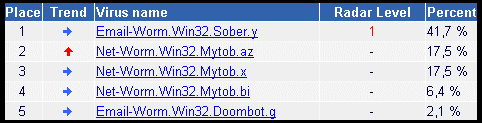
Sober.Y was the biggest email outbreak of the year. It still is responsbile for around 40% of all the infections we see. This variant is programmed to activate on January 5th, 2006. After this date all the infected machines will regularily try to download and run a file from a website, forever. The virus even synchronizes the machines via atom clocks so the activation will not happen before January 5th, even if the clock of the computer is incorrect.
So, what URL is the virus using? This is the tricky part. The virus writer knows well that if he uses a single, constant address in the virus body, it will get blocked quickly. So instead, Sober has been using an algorithm to create pseudorandom URLs which will change based on date. These URLs point to free hosting servers typically operating in Germany or in Austria. And 99% of the URLs generated by the virus simply don't exist.
However, the virus author can precalculate the URL for any date, and when he wants to run something on all the infected machines, he just registers the right URL, uploads his program and BANG! It's run globally in hundreds of thousands of machines.
The Sober virus author can precalculate the URLs. We wanted to be able to do the same thing. So we cracked the algorithm. This enabled us to calculate the download URLs for any future date. In fact, we did this already in May 2005, and we informed the local police in Germany as well as the affected ISPs. But we didn't want to talk about it publically then - we didn't want to fill in the virus writer on this. But he must know this by now.
So what do these pseudorandom URLs look like?
 They look like this. These are the download sites Sober.Y will start using on 5th of January. We're leaving out the filename of the actual executable, but this should be good enough list of addresses you might want to block at your corporate firewall, if you're a system administrator:
http://people.freenet.de/gixcihnm/
http://people.freenet.de/tobtrfjabzw/
http://people.freenet.de/utzmfucaau/+
http://people.freenet.de/phyibrpkcpl/
http://people.freenet.de/lhxrdryo/
http://people.freenet.de/yediykdq/
http://people.freenet.de/bjjhdkybpyaj/
http://scifi.pages.at/agzytvfbybn/
http://home.pages.at/bdalczxpctcb/
http://free.pages.at/ftvuefbumebug/
http://home.arcor.de/ijdsqkkxuwp/
http://home.arcor.de/ldhdytdu/
http://home.arcor.de/wdqodvdhwwese/
http://home.arcor.de/frweemrecuvw/
http://home.arcor.de/nulmjznomnt/
Right now, none of these URLs exist. If they are to be used, the virus writer will register them just before the activation.
However, the list will change every 14 days, and the first change will happen already on 6th of January. Then the list becomes:
http://people.freenet.de/mookflolfctm/
http://people.freenet.de/aohobygi/
http://people.freenet.de/wlpgskmv/
http://people.freenet.de/svclxatmlhavj/
http://people.freenet.de/jpjpoptwql/
http://people.freenet.de/iohgdhkzfhdzo/
http://people.freenet.de/eetbuviaebe/
http://scifi.pages.at/vvvjkhmbgnbbw/
http://home.pages.at/twfofrfzlugq/
http://free.pages.at/sfhfksjzsfu/
http://home.arcor.de/qlqqlbojvii/
http://home.arcor.de/fulmxct/
http://home.arcor.de/fowclxccdxn/
http://home.arcor.de/lnzzlnbk/
http://home.arcor.de/rprpgbnrppb/
Last thing: Several earlier Sober variants (most notably Sober.Q) have been sending out neonazi propaganda messages. According to iDefense, the activation date of January 5th is an anniversary date for the nazi party.
by mozbe
Looks like we are in for some fun next year...
iDefense Exposes Sober Worm Variant Timed with Nazi Party’s 87th Anniversary
Widespread Worm is Scheduled to Launch Jan. 5, 2006
December 7, 2005
Reston, VA. - Dec. 7, 2005 - iDefense, cyber security intelligence provider and VeriSign company (Nasdaq: VRSN), reports that the next planned attack of 2005's most prolific e-mail worm family, Sober, is scheduled to start on Jan. 5, 2006 based on commands hard-coded within the worm. The attack date coincides with the 87th anniversary of the founding of the Nazi party. Additionally, the attack could have a significantly detrimental effect on Internet traffic, as e-mail servers are flooded with politically motivated spam e-mails from potentially tens of millions of e-mail addresses.
In addition to the Nazi party anniversary, the Jan. 5 trigger on the Sober variant appears to also be timed to coincide with a major German political convention meeting the next day, Jan. 6. In the past, VeriSign iDefense Security Intelligence Services has seen mass distribution of propaganda timed with political events to increase the worm's notoriety, and help to further circulate it.
"This discovery emphasizes the ever-present and often underestimated threat of 'hacktivism' - combining malicious code with political causes," said Joe Payne, Vice President, VeriSign iDefense Security Intelligence Services. "Exposing this latest variant required technical and geopolitical analysis that connected the dots to give enterprises and home users plenty of time to shore up their defenses."
The Sober family appears to be authored by a German speaker or group of German speakers, and is composed of nearly 30 variants dating to October 2003. Infected e-mails propagate as attachments with a social engineering component, enticing readers to open malicious files with messages using information on current events. Sober is also a bilingual worm, sending German-language messages to German e-mail addresses, and English-language messages to other addresses.
Read the rest of the article here: iDefense : About iDefense : News Center : Recent Releases.
by mozbe
Looks like we are in for some fun next year...
iDefense Exposes Sober Worm Variant Timed with Nazi Party’s 87th Anniversary
Widespread Worm is Scheduled to Launch Jan. 5, 2006
December 7, 2005
Reston, VA. - Dec. 7, 2005 - iDefense, cyber security intelligence provider and VeriSign company (Nasdaq: VRSN), reports that the next planned attack of 2005's most prolific e-mail worm family, Sober, is scheduled to start on Jan. 5, 2006 based on commands hard-coded within the worm. The attack date coincides with the 87th anniversary of the founding of the Nazi party. Additionally, the attack could have a significantly detrimental effect on Internet traffic, as e-mail servers are flooded with politically motivated spam e-mails from potentially tens of millions of e-mail addresses.
In addition to the Nazi party anniversary, the Jan. 5 trigger on the Sober variant appears to also be timed to coincide with a major German political convention meeting the next day, Jan. 6. In the past, VeriSign iDefense Security Intelligence Services has seen mass distribution of propaganda timed with political events to increase the worm's notoriety, and help to further circulate it.
"This discovery emphasizes the ever-present and often underestimated threat of 'hacktivism' - combining malicious code with political causes," said Joe Payne, Vice President, VeriSign iDefense Security Intelligence Services. "Exposing this latest variant required technical and geopolitical analysis that connected the dots to give enterprises and home users plenty of time to shore up their defenses."
The Sober family appears to be authored by a German speaker or group of German speakers, and is composed of nearly 30 variants dating to October 2003. Infected e-mails propagate as attachments with a social engineering component, enticing readers to open malicious files with messages using information on current events. Sober is also a bilingual worm, sending German-language messages to German e-mail addresses, and English-language messages to other addresses.
Read the rest of the article here: iDefense : About iDefense : News Center : Recent Releases.
by mozbe
Looks like we are in for some fun next year...
iDefense Exposes Sober Worm Variant Timed with Nazi Party’s 87th Anniversary
Widespread Worm is Scheduled to Launch Jan. 5, 2006
December 7, 2005
Reston, VA. - Dec. 7, 2005 - iDefense, cyber security intelligence provider and VeriSign company (Nasdaq: VRSN), reports that the next planned attack of 2005's most prolific e-mail worm family, Sober, is scheduled to start on Jan. 5, 2006 based on commands hard-coded within the worm. The attack date coincides with the 87th anniversary of the founding of the Nazi party. Additionally, the attack could have a significantly detrimental effect on Internet traffic, as e-mail servers are flooded with politically motivated spam e-mails from potentially tens of millions of e-mail addresses.
In addition to the Nazi party anniversary, the Jan. 5 trigger on the Sober variant appears to also be timed to coincide with a major German political convention meeting the next day, Jan. 6. In the past, VeriSign iDefense Security Intelligence Services has seen mass distribution of propaganda timed with political events to increase the worm's notoriety, and help to further circulate it.
"This discovery emphasizes the ever-present and often underestimated threat of 'hacktivism' - combining malicious code with political causes," said Joe Payne, Vice President, VeriSign iDefense Security Intelligence Services. "Exposing this latest variant required technical and geopolitical analysis that connected the dots to give enterprises and home users plenty of time to shore up their defenses."
The Sober family appears to be authored by a German speaker or group of German speakers, and is composed of nearly 30 variants dating to October 2003. Infected e-mails propagate as attachments with a social engineering component, enticing readers to open malicious files with messages using information on current events. Sober is also a bilingual worm, sending German-language messages to German e-mail addresses, and English-language messages to other addresses.
Read the rest of the article here: iDefense : About iDefense : News Center : Recent Releases.
by mozbe
Looks like we are in for some fun next year...
iDefense Exposes Sober Worm Variant Timed with Nazi Party’s 87th Anniversary
Widespread Worm is Scheduled to Launch Jan. 5, 2006
December 7, 2005
Reston, VA. - Dec. 7, 2005 - iDefense, cyber security intelligence provider and VeriSign company (Nasdaq: VRSN), reports that the next planned attack of 2005's most prolific e-mail worm family, Sober, is scheduled to start on Jan. 5, 2006 based on commands hard-coded within the worm. The attack date coincides with the 87th anniversary of the founding of the Nazi party. Additionally, the attack could have a significantly detrimental effect on Internet traffic, as e-mail servers are flooded with politically motivated spam e-mails from potentially tens of millions of e-mail addresses.
In addition to the Nazi party anniversary, the Jan. 5 trigger on the Sober variant appears to also be timed to coincide with a major German political convention meeting the next day, Jan. 6. In the past, VeriSign iDefense Security Intelligence Services has seen mass distribution of propaganda timed with political events to increase the worm's notoriety, and help to further circulate it.
"This discovery emphasizes the ever-present and often underestimated threat of 'hacktivism' - combining malicious code with political causes," said Joe Payne, Vice President, VeriSign iDefense Security Intelligence Services. "Exposing this latest variant required technical and geopolitical analysis that connected the dots to give enterprises and home users plenty of time to shore up their defenses."
The Sober family appears to be authored by a German speaker or group of German speakers, and is composed of nearly 30 variants dating to October 2003. Infected e-mails propagate as attachments with a social engineering component, enticing readers to open malicious files with messages using information on current events. Sober is also a bilingual worm, sending German-language messages to German e-mail addresses, and English-language messages to other addresses.
Read the rest of the article here: iDefense : About iDefense : News Center : Recent Releases.
by mozbe
Looks like we are in for some fun next year...
iDefense Exposes Sober Worm Variant Timed with Nazi Party’s 87th Anniversary
Widespread Worm is Scheduled to Launch Jan. 5, 2006
December 7, 2005
Reston, VA. - Dec. 7, 2005 - iDefense, cyber security intelligence provider and VeriSign company (Nasdaq: VRSN), reports that the next planned attack of 2005's most prolific e-mail worm family, Sober, is scheduled to start on Jan. 5, 2006 based on commands hard-coded within the worm. The attack date coincides with the 87th anniversary of the founding of the Nazi party. Additionally, the attack could have a significantly detrimental effect on Internet traffic, as e-mail servers are flooded with politically motivated spam e-mails from potentially tens of millions of e-mail addresses.
In addition to the Nazi party anniversary, the Jan. 5 trigger on the Sober variant appears to also be timed to coincide with a major German political convention meeting the next day, Jan. 6. In the past, VeriSign iDefense Security Intelligence Services has seen mass distribution of propaganda timed with political events to increase the worm's notoriety, and help to further circulate it.
"This discovery emphasizes the ever-present and often underestimated threat of 'hacktivism' - combining malicious code with political causes," said Joe Payne, Vice President, VeriSign iDefense Security Intelligence Services. "Exposing this latest variant required technical and geopolitical analysis that connected the dots to give enterprises and home users plenty of time to shore up their defenses."
The Sober family appears to be authored by a German speaker or group of German speakers, and is composed of nearly 30 variants dating to October 2003. Infected e-mails propagate as attachments with a social engineering component, enticing readers to open malicious files with messages using information on current events. Sober is also a bilingual worm, sending German-language messages to German e-mail addresses, and English-language messages to other addresses.
Read the rest of the article here: iDefense : About iDefense : News Center : Recent Releases.
by mozbe
Looks like we are in for some fun next year...
iDefense Exposes Sober Worm Variant Timed with Nazi Party’s 87th Anniversary
Widespread Worm is Scheduled to Launch Jan. 5, 2006
December 7, 2005
Reston, VA. - Dec. 7, 2005 - iDefense, cyber security intelligence provider and VeriSign company (Nasdaq: VRSN), reports that the next planned attack of 2005's most prolific e-mail worm family, Sober, is scheduled to start on Jan. 5, 2006 based on commands hard-coded within the worm. The attack date coincides with the 87th anniversary of the founding of the Nazi party. Additionally, the attack could have a significantly detrimental effect on Internet traffic, as e-mail servers are flooded with politically motivated spam e-mails from potentially tens of millions of e-mail addresses.
In addition to the Nazi party anniversary, the Jan. 5 trigger on the Sober variant appears to also be timed to coincide with a major German political convention meeting the next day, Jan. 6. In the past, VeriSign iDefense Security Intelligence Services has seen mass distribution of propaganda timed with political events to increase the worm's notoriety, and help to further circulate it.
"This discovery emphasizes the ever-present and often underestimated threat of 'hacktivism' - combining malicious code with political causes," said Joe Payne, Vice President, VeriSign iDefense Security Intelligence Services. "Exposing this latest variant required technical and geopolitical analysis that connected the dots to give enterprises and home users plenty of time to shore up their defenses."
The Sober family appears to be authored by a German speaker or group of German speakers, and is composed of nearly 30 variants dating to October 2003. Infected e-mails propagate as attachments with a social engineering component, enticing readers to open malicious files with messages using information on current events. Sober is also a bilingual worm, sending German-language messages to German e-mail addresses, and English-language messages to other addresses.
Read the rest of the article here: iDefense : About iDefense : News Center : Recent Releases.
by mozbe
Handler's Diary December 8th 2005
previous - nextFirst Vulnerability for Firefox 1.5 (released version) Announced - PoC available (NEW)
Published: 2005-12-09,
Last Updated: 2005-12-09 15:33:49 UTC by John Bambenek (Version: 2(click to highlight changes))Update 2: The official response from the folks at mozilla.org can be found here. Their results match our testing, that we were able to make it take a long time for Firefox to start, but were not able to make it crash. Further, there doesn't seem to be any credible evidence at this time that this could be exploited to execute arbitrary code.
When Firefox 1.5 was officially released I wondered when the first security vulnerability would be announced. To be fair, it's taken longer than I thought it would. Packetstorm Security has released
proof of concept code that causes a buffer overflow and denial of service on the Firefox browser. Long and short of it is, history.dat stores various pieces of information on websites you've visited. If the topic of a page is crafted to be long enough, it will crash the browser each time it is started after going to such a page. This vulnerability has been tested and does work, and no known patches are available at this time. Once this happens, firefox will be unable to be started until you erase the history.dat file manually. Presumably, if the topic was more tightly crafted than in the proof-of-concept code, a more malicious attack could be crafted that would install malware on the machine with the extra fun step of being reinstalled after each restart of firefox (unless you erase history.dat).
As we research this more, details will be added on to this post.
UPDATES:
The machine I was testing this on has McAfee Enterprise 8, and Firefox would not crash. Despite my valiant efforts in disabling the protection, I couldn't get it to crash. While annoyed that I couldn't (short of uninstalling) get the protection disabled, it probablly is a good thing. I'll test more when I get in the office tomorrow and have more machines to play with.
This seems to be more of a denial of service than a true buffer overflow. It looks like Firefox just chokes on page topics that are too long. Some people it hangs, other people it crashes.
WORKAROUNDS:
However, the following is a workaround that should work (if it doesn't let me know). Go to Tools -> Options.
Select the Privacy Icon, and then the History tab. Set the number of days to save pages at 0. This will disable writing anything to history.dat as far as I can tell, and should nullify the exploit. Readers have confirmed that this workaround does prevent the buffer overflow. You can also change your privacy settings to delete personal info when you close Firefox.
Another workaround is to modify prefs.js while Firefox has not been started and put in the line:
user_pref("capability.policy.default.HTMLDocument.title.set","noAccess");
Lastly, you can also run the NoScript extension, found here. (Which I have not looked at in depth.) However, there are other ways of exploiting this where NoScript might not work.
Some users have reported being unable to reproduce this error. I will test more to try to establish what makes this work and not. So far it appears Mac users are not affected by this.
HOW TO LOCATE THE PROFILE FOLDER:
If you need to delete your history.dat file (in case you tested this PoC code), it can be difficult to locate where exactly this file is.
You can find instructions for locating the profile folder at the following URL: http://www.mozilla.org/support/firefox/edit#profile.--
John Bambenek, bambenek *at* gmail *dot* com
by mozbe
Looks like we are in for some fun next year...
iDefense Exposes Sober Worm Variant Timed with Nazi Party’s 87th Anniversary
Widespread Worm is Scheduled to Launch Jan. 5, 2006
December 7, 2005
Reston, VA. - Dec. 7, 2005 - iDefense, cyber security intelligence provider and VeriSign company (Nasdaq: VRSN), reports that the next planned attack of 2005's most prolific e-mail worm family, Sober, is scheduled to start on Jan. 5, 2006 based on commands hard-coded within the worm. The attack date coincides with the 87th anniversary of the founding of the Nazi party. Additionally, the attack could have a significantly detrimental effect on Internet traffic, as e-mail servers are flooded with politically motivated spam e-mails from potentially tens of millions of e-mail addresses.
In addition to the Nazi party anniversary, the Jan. 5 trigger on the Sober variant appears to also be timed to coincide with a major German political convention meeting the next day, Jan. 6. In the past, VeriSign iDefense Security Intelligence Services has seen mass distribution of propaganda timed with political events to increase the worm's notoriety, and help to further circulate it.
"This discovery emphasizes the ever-present and often underestimated threat of 'hacktivism' - combining malicious code with political causes," said Joe Payne, Vice President, VeriSign iDefense Security Intelligence Services. "Exposing this latest variant required technical and geopolitical analysis that connected the dots to give enterprises and home users plenty of time to shore up their defenses."
The Sober family appears to be authored by a German speaker or group of German speakers, and is composed of nearly 30 variants dating to October 2003. Infected e-mails propagate as attachments with a social engineering component, enticing readers to open malicious files with messages using information on current events. Sober is also a bilingual worm, sending German-language messages to German e-mail addresses, and English-language messages to other addresses.
Read the rest of the article here: iDefense : About iDefense : News Center : Recent Releases.
by mozbe
Looks like we are in for some fun next year...
iDefense Exposes Sober Worm Variant Timed with Nazi Party’s 87th Anniversary
Widespread Worm is Scheduled to Launch Jan. 5, 2006
December 7, 2005
Reston, VA. - Dec. 7, 2005 - iDefense, cyber security intelligence provider and VeriSign company (Nasdaq: VRSN), reports that the next planned attack of 2005's most prolific e-mail worm family, Sober, is scheduled to start on Jan. 5, 2006 based on commands hard-coded within the worm. The attack date coincides with the 87th anniversary of the founding of the Nazi party. Additionally, the attack could have a significantly detrimental effect on Internet traffic, as e-mail servers are flooded with politically motivated spam e-mails from potentially tens of millions of e-mail addresses.
In addition to the Nazi party anniversary, the Jan. 5 trigger on the Sober variant appears to also be timed to coincide with a major German political convention meeting the next day, Jan. 6. In the past, VeriSign iDefense Security Intelligence Services has seen mass distribution of propaganda timed with political events to increase the worm's notoriety, and help to further circulate it.
"This discovery emphasizes the ever-present and often underestimated threat of 'hacktivism' - combining malicious code with political causes," said Joe Payne, Vice President, VeriSign iDefense Security Intelligence Services. "Exposing this latest variant required technical and geopolitical analysis that connected the dots to give enterprises and home users plenty of time to shore up their defenses."
The Sober family appears to be authored by a German speaker or group of German speakers, and is composed of nearly 30 variants dating to October 2003. Infected e-mails propagate as attachments with a social engineering component, enticing readers to open malicious files with messages using information on current events. Sober is also a bilingual worm, sending German-language messages to German e-mail addresses, and English-language messages to other addresses.
Read the rest of the article here: iDefense : About iDefense : News Center : Recent Releases.
by mozbe
Looks like we are in for some fun next year...
iDefense Exposes Sober Worm Variant Timed with Nazi Party’s 87th Anniversary
Widespread Worm is Scheduled to Launch Jan. 5, 2006
December 7, 2005
Reston, VA. - Dec. 7, 2005 - iDefense, cyber security intelligence provider and VeriSign company (Nasdaq: VRSN), reports that the next planned attack of 2005's most prolific e-mail worm family, Sober, is scheduled to start on Jan. 5, 2006 based on commands hard-coded within the worm. The attack date coincides with the 87th anniversary of the founding of the Nazi party. Additionally, the attack could have a significantly detrimental effect on Internet traffic, as e-mail servers are flooded with politically motivated spam e-mails from potentially tens of millions of e-mail addresses.
In addition to the Nazi party anniversary, the Jan. 5 trigger on the Sober variant appears to also be timed to coincide with a major German political convention meeting the next day, Jan. 6. In the past, VeriSign iDefense Security Intelligence Services has seen mass distribution of propaganda timed with political events to increase the worm's notoriety, and help to further circulate it.
"This discovery emphasizes the ever-present and often underestimated threat of 'hacktivism' - combining malicious code with political causes," said Joe Payne, Vice President, VeriSign iDefense Security Intelligence Services. "Exposing this latest variant required technical and geopolitical analysis that connected the dots to give enterprises and home users plenty of time to shore up their defenses."
The Sober family appears to be authored by a German speaker or group of German speakers, and is composed of nearly 30 variants dating to October 2003. Infected e-mails propagate as attachments with a social engineering component, enticing readers to open malicious files with messages using information on current events. Sober is also a bilingual worm, sending German-language messages to German e-mail addresses, and English-language messages to other addresses.
Read the rest of the article here: iDefense : About iDefense : News Center : Recent Releases.
by mozbe
Looks like we are in for some fun next year...
iDefense Exposes Sober Worm Variant Timed with Nazi Party’s 87th Anniversary
Widespread Worm is Scheduled to Launch Jan. 5, 2006
December 7, 2005
Reston, VA. - Dec. 7, 2005 - iDefense, cyber security intelligence provider and VeriSign company (Nasdaq: VRSN), reports that the next planned attack of 2005's most prolific e-mail worm family, Sober, is scheduled to start on Jan. 5, 2006 based on commands hard-coded within the worm. The attack date coincides with the 87th anniversary of the founding of the Nazi party. Additionally, the attack could have a significantly detrimental effect on Internet traffic, as e-mail servers are flooded with politically motivated spam e-mails from potentially tens of millions of e-mail addresses.
In addition to the Nazi party anniversary, the Jan. 5 trigger on the Sober variant appears to also be timed to coincide with a major German political convention meeting the next day, Jan. 6. In the past, VeriSign iDefense Security Intelligence Services has seen mass distribution of propaganda timed with political events to increase the worm's notoriety, and help to further circulate it.
"This discovery emphasizes the ever-present and often underestimated threat of 'hacktivism' - combining malicious code with political causes," said Joe Payne, Vice President, VeriSign iDefense Security Intelligence Services. "Exposing this latest variant required technical and geopolitical analysis that connected the dots to give enterprises and home users plenty of time to shore up their defenses."
The Sober family appears to be authored by a German speaker or group of German speakers, and is composed of nearly 30 variants dating to October 2003. Infected e-mails propagate as attachments with a social engineering component, enticing readers to open malicious files with messages using information on current events. Sober is also a bilingual worm, sending German-language messages to German e-mail addresses, and English-language messages to other addresses.
Read the rest of the article here: iDefense : About iDefense : News Center : Recent Releases.
by mozbe
Looks like we are in for some fun next year...
iDefense Exposes Sober Worm Variant Timed with Nazi Party’s 87th Anniversary
Widespread Worm is Scheduled to Launch Jan. 5, 2006
December 7, 2005
Reston, VA. - Dec. 7, 2005 - iDefense, cyber security intelligence provider and VeriSign company (Nasdaq: VRSN), reports that the next planned attack of 2005's most prolific e-mail worm family, Sober, is scheduled to start on Jan. 5, 2006 based on commands hard-coded within the worm. The attack date coincides with the 87th anniversary of the founding of the Nazi party. Additionally, the attack could have a significantly detrimental effect on Internet traffic, as e-mail servers are flooded with politically motivated spam e-mails from potentially tens of millions of e-mail addresses.
In addition to the Nazi party anniversary, the Jan. 5 trigger on the Sober variant appears to also be timed to coincide with a major German political convention meeting the next day, Jan. 6. In the past, VeriSign iDefense Security Intelligence Services has seen mass distribution of propaganda timed with political events to increase the worm's notoriety, and help to further circulate it.
"This discovery emphasizes the ever-present and often underestimated threat of 'hacktivism' - combining malicious code with political causes," said Joe Payne, Vice President, VeriSign iDefense Security Intelligence Services. "Exposing this latest variant required technical and geopolitical analysis that connected the dots to give enterprises and home users plenty of time to shore up their defenses."
The Sober family appears to be authored by a German speaker or group of German speakers, and is composed of nearly 30 variants dating to October 2003. Infected e-mails propagate as attachments with a social engineering component, enticing readers to open malicious files with messages using information on current events. Sober is also a bilingual worm, sending German-language messages to German e-mail addresses, and English-language messages to other addresses.
Read the rest of the article here: iDefense : About iDefense : News Center : Recent Releases.
by mozbe
Looks like we are in for some fun next year...
iDefense Exposes Sober Worm Variant Timed with Nazi Party’s 87th Anniversary
Widespread Worm is Scheduled to Launch Jan. 5, 2006
December 7, 2005
Reston, VA. - Dec. 7, 2005 - iDefense, cyber security intelligence provider and VeriSign company (Nasdaq: VRSN), reports that the next planned attack of 2005's most prolific e-mail worm family, Sober, is scheduled to start on Jan. 5, 2006 based on commands hard-coded within the worm. The attack date coincides with the 87th anniversary of the founding of the Nazi party. Additionally, the attack could have a significantly detrimental effect on Internet traffic, as e-mail servers are flooded with politically motivated spam e-mails from potentially tens of millions of e-mail addresses.
In addition to the Nazi party anniversary, the Jan. 5 trigger on the Sober variant appears to also be timed to coincide with a major German political convention meeting the next day, Jan. 6. In the past, VeriSign iDefense Security Intelligence Services has seen mass distribution of propaganda timed with political events to increase the worm's notoriety, and help to further circulate it.
"This discovery emphasizes the ever-present and often underestimated threat of 'hacktivism' - combining malicious code with political causes," said Joe Payne, Vice President, VeriSign iDefense Security Intelligence Services. "Exposing this latest variant required technical and geopolitical analysis that connected the dots to give enterprises and home users plenty of time to shore up their defenses."
The Sober family appears to be authored by a German speaker or group of German speakers, and is composed of nearly 30 variants dating to October 2003. Infected e-mails propagate as attachments with a social engineering component, enticing readers to open malicious files with messages using information on current events. Sober is also a bilingual worm, sending German-language messages to German e-mail addresses, and English-language messages to other addresses.
Read the rest of the article here: iDefense : About iDefense : News Center : Recent Releases.
by mozbe
Looks like we are in for some fun next year...
iDefense Exposes Sober Worm Variant Timed with Nazi Party’s 87th Anniversary
Widespread Worm is Scheduled to Launch Jan. 5, 2006
December 7, 2005
Reston, VA. - Dec. 7, 2005 - iDefense, cyber security intelligence provider and VeriSign company (Nasdaq: VRSN), reports that the next planned attack of 2005's most prolific e-mail worm family, Sober, is scheduled to start on Jan. 5, 2006 based on commands hard-coded within the worm. The attack date coincides with the 87th anniversary of the founding of the Nazi party. Additionally, the attack could have a significantly detrimental effect on Internet traffic, as e-mail servers are flooded with politically motivated spam e-mails from potentially tens of millions of e-mail addresses.
In addition to the Nazi party anniversary, the Jan. 5 trigger on the Sober variant appears to also be timed to coincide with a major German political convention meeting the next day, Jan. 6. In the past, VeriSign iDefense Security Intelligence Services has seen mass distribution of propaganda timed with political events to increase the worm's notoriety, and help to further circulate it.
"This discovery emphasizes the ever-present and often underestimated threat of 'hacktivism' - combining malicious code with political causes," said Joe Payne, Vice President, VeriSign iDefense Security Intelligence Services. "Exposing this latest variant required technical and geopolitical analysis that connected the dots to give enterprises and home users plenty of time to shore up their defenses."
The Sober family appears to be authored by a German speaker or group of German speakers, and is composed of nearly 30 variants dating to October 2003. Infected e-mails propagate as attachments with a social engineering component, enticing readers to open malicious files with messages using information on current events. Sober is also a bilingual worm, sending German-language messages to German e-mail addresses, and English-language messages to other addresses.
Read the rest of the article here: iDefense : About iDefense : News Center : Recent Releases.
by mozbe
Looks like we are in for some fun next year...
iDefense Exposes Sober Worm Variant Timed with Nazi Party’s 87th Anniversary
Widespread Worm is Scheduled to Launch Jan. 5, 2006
December 7, 2005
Reston, VA. - Dec. 7, 2005 - iDefense, cyber security intelligence provider and VeriSign company (Nasdaq: VRSN), reports that the next planned attack of 2005's most prolific e-mail worm family, Sober, is scheduled to start on Jan. 5, 2006 based on commands hard-coded within the worm. The attack date coincides with the 87th anniversary of the founding of the Nazi party. Additionally, the attack could have a significantly detrimental effect on Internet traffic, as e-mail servers are flooded with politically motivated spam e-mails from potentially tens of millions of e-mail addresses.
In addition to the Nazi party anniversary, the Jan. 5 trigger on the Sober variant appears to also be timed to coincide with a major German political convention meeting the next day, Jan. 6. In the past, VeriSign iDefense Security Intelligence Services has seen mass distribution of propaganda timed with political events to increase the worm's notoriety, and help to further circulate it.
"This discovery emphasizes the ever-present and often underestimated threat of 'hacktivism' - combining malicious code with political causes," said Joe Payne, Vice President, VeriSign iDefense Security Intelligence Services. "Exposing this latest variant required technical and geopolitical analysis that connected the dots to give enterprises and home users plenty of time to shore up their defenses."
The Sober family appears to be authored by a German speaker or group of German speakers, and is composed of nearly 30 variants dating to October 2003. Infected e-mails propagate as attachments with a social engineering component, enticing readers to open malicious files with messages using information on current events. Sober is also a bilingual worm, sending German-language messages to German e-mail addresses, and English-language messages to other addresses.
Read the rest of the article here: iDefense : About iDefense : News Center : Recent Releases.
by mozbe
Looks like we are in for some fun next year...
iDefense Exposes Sober Worm Variant Timed with Nazi Party’s 87th Anniversary
Widespread Worm is Scheduled to Launch Jan. 5, 2006
December 7, 2005
Reston, VA. - Dec. 7, 2005 - iDefense, cyber security intelligence provider and VeriSign company (Nasdaq: VRSN), reports that the next planned attack of 2005's most prolific e-mail worm family, Sober, is scheduled to start on Jan. 5, 2006 based on commands hard-coded within the worm. The attack date coincides with the 87th anniversary of the founding of the Nazi party. Additionally, the attack could have a significantly detrimental effect on Internet traffic, as e-mail servers are flooded with politically motivated spam e-mails from potentially tens of millions of e-mail addresses.
In addition to the Nazi party anniversary, the Jan. 5 trigger on the Sober variant appears to also be timed to coincide with a major German political convention meeting the next day, Jan. 6. In the past, VeriSign iDefense Security Intelligence Services has seen mass distribution of propaganda timed with political events to increase the worm's notoriety, and help to further circulate it.
"This discovery emphasizes the ever-present and often underestimated threat of 'hacktivism' - combining malicious code with political causes," said Joe Payne, Vice President, VeriSign iDefense Security Intelligence Services. "Exposing this latest variant required technical and geopolitical analysis that connected the dots to give enterprises and home users plenty of time to shore up their defenses."
The Sober family appears to be authored by a German speaker or group of German speakers, and is composed of nearly 30 variants dating to October 2003. Infected e-mails propagate as attachments with a social engineering component, enticing readers to open malicious files with messages using information on current events. Sober is also a bilingual worm, sending German-language messages to German e-mail addresses, and English-language messages to other addresses.
Read the rest of the article here: iDefense : About iDefense : News Center : Recent Releases.
by mozbe
Looks like we are in for some fun next year...
iDefense Exposes Sober Worm Variant Timed with Nazi Party’s 87th Anniversary
Widespread Worm is Scheduled to Launch Jan. 5, 2006
December 7, 2005
Reston, VA. - Dec. 7, 2005 - iDefense, cyber security intelligence provider and VeriSign company (Nasdaq: VRSN), reports that the next planned attack of 2005's most prolific e-mail worm family, Sober, is scheduled to start on Jan. 5, 2006 based on commands hard-coded within the worm. The attack date coincides with the 87th anniversary of the founding of the Nazi party. Additionally, the attack could have a significantly detrimental effect on Internet traffic, as e-mail servers are flooded with politically motivated spam e-mails from potentially tens of millions of e-mail addresses.
In addition to the Nazi party anniversary, the Jan. 5 trigger on the Sober variant appears to also be timed to coincide with a major German political convention meeting the next day, Jan. 6. In the past, VeriSign iDefense Security Intelligence Services has seen mass distribution of propaganda timed with political events to increase the worm's notoriety, and help to further circulate it.
"This discovery emphasizes the ever-present and often underestimated threat of 'hacktivism' - combining malicious code with political causes," said Joe Payne, Vice President, VeriSign iDefense Security Intelligence Services. "Exposing this latest variant required technical and geopolitical analysis that connected the dots to give enterprises and home users plenty of time to shore up their defenses."
The Sober family appears to be authored by a German speaker or group of German speakers, and is composed of nearly 30 variants dating to October 2003. Infected e-mails propagate as attachments with a social engineering component, enticing readers to open malicious files with messages using information on current events. Sober is also a bilingual worm, sending German-language messages to German e-mail addresses, and English-language messages to other addresses.
Read the rest of the article here: iDefense : About iDefense : News Center : Recent Releases.
by mozbe
Looks like we are in for some fun next year...
iDefense Exposes Sober Worm Variant Timed with Nazi Party’s 87th Anniversary
Widespread Worm is Scheduled to Launch Jan. 5, 2006
December 7, 2005
Reston, VA. - Dec. 7, 2005 - iDefense, cyber security intelligence provider and VeriSign company (Nasdaq: VRSN), reports that the next planned attack of 2005's most prolific e-mail worm family, Sober, is scheduled to start on Jan. 5, 2006 based on commands hard-coded within the worm. The attack date coincides with the 87th anniversary of the founding of the Nazi party. Additionally, the attack could have a significantly detrimental effect on Internet traffic, as e-mail servers are flooded with politically motivated spam e-mails from potentially tens of millions of e-mail addresses.
In addition to the Nazi party anniversary, the Jan. 5 trigger on the Sober variant appears to also be timed to coincide with a major German political convention meeting the next day, Jan. 6. In the past, VeriSign iDefense Security Intelligence Services has seen mass distribution of propaganda timed with political events to increase the worm's notoriety, and help to further circulate it.
"This discovery emphasizes the ever-present and often underestimated threat of 'hacktivism' - combining malicious code with political causes," said Joe Payne, Vice President, VeriSign iDefense Security Intelligence Services. "Exposing this latest variant required technical and geopolitical analysis that connected the dots to give enterprises and home users plenty of time to shore up their defenses."
The Sober family appears to be authored by a German speaker or group of German speakers, and is composed of nearly 30 variants dating to October 2003. Infected e-mails propagate as attachments with a social engineering component, enticing readers to open malicious files with messages using information on current events. Sober is also a bilingual worm, sending German-language messages to German e-mail addresses, and English-language messages to other addresses.
Read the rest of the article here: iDefense : About iDefense : News Center : Recent Releases.
by mozbe
Looks like we are in for some fun next year...
iDefense Exposes Sober Worm Variant Timed with Nazi Party’s 87th Anniversary
Widespread Worm is Scheduled to Launch Jan. 5, 2006
December 7, 2005
Reston, VA. - Dec. 7, 2005 - iDefense, cyber security intelligence provider and VeriSign company (Nasdaq: VRSN), reports that the next planned attack of 2005's most prolific e-mail worm family, Sober, is scheduled to start on Jan. 5, 2006 based on commands hard-coded within the worm. The attack date coincides with the 87th anniversary of the founding of the Nazi party. Additionally, the attack could have a significantly detrimental effect on Internet traffic, as e-mail servers are flooded with politically motivated spam e-mails from potentially tens of millions of e-mail addresses.
In addition to the Nazi party anniversary, the Jan. 5 trigger on the Sober variant appears to also be timed to coincide with a major German political convention meeting the next day, Jan. 6. In the past, VeriSign iDefense Security Intelligence Services has seen mass distribution of propaganda timed with political events to increase the worm's notoriety, and help to further circulate it.
"This discovery emphasizes the ever-present and often underestimated threat of 'hacktivism' - combining malicious code with political causes," said Joe Payne, Vice President, VeriSign iDefense Security Intelligence Services. "Exposing this latest variant required technical and geopolitical analysis that connected the dots to give enterprises and home users plenty of time to shore up their defenses."
The Sober family appears to be authored by a German speaker or group of German speakers, and is composed of nearly 30 variants dating to October 2003. Infected e-mails propagate as attachments with a social engineering component, enticing readers to open malicious files with messages using information on current events. Sober is also a bilingual worm, sending German-language messages to German e-mail addresses, and English-language messages to other addresses.
Read the rest of the article here: iDefense : About iDefense : News Center : Recent Releases.
by mozbe
Looks like we are in for some fun next year...
iDefense Exposes Sober Worm Variant Timed with Nazi Party’s 87th Anniversary
Widespread Worm is Scheduled to Launch Jan. 5, 2006
December 7, 2005
Reston, VA. - Dec. 7, 2005 - iDefense, cyber security intelligence provider and VeriSign company (Nasdaq: VRSN), reports that the next planned attack of 2005's most prolific e-mail worm family, Sober, is scheduled to start on Jan. 5, 2006 based on commands hard-coded within the worm. The attack date coincides with the 87th anniversary of the founding of the Nazi party. Additionally, the attack could have a significantly detrimental effect on Internet traffic, as e-mail servers are flooded with politically motivated spam e-mails from potentially tens of millions of e-mail addresses.
In addition to the Nazi party anniversary, the Jan. 5 trigger on the Sober variant appears to also be timed to coincide with a major German political convention meeting the next day, Jan. 6. In the past, VeriSign iDefense Security Intelligence Services has seen mass distribution of propaganda timed with political events to increase the worm's notoriety, and help to further circulate it.
"This discovery emphasizes the ever-present and often underestimated threat of 'hacktivism' - combining malicious code with political causes," said Joe Payne, Vice President, VeriSign iDefense Security Intelligence Services. "Exposing this latest variant required technical and geopolitical analysis that connected the dots to give enterprises and home users plenty of time to shore up their defenses."
The Sober family appears to be authored by a German speaker or group of German speakers, and is composed of nearly 30 variants dating to October 2003. Infected e-mails propagate as attachments with a social engineering component, enticing readers to open malicious files with messages using information on current events. Sober is also a bilingual worm, sending German-language messages to German e-mail addresses, and English-language messages to other addresses.
Read the rest of the article here: iDefense : About iDefense : News Center : Recent Releases.
by mozbe
Looks like we are in for some fun next year...
iDefense Exposes Sober Worm Variant Timed with Nazi Party’s 87th Anniversary
Widespread Worm is Scheduled to Launch Jan. 5, 2006
December 7, 2005
Reston, VA. - Dec. 7, 2005 - iDefense, cyber security intelligence provider and VeriSign company (Nasdaq: VRSN), reports that the next planned attack of 2005's most prolific e-mail worm family, Sober, is scheduled to start on Jan. 5, 2006 based on commands hard-coded within the worm. The attack date coincides with the 87th anniversary of the founding of the Nazi party. Additionally, the attack could have a significantly detrimental effect on Internet traffic, as e-mail servers are flooded with politically motivated spam e-mails from potentially tens of millions of e-mail addresses.
In addition to the Nazi party anniversary, the Jan. 5 trigger on the Sober variant appears to also be timed to coincide with a major German political convention meeting the next day, Jan. 6. In the past, VeriSign iDefense Security Intelligence Services has seen mass distribution of propaganda timed with political events to increase the worm's notoriety, and help to further circulate it.
"This discovery emphasizes the ever-present and often underestimated threat of 'hacktivism' - combining malicious code with political causes," said Joe Payne, Vice President, VeriSign iDefense Security Intelligence Services. "Exposing this latest variant required technical and geopolitical analysis that connected the dots to give enterprises and home users plenty of time to shore up their defenses."
The Sober family appears to be authored by a German speaker or group of German speakers, and is composed of nearly 30 variants dating to October 2003. Infected e-mails propagate as attachments with a social engineering component, enticing readers to open malicious files with messages using information on current events. Sober is also a bilingual worm, sending German-language messages to German e-mail addresses, and English-language messages to other addresses.
Read the rest of the article here: iDefense : About iDefense : News Center : Recent Releases.
by mozbe
Looks like we are in for some fun next year...
iDefense Exposes Sober Worm Variant Timed with Nazi Party’s 87th Anniversary
Widespread Worm is Scheduled to Launch Jan. 5, 2006
December 7, 2005
Reston, VA. - Dec. 7, 2005 - iDefense, cyber security intelligence provider and VeriSign company (Nasdaq: VRSN), reports that the next planned attack of 2005's most prolific e-mail worm family, Sober, is scheduled to start on Jan. 5, 2006 based on commands hard-coded within the worm. The attack date coincides with the 87th anniversary of the founding of the Nazi party. Additionally, the attack could have a significantly detrimental effect on Internet traffic, as e-mail servers are flooded with politically motivated spam e-mails from potentially tens of millions of e-mail addresses.
In addition to the Nazi party anniversary, the Jan. 5 trigger on the Sober variant appears to also be timed to coincide with a major German political convention meeting the next day, Jan. 6. In the past, VeriSign iDefense Security Intelligence Services has seen mass distribution of propaganda timed with political events to increase the worm's notoriety, and help to further circulate it.
"This discovery emphasizes the ever-present and often underestimated threat of 'hacktivism' - combining malicious code with political causes," said Joe Payne, Vice President, VeriSign iDefense Security Intelligence Services. "Exposing this latest variant required technical and geopolitical analysis that connected the dots to give enterprises and home users plenty of time to shore up their defenses."
The Sober family appears to be authored by a German speaker or group of German speakers, and is composed of nearly 30 variants dating to October 2003. Infected e-mails propagate as attachments with a social engineering component, enticing readers to open malicious files with messages using information on current events. Sober is also a bilingual worm, sending German-language messages to German e-mail addresses, and English-language messages to other addresses.
Read the rest of the article here: iDefense : About iDefense : News Center : Recent Releases.
by mozbe
Looks like we are in for some fun next year...
iDefense Exposes Sober Worm Variant Timed with Nazi Party’s 87th Anniversary
Widespread Worm is Scheduled to Launch Jan. 5, 2006
December 7, 2005
Reston, VA. - Dec. 7, 2005 - iDefense, cyber security intelligence provider and VeriSign company (Nasdaq: VRSN), reports that the next planned attack of 2005's most prolific e-mail worm family, Sober, is scheduled to start on Jan. 5, 2006 based on commands hard-coded within the worm. The attack date coincides with the 87th anniversary of the founding of the Nazi party. Additionally, the attack could have a significantly detrimental effect on Internet traffic, as e-mail servers are flooded with politically motivated spam e-mails from potentially tens of millions of e-mail addresses.
In addition to the Nazi party anniversary, the Jan. 5 trigger on the Sober variant appears to also be timed to coincide with a major German political convention meeting the next day, Jan. 6. In the past, VeriSign iDefense Security Intelligence Services has seen mass distribution of propaganda timed with political events to increase the worm's notoriety, and help to further circulate it.
"This discovery emphasizes the ever-present and often underestimated threat of 'hacktivism' - combining malicious code with political causes," said Joe Payne, Vice President, VeriSign iDefense Security Intelligence Services. "Exposing this latest variant required technical and geopolitical analysis that connected the dots to give enterprises and home users plenty of time to shore up their defenses."
The Sober family appears to be authored by a German speaker or group of German speakers, and is composed of nearly 30 variants dating to October 2003. Infected e-mails propagate as attachments with a social engineering component, enticing readers to open malicious files with messages using information on current events. Sober is also a bilingual worm, sending German-language messages to German e-mail addresses, and English-language messages to other addresses.
Read the rest of the article here: iDefense : About iDefense : News Center : Recent Releases.
by mozbe
Looks like we are in for some fun next year...
iDefense Exposes Sober Worm Variant Timed with Nazi Party’s 87th Anniversary
Widespread Worm is Scheduled to Launch Jan. 5, 2006
December 7, 2005
Reston, VA. - Dec. 7, 2005 - iDefense, cyber security intelligence provider and VeriSign company (Nasdaq: VRSN), reports that the next planned attack of 2005's most prolific e-mail worm family, Sober, is scheduled to start on Jan. 5, 2006 based on commands hard-coded within the worm. The attack date coincides with the 87th anniversary of the founding of the Nazi party. Additionally, the attack could have a significantly detrimental effect on Internet traffic, as e-mail servers are flooded with politically motivated spam e-mails from potentially tens of millions of e-mail addresses.
In addition to the Nazi party anniversary, the Jan. 5 trigger on the Sober variant appears to also be timed to coincide with a major German political convention meeting the next day, Jan. 6. In the past, VeriSign iDefense Security Intelligence Services has seen mass distribution of propaganda timed with political events to increase the worm's notoriety, and help to further circulate it.
"This discovery emphasizes the ever-present and often underestimated threat of 'hacktivism' - combining malicious code with political causes," said Joe Payne, Vice President, VeriSign iDefense Security Intelligence Services. "Exposing this latest variant required technical and geopolitical analysis that connected the dots to give enterprises and home users plenty of time to shore up their defenses."
The Sober family appears to be authored by a German speaker or group of German speakers, and is composed of nearly 30 variants dating to October 2003. Infected e-mails propagate as attachments with a social engineering component, enticing readers to open malicious files with messages using information on current events. Sober is also a bilingual worm, sending German-language messages to German e-mail addresses, and English-language messages to other addresses.
Read the rest of the article here: iDefense : About iDefense : News Center : Recent Releases.
by mozbe
Looks like we are in for some fun next year...
iDefense Exposes Sober Worm Variant Timed with Nazi Party’s 87th Anniversary
Widespread Worm is Scheduled to Launch Jan. 5, 2006
December 7, 2005
Reston, VA. - Dec. 7, 2005 - iDefense, cyber security intelligence provider and VeriSign company (Nasdaq: VRSN), reports that the next planned attack of 2005's most prolific e-mail worm family, Sober, is scheduled to start on Jan. 5, 2006 based on commands hard-coded within the worm. The attack date coincides with the 87th anniversary of the founding of the Nazi party. Additionally, the attack could have a significantly detrimental effect on Internet traffic, as e-mail servers are flooded with politically motivated spam e-mails from potentially tens of millions of e-mail addresses.
In addition to the Nazi party anniversary, the Jan. 5 trigger on the Sober variant appears to also be timed to coincide with a major German political convention meeting the next day, Jan. 6. In the past, VeriSign iDefense Security Intelligence Services has seen mass distribution of propaganda timed with political events to increase the worm's notoriety, and help to further circulate it.
"This discovery emphasizes the ever-present and often underestimated threat of 'hacktivism' - combining malicious code with political causes," said Joe Payne, Vice President, VeriSign iDefense Security Intelligence Services. "Exposing this latest variant required technical and geopolitical analysis that connected the dots to give enterprises and home users plenty of time to shore up their defenses."
The Sober family appears to be authored by a German speaker or group of German speakers, and is composed of nearly 30 variants dating to October 2003. Infected e-mails propagate as attachments with a social engineering component, enticing readers to open malicious files with messages using information on current events. Sober is also a bilingual worm, sending German-language messages to German e-mail addresses, and English-language messages to other addresses.
Read the rest of the article here: iDefense : About iDefense : News Center : Recent Releases.
by mozbe
Looks like we are in for some fun next year...
iDefense Exposes Sober Worm Variant Timed with Nazi Party’s 87th Anniversary
Widespread Worm is Scheduled to Launch Jan. 5, 2006
December 7, 2005
Reston, VA. - Dec. 7, 2005 - iDefense, cyber security intelligence provider and VeriSign company (Nasdaq: VRSN), reports that the next planned attack of 2005's most prolific e-mail worm family, Sober, is scheduled to start on Jan. 5, 2006 based on commands hard-coded within the worm. The attack date coincides with the 87th anniversary of the founding of the Nazi party. Additionally, the attack could have a significantly detrimental effect on Internet traffic, as e-mail servers are flooded with politically motivated spam e-mails from potentially tens of millions of e-mail addresses.
In addition to the Nazi party anniversary, the Jan. 5 trigger on the Sober variant appears to also be timed to coincide with a major German political convention meeting the next day, Jan. 6. In the past, VeriSign iDefense Security Intelligence Services has seen mass distribution of propaganda timed with political events to increase the worm's notoriety, and help to further circulate it.
"This discovery emphasizes the ever-present and often underestimated threat of 'hacktivism' - combining malicious code with political causes," said Joe Payne, Vice President, VeriSign iDefense Security Intelligence Services. "Exposing this latest variant required technical and geopolitical analysis that connected the dots to give enterprises and home users plenty of time to shore up their defenses."
The Sober family appears to be authored by a German speaker or group of German speakers, and is composed of nearly 30 variants dating to October 2003. Infected e-mails propagate as attachments with a social engineering component, enticing readers to open malicious files with messages using information on current events. Sober is also a bilingual worm, sending German-language messages to German e-mail addresses, and English-language messages to other addresses.
Read the rest of the article here: iDefense : About iDefense : News Center : Recent Releases.
by mozbe
Looks like we are in for some fun next year...
iDefense Exposes Sober Worm Variant Timed with Nazi Party’s 87th Anniversary
Widespread Worm is Scheduled to Launch Jan. 5, 2006
December 7, 2005
Reston, VA. - Dec. 7, 2005 - iDefense, cyber security intelligence provider and VeriSign company (Nasdaq: VRSN), reports that the next planned attack of 2005's most prolific e-mail worm family, Sober, is scheduled to start on Jan. 5, 2006 based on commands hard-coded within the worm. The attack date coincides with the 87th anniversary of the founding of the Nazi party. Additionally, the attack could have a significantly detrimental effect on Internet traffic, as e-mail servers are flooded with politically motivated spam e-mails from potentially tens of millions of e-mail addresses.
In addition to the Nazi party anniversary, the Jan. 5 trigger on the Sober variant appears to also be timed to coincide with a major German political convention meeting the next day, Jan. 6. In the past, VeriSign iDefense Security Intelligence Services has seen mass distribution of propaganda timed with political events to increase the worm's notoriety, and help to further circulate it.
"This discovery emphasizes the ever-present and often underestimated threat of 'hacktivism' - combining malicious code with political causes," said Joe Payne, Vice President, VeriSign iDefense Security Intelligence Services. "Exposing this latest variant required technical and geopolitical analysis that connected the dots to give enterprises and home users plenty of time to shore up their defenses."
The Sober family appears to be authored by a German speaker or group of German speakers, and is composed of nearly 30 variants dating to October 2003. Infected e-mails propagate as attachments with a social engineering component, enticing readers to open malicious files with messages using information on current events. Sober is also a bilingual worm, sending German-language messages to German e-mail addresses, and English-language messages to other addresses.
Read the rest of the article here: iDefense : About iDefense : News Center : Recent Releases.
by mozbe
Looks like we are in for some fun next year...
iDefense Exposes Sober Worm Variant Timed with Nazi Party’s 87th Anniversary
Widespread Worm is Scheduled to Launch Jan. 5, 2006
December 7, 2005
Reston, VA. - Dec. 7, 2005 - iDefense, cyber security intelligence provider and VeriSign company (Nasdaq: VRSN), reports that the next planned attack of 2005's most prolific e-mail worm family, Sober, is scheduled to start on Jan. 5, 2006 based on commands hard-coded within the worm. The attack date coincides with the 87th anniversary of the founding of the Nazi party. Additionally, the attack could have a significantly detrimental effect on Internet traffic, as e-mail servers are flooded with politically motivated spam e-mails from potentially tens of millions of e-mail addresses.
In addition to the Nazi party anniversary, the Jan. 5 trigger on the Sober variant appears to also be timed to coincide with a major German political convention meeting the next day, Jan. 6. In the past, VeriSign iDefense Security Intelligence Services has seen mass distribution of propaganda timed with political events to increase the worm's notoriety, and help to further circulate it.
"This discovery emphasizes the ever-present and often underestimated threat of 'hacktivism' - combining malicious code with political causes," said Joe Payne, Vice President, VeriSign iDefense Security Intelligence Services. "Exposing this latest variant required technical and geopolitical analysis that connected the dots to give enterprises and home users plenty of time to shore up their defenses."
The Sober family appears to be authored by a German speaker or group of German speakers, and is composed of nearly 30 variants dating to October 2003. Infected e-mails propagate as attachments with a social engineering component, enticing readers to open malicious files with messages using information on current events. Sober is also a bilingual worm, sending German-language messages to German e-mail addresses, and English-language messages to other addresses.
Read the rest of the article here: iDefense : About iDefense : News Center : Recent Releases.
Sort by Trending