


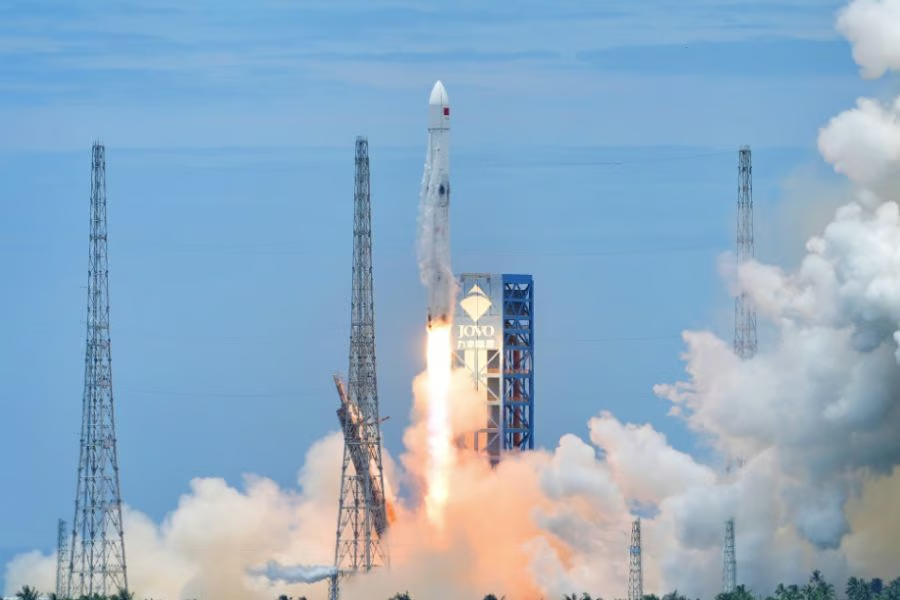
China has taken a major step toward reusable spaceflight after recovering an orbital rocket booster for the first time, moving closer to the technology that helped SpaceX transform the launch industry.
The test, carried out Friday from Hainan in southern China, saw the Long March 10B place a satellite into orbit before its first-stage booster returned to a floating recovery vessel roughly six minutes after separation. Instead of landing on deployable legs like SpaceX’s Falcon 9, the booster used a net-based capture system to catch a net suspended above a sea platform.
According to Chinese state media and the China Aerospace Science and Technology Corporation (CASC), the mission marked China’s first successful recovery of an orbital-class rocket booster. The company said it plans to fly the first-stage booster again later this year.
A different route to reusable launches
Reusable rockets have transformed the economics of spaceflight by allowing the most expensive part of a launch vehicle, the first-stage booster, to fly multiple missions rather than being discarded after each launch.
China’s approach differs from the system pioneered by SpaceX. Rather than touching down on landing legs atop a drone ship, the Long March 10B is designed to be captured by a net mounted on a sea-based recovery platform. Chinese engineers say the design reduces the rocket’s weight, increases payload capacity, and provides a larger capture area during landing.
According to Reuters, the Long March 10B can carry at least 16 metric tons into low-Earth orbit, placing it in the same class as SpaceX’s Falcon 9, which has become the backbone of Starlink deployments, NASA missions, and US government launches.
A growing challenge to US space leadership
Although China and the United States largely serve different launch markets due to national security restrictions, reusable launch technology could bolster China’s broader ambitions in space.
Lower launch costs would support the country’s expanding commercial satellite constellations, future broadband networks, and long-term lunar program. The Long March 10 family is also expected to play a key role in China’s planned crewed Moon missions before 2030.
Chinese aerospace stocks reacted positively after the announcement, with China Spacesat and China Satellite Communications climbing to their daily trading limits, Reuters reported.
The race is far from over
China’s latest success follows several failed recovery attempts by both state-backed and private companies, which have also been developing reusable rockets.
Even so, SpaceX maintains a commanding lead. The company first landed an orbital Falcon 9 booster in 2015. Blue Origin has also joined the reusable rocket club after recovering its New Glenn booster.
China’s immediate goal is more modest: proving the recovered Long March 10B booster can fly again later this year.
More about Innovation
- Sovereign AI Explained
- The Rise of the AI-Native Factory
- Why Data Determines AI Success
- SS&C Intralinks DealCentre AI vs. Datasite: Which platform is built for the future of dealmaking?
Looking beyond a single landing
The successful recovery is less about one rocket than what it could unlock over the next decade.
If China can repeatedly reuse boosters, it could reduce launch costs, accelerate satellite deployments, and strengthen its commercial space industry. That would increase competition in satellite internet and other space services, particularly in emerging markets where affordable launches matter most.
The remaining challenge is consistency. Recovering one booster is an important milestone, but matching SpaceX’s rapid launch pace and demonstrated reusability will require years of reliable operations, repeated reflights, and mature launch infrastructure.
Also read: China’s LineShine supercomputer topped the June 2026 TOP500 list, adding another benchmark to the country’s advanced-technology push.