


For more than two decades, SpaceX has reshaped the commercial space industry.
What began as an ambitious startup has grown into one of the world’s most valuable technology companies, pioneering reusable rockets, launching astronauts for NASA, building the largest satellite internet constellation ever deployed, and developing Starship, the spacecraft designed to carry humans back to the Moon and eventually to Mars.
Here’s a look at the milestones that transformed SpaceX from a risky startup into a global space powerhouse.
- 2002: Elon Musk Founds SpaceX
- 2008: Falcon 1 reaches orbit
- 2008: NASA awards SpaceX a Commercial Resupply Contract
- 2010: Falcon 9 makes its debut
- 2012: Dragon reaches the International Space Station
- 2015: SpaceX Lands an Orbital Rocket
- 2017: A reused Falcon 9 flies again
- 2018: Falcon Heavy takes flight
- 2019: Starlink begins
- 2020: SpaceX launches NASA astronauts
- 2021: NASA selects starship for Artemis
- 2022: NASA expands Starship’s role
- 2023-2026: Starship testing continues
- 2024-2026: Starlink becomes a global communications platform
- 2026: SpaceX goes public
- What’s next for SpaceX?
2002: Elon Musk Founds SpaceX
Elon Musk founded SpaceX in 2002 with an ambitious objective: to dramatically reduce the cost of launching payloads into space and help make humanity a multiplanetary species.
At the time, orbital launches were dominated by government agencies and traditional aerospace contractors. SpaceX instead focused on designing and manufacturing much of its hardware in-house while pursuing reusable launch systems.
Why it mattered: SpaceX challenged decades of conventional thinking about how rockets should be designed, built, and operated.
2008: Falcon 1 reaches orbit
The company’s first rocket, Falcon 1, failed during its first three launches. On Sept. 28, 2008, the fourth attempt finally succeeded, making Falcon 1 the first privately developed, liquid-fueled rocket to reach Earth orbit.
Why it mattered: The success proved SpaceX could build an orbital launch vehicle and arrived just as the company was running low on funding.
2008: NASA awards SpaceX a Commercial Resupply Contract
Just months after Falcon 1’s breakthrough, NASA selected SpaceX for its Commercial Resupply Services program to deliver cargo to the International Space Station.
The contract provided both financial stability and credibility, helping transform SpaceX from an experimental startup into a trusted NASA partner.
2010: Falcon 9 makes its debut
Falcon 9 launched successfully for the first time in June 2010.
The larger rocket became the backbone of SpaceX’s launch business, carrying commercial satellites, national security payloads, NASA missions, and eventually Starlink satellites. Wired covered the significance of the first Falcon 9 launch as a major milestone for private spaceflight.
Why it mattered: Falcon 9 laid the foundation for nearly every major SpaceX achievement that followed.
2012: Dragon reaches the International Space Station
Dragon became the first privately built spacecraft to deliver cargo to the International Space Station.
The successful mission demonstrated that commercial companies could safely support NASA’s human spaceflight program. Wired documented Dragon’s historic arrival at the ISS.
Why it mattered: SpaceX proved it could do far more than launch rockets. It could operate spacecraft in orbit.
2015: SpaceX Lands an Orbital Rocket
On Dec. 21, 2015, SpaceX successfully landed a Falcon 9 first-stage booster after launching a payload into orbit. Before then, orbital rockets were largely treated as disposable hardware.
Why it mattered: Recovering a booster opened the door to dramatically lowering launch costs through reuse.
2017: A reused Falcon 9 flies again
Landing a booster was only the first step.
In March 2017, SpaceX successfully launched and landed a previously flown Falcon 9 booster, proving reusable rockets could become part of routine operations. Space.com covered the historic reused booster mission.
Why it mattered: Reusability became one of SpaceX’s biggest competitive advantages, allowing the company to fly more missions at lower cost.
2018: Falcon Heavy takes flight
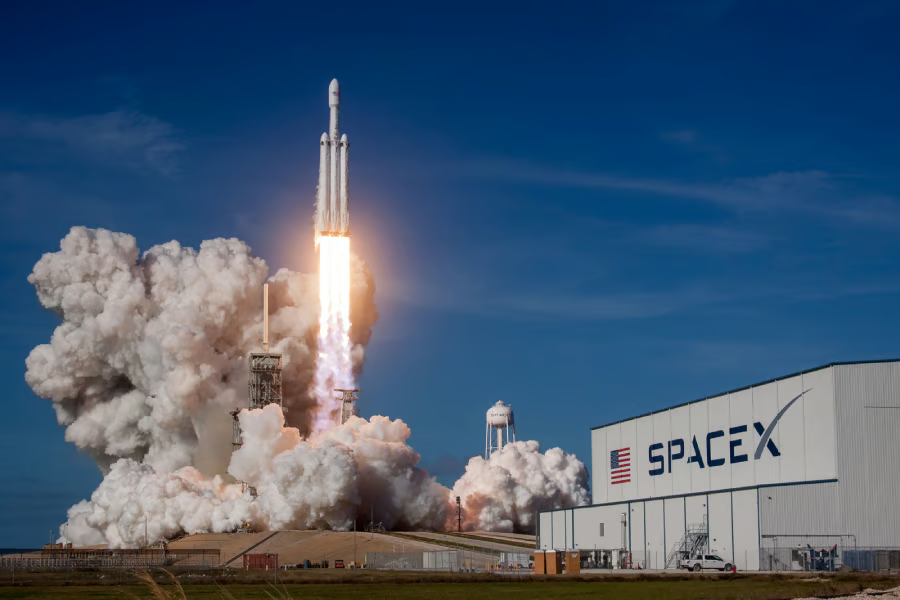
Falcon Heavy debuted in February 2018 as the world’s most powerful operational rocket at the time. Its inaugural mission famously launched Elon Musk’s Tesla Roadster into deep space while two side boosters landed simultaneously.
Why it mattered: Falcon Heavy expanded SpaceX’s ability to launch heavier government, scientific, and commercial payloads.
2019: Starlink begins
SpaceX launched its first large batch of Starlink satellites in 2019, beginning construction of what would become the world’s largest satellite internet constellation.
Since then, Starlink has expanded beyond residential broadband into aviation, maritime, enterprise networking, emergency communications, and direct-to-cell connectivity.
Why it mattered: Starlink gave SpaceX a recurring revenue business that extends well beyond rocket launches.
2020: SpaceX launches NASA astronauts
On May 30, 2020, Crew Dragon Demo-2 carried NASA astronauts Bob Behnken and Doug Hurley to the International Space Station.
It marked the first crewed orbital launch from U.S. soil since the Space Shuttle retired in 2011. NASA details the significance of the Demo-2 mission.
Why it mattered: The mission proved a private company could transport NASA astronauts to orbit, setting up SpaceX’s later operational crewed missions.
2021: NASA selects starship for Artemis
NASA selected SpaceX’s Starship Human Landing System to support the Artemis program’s return to the Moon.
The decision placed Starship at the center of NASA’s long-term lunar exploration plans. NASA announced the Starship Human Landing System award.
Why it mattered: Starship became more than a Mars project. It also became a cornerstone of NASA’s future lunar ambitions.
More about Innovation
- Sovereign AI Explained
- The Rise of the AI-Native Factory
- Why Data Determines AI Success
- SS&C Intralinks DealCentre AI vs. Datasite: Which platform is built for the future of dealmaking?
2022: NASA expands Starship’s role
NASA later exercised an option to support Artemis IV with Starship, reinforcing the agency’s long-term commitment to the vehicle. NASA said the additional award would require SpaceX to develop and demonstrate a Starship lunar lander that meets NASA’s requirements for a crewed Artemis IV landing.
Why it mattered: The follow-on award showed NASA viewed Starship as part of a broader exploration architecture rather than a one-time demonstration.
2023-2026: Starship testing continues
SpaceX accelerated Starship development through a series of increasingly ambitious integrated flight tests.
Although several tests ended unsuccessfully, each generated engineering data that informed the next vehicle iteration. Recent Space.com coverage of Starship testing notes the system remains central to SpaceX’s plans for heavy-lift launches and NASA’s Artemis program.
Why it mattered: Starship represents SpaceX’s biggest technical gamble and could eventually eclipse Falcon 9 if fully reusable operations become routine.
2024-2026: Starlink becomes a global communications platform
SpaceX continued launching Starlink satellites at a rapid pace while expanding the network into aviation, maritime, government, emergency response, and direct-to-cell services.
Why it mattered: Starlink transformed SpaceX from a launch provider into a communications and infrastructure company with recurring global revenue.
2026: SpaceX goes public
SpaceX completed its long-awaited initial public offering in June 2026. Shares debuted at $135, valuing the company at roughly $1.8 trillion, making it one of the largest IPOs ever, according to market reports.
Early trading pushed the stock above its offering price, but shares later pulled back as investors weighed the company’s long-term growth prospects.
Why it mattered: Going public gave investors direct exposure to SpaceX’s launch services, Starlink, and Starship development while placing the company under the scrutiny and expectations of public markets.
What’s next for SpaceX?
SpaceX’s next challenge is making Starship as operationally successful as Falcon 9.
The company still must demonstrate reliable Starship reuse, orbital refueling, and the capabilities needed to support NASA’s evolving Artemis plans. Meanwhile, Falcon 9 and Starlink continue to finance many of SpaceX’s most ambitious projects.
Whether SpaceX ultimately fulfills its vision of returning humans to the Moon, reaching Mars, or building the next generation of global communications infrastructure, its first two decades have already transformed the economics of spaceflight.
Want to see how SpaceX fits into Elon Musk’s bigger strategy? Read our guide to Elon Musk’s AI ecosystem, which explores how SpaceX, xAI, Tesla, Neuralink, and X are increasingly connected.