


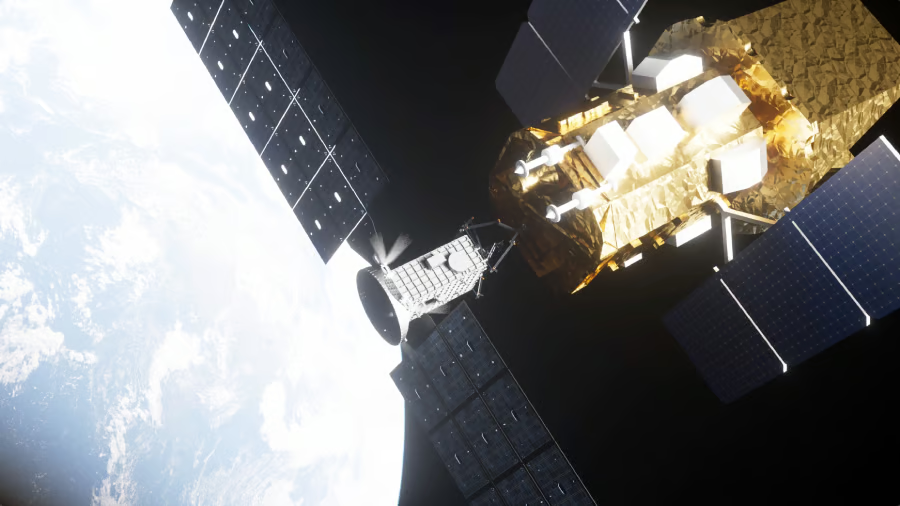
A last-minute space rescue.
NASA is preparing an unusual rescue mission to keep one of its longest-serving space observatories alive rather than letting it burn up in Earth’s atmosphere.
The agency plans to launch Katalyst Space’s LINK robotic servicing spacecraft aboard Northrop Grumman’s Pegasus XL rocket no earlier than July 2, after weather delays. The mission will attempt to rendezvous with NASA’s Neil Gehrels Swift Observatory, capture it using robotic arms, and gradually raise it to a higher orbit over the coming months.
Why Swift needs help
Swift, launched in 2004, was built to rapidly observe gamma-ray bursts and other high-energy cosmic events across visible, ultraviolet, X-ray, and gamma-ray wavelengths. NASA originally expected the observatory to operate for just two years, but it has remained scientifically productive for more than two decades. Its biggest threat now is Earth’s atmosphere.
Although satellites in low Earth orbit experience only slight atmospheric drag, recent solar storms have expanded the upper atmosphere, increasing resistance and causing Swift to lose altitude faster than expected. NASA said the observatory must remain above roughly 185 miles (300 kilometers) for the rescue mission to succeed.
Rather than allowing Swift to re-enter the atmosphere, NASA awarded Arizona-based Katalyst Space a contract in September 2025 to design, build, test and launch a robotic servicing spacecraft in less than a year. According to NASA, extending Swift’s life is cheaper than replacing the observatory and offers an opportunity to demonstrate on-orbit satellite servicing technology.
How the rescue will work
The LINK spacecraft will launch beneath Northrop Grumman’s Stargazer aircraft before the Pegasus XL rocket is released at roughly 40,000 feet, carrying the satellite into orbit.
After initial system checks, LINK will spend several weeks approaching Swift and identifying the safest point to grab the observatory. Using three robotic arms, it will capture the spacecraft before slowly raising its orbit with ion thrusters over a period of months.
If successful, Swift will be returned to an orbit of about 373 miles (600 kilometers), potentially extending its operational life by years. The mission also marks the final planned flight of the Pegasus rocket, a launch vehicle first introduced in 1990 that can reach orbital inclinations difficult to access from conventional launch sites.
What's hot at TechRepublic
- Blackpoint Cyber vs. Arctic Wolf: Which MDR Solution is Right for You?
- Why AWS Sellers Choose Deepgram Over Other Voice AI Tools
- SS&C Intralinks DealCentre AI vs. Datasite: Which platform is built for the future of dealmaking?
- SS&C Intralinks FundCentre AI vs. Juniper Square: Which platform better supports modern private markets fund managers?
- Verito vs. Rightworks: Which IT Provider Is Best for Your Firm?
Why this mission matters
Beyond saving a valuable science mission, NASA sees the effort as a test of technology that could reshape how satellites are maintained.
Instead of replacing aging spacecraft, robotic servicing could extend missions, reduce costs, and eventually support repairs, refueling, and orbital upgrades. According to PBS, Katalyst has said future versions of its spacecraft could eventually service larger observatories, including the Hubble Space Telescope.
NASA also faces a practical challenge. As science mission chief Nicky Fox said, “If we let Swift reenter, we would lose that telescope. We would lose a lot of capability.” She added, “We don’t currently have the budget to build another one to replace that,” PBS reported.
NASA astrophysics division director Shawn Domagal-Goldman also acknowledged the ambitious nature of the project, saying, “I have to be honest. No one thought it was going to be possible. No one thought we would get as far as we’ve already gotten today.”
A turning point for space servicing
The Swift Boost mission is about far more than extending the life of a single telescope. If LINK succeeds, NASA will have demonstrated that commercial companies can rapidly develop robotic servicing missions for government spacecraft at a fraction of the cost of building replacements.
That could influence future mission planning, especially as more valuable satellites age without built-in propulsion or servicing capabilities. The tradeoff, however, is that this remains an unproven approach for US spacecraft. Swift was never designed to be captured by a robot, making the mission technically risky despite its relatively modest $30 million price tag.
Success would validate a new commercial market for in-orbit servicing, while failure would still leave NASA facing the eventual loss of one of its most productive astrophysics observatories.
Also read: Nvidia’s space-ready AI platforms are aimed at orbital data centers, where space hardware could process workloads closer to satellites.