


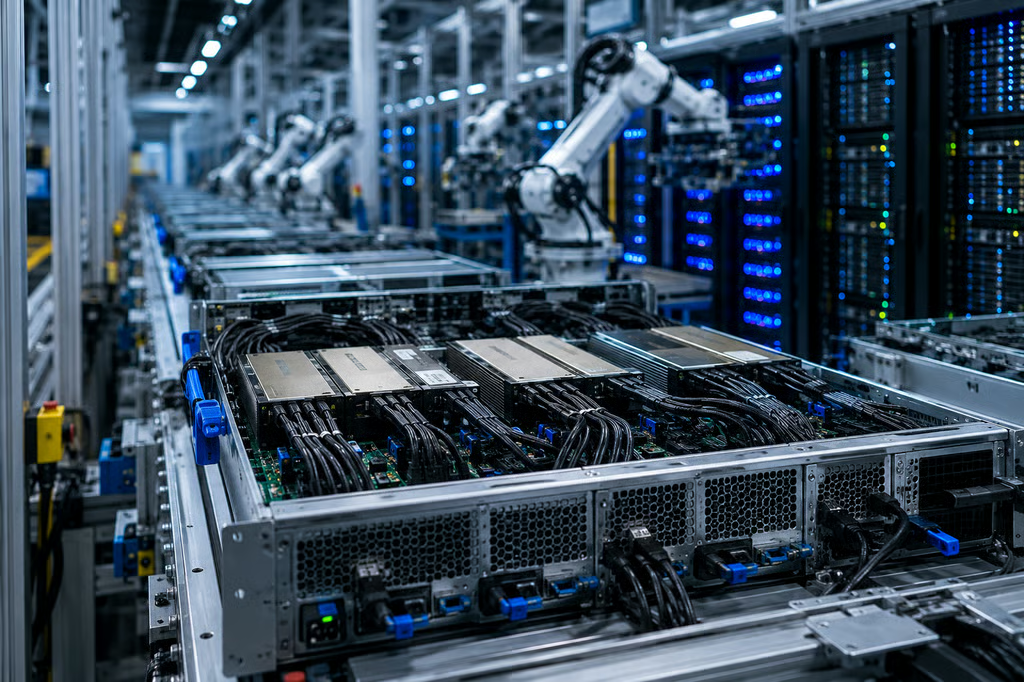
Foxconn’s AI server business is now large enough to reshape the company’s financial results.
Second-quarter net profit rose 35% year over year to NT$59.97 billion, or about $1.86 billion, while revenue jumped 41% to NT$2.526 trillion. Cloud and Networking products, including AI servers, accounted for more than half of revenue for the first time.
The manufacturer expects AI server rack shipments to grow by a high double-digit percentage sequentially in the third quarter and more than double for the full year.
For infrastructure and procurement teams, Foxconn’s results confirm that hyperscaler spending is already reaching manufacturing lines, but stronger production does not guarantee that every rack configuration will be readily available.
AI servers push Foxconn beyond its iPhone-era revenue mix
Once best known as Apple’s largest device assembler, Foxconn now gets a meaningful share of its business from AI hardware.
The Wall Street Journal reported that Foxconn’s NT$59.97 billion quarterly profit also beat the NT$58.22 billion expected by analysts surveyed by FactSet.
Chairman Young Liu said in July that AI infrastructure demand is coming from model developers and cloud providers as well as governments and enterprises. He expects the infrastructure build-out to continue for at least another three to five years, according to the Journal.
Cloud providers remain the largest near-term driver. TrendForce’s latest AI server forecast projects that Google, Amazon, Meta, Microsoft, Oracle, ByteDance, Tencent, Alibaba, and Baidu will spend more than $886.7 billion combined in 2026, roughly 90% more than a year earlier.
The five North American hyperscalers are expected to account for nearly 90% of that spending. TrendForce also raised its forecast for global AI server shipment growth from 28% to nearly 31% this year.
Foxconn’s earnings put a manufacturing result beside those cloud infrastructure spending projections. The capex number measures what major buyers expect to invest; Foxconn’s revenue and profit show that AI hardware demand is already translating into supplier sales.
Procurement pressure moves beyond GPUs
The next wave of racks will not all use the same hardware. TrendForce expects Google to continue expanding its own TPUs, while AWS combines Nvidia systems with its in-house ASICs and Meta uses Nvidia and AMD racks alongside proprietary silicon.
That diversification increases the number of configurations manufacturers such as Foxconn must integrate. It also shifts some of the procurement pressure beyond GPUs to advanced chip packaging, high-bandwidth memory, networking, and other rack components.
Power and cooling are another constraint. New rack-scale AI systems require substantially different facilities than conventional servers, making power and liquid-cooling capacity part of the purchasing decision rather than an afterthought.
Before treating rising production as proof that supply will be easy to secure, buyers should confirm:
- Production status: Is the exact rack configuration already in volume production?
- Component exposure: How dependent is delivery on HBM or advanced packaging capacity?
- Facility readiness: Can the data center provide the required power and liquid cooling?
Foxconn’s latest quarter provides stronger evidence than a spending forecast alone that the AI infrastructure boom is reaching hardware manufacturers.
For enterprise buyers, that also means competition is moving from GPUs toward complete rack capacity, memory, packaging, cooling, and power.
Also read: SpaceX’s exclusive Nvidia chip strategy could simplify AI infrastructure deployment while concentrating supplier and supply-chain risk.