
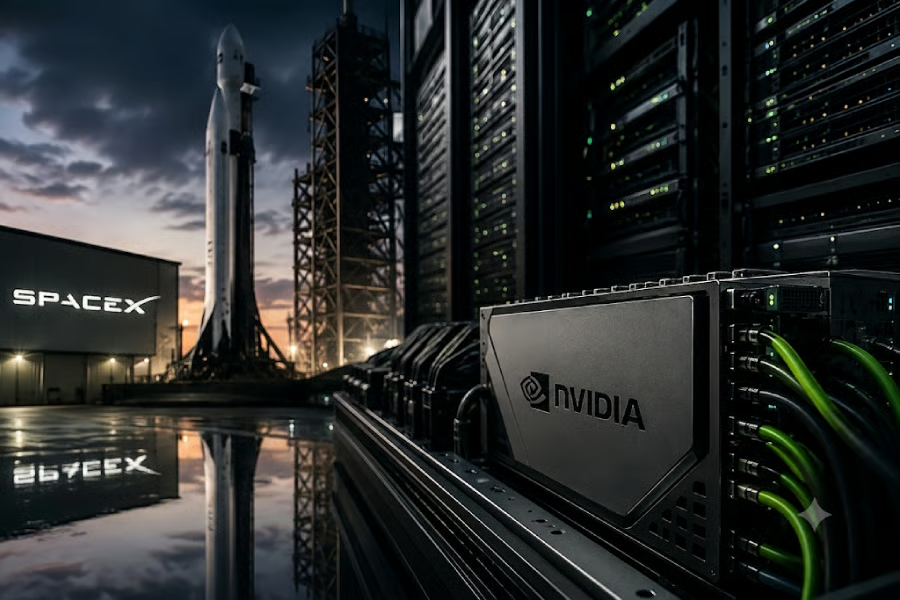


Elon Musk has placed one of the AI industry’s largest infrastructure bets on a single square of silicon.
During SpaceX’s first public earnings call, Musk said the company plans to build its computing infrastructure “exclusively” on Nvidia hardware, praising the chipmaker’s forthcoming Vera Rubin architecture as the best AI computing platform available. He also suggested SpaceX could receive a significant share of Nvidia’s GPU output next year, according to Business Insider.
The announcement sent Nvidia shares higher, but its significance stretches beyond another market-moving Musk endorsement.
SpaceX’s decision illustrates how the AI infrastructure race is pushing even the wealthiest companies toward a difficult trade-off: concentrating spending with the supplier that offers the strongest complete platform while accepting greater exposure to its pricing, product schedule, and supply chain.
Nvidia is selling an ecosystem, not just a chip
SpaceX’s commitment reflects Nvidia’s most formidable advantage. The company does not merely sell graphics processors. It supplies an increasingly integrated computing system encompassing processors, networking equipment, software libraries, development tools, and technical support.
That breadth makes Nvidia difficult for large AI deployments to replace.
A company buying thousands of GPUs is also designing data centers, training workflows, networking systems, and applications around Nvidia’s technology. Engineers become familiar with its software, models are optimized for its hardware, and future expansion becomes easier when it follows the same architectural blueprint.
For an organization scaling as quickly as SpaceX, consistency can be worth more than keeping multiple suppliers in the mix. Standardizing hardware may simplify deployment, reduce compatibility problems, and allow engineers to expand computing clusters without repeatedly adapting software for different chip architectures.
The compromise is dependency.
Once workloads and infrastructure have been deeply optimized for one platform, moving to another supplier becomes more complicated. A competing processor may offer a lower purchase price, but migration expenses, engineering time, software changes, and uncertain performance can erase some of those savings.
SpaceX is therefore making two bets at once: that Nvidia will retain its technical lead and that the benefits of standardization will outweigh the risks of relying on one supplier.
Exclusivity could intensify the fight for AI capacity
SpaceX is not buying GPUs solely to train its own models. Regulatory filings show that the company is turning computing capacity into a commercial business.
One disclosed agreement covers access to infrastructure containing approximately 110,000 Nvidia GPUs, with Google agreeing to pay SpaceX as much as $920 million per month as capacity ramps up, according to a SpaceX SEC filing.
A separate agreement with Anthropic, disclosed in a separate SpaceX SEC filing, involves access to infrastructure containing approximately 325,000 Nvidia GPUs and payments of up to $1.25 billion per month as capacity comes online.
Those arrangements reveal why securing chips has become strategically important. GPUs are no longer simply equipment sitting inside a data center. For companies with enough capital, power, and land, they can become revenue-producing infrastructure leased to businesses that cannot build large AI clusters quickly enough themselves.
SpaceX’s exclusive purchasing strategy could give it a more predictable platform on which to construct that business. It could also increase pressure on organizations already competing for Nvidia’s most advanced systems.
Musk said SpaceX expects to receive a significant share of Nvidia’s GPU output next year, according to Business Insider. The company has not disclosed how large that allocation would be or how it compares with those of other major customers.
The practical concern is not that Nvidia will suddenly run out of every processor. Supply constraints can surface elsewhere, including advanced packaging, memory, networking components, electrical equipment, and data center power. A GPU order may be the headline, but an operational AI cluster depends on an entire industrial chain arriving at roughly the same time.
More must-read AI coverage
- SS&C Intralinks DealCentre AI vs. Datasite: Which platform is built for the future of dealmaking?
- SS&C Intralinks FundCentre AI vs. Juniper Square: Which platform better supports modern private markets fund managers?
- Why Data, Not Models, Determines AI Success
- The Rise of the AI-Native Factory: How Physical AI Is Transforming Manufacturing
AMD faces more than a performance contest
SpaceX’s announcement also highlights the challenge facing Nvidia’s competitors.
AMD and other chipmakers can produce capable AI accelerators, but winning large deployments requires more than matching benchmark results. Buyers need stable software, readily available engineers, dependable networking, deployment support, and confidence that future generations will remain compatible with today’s investment.
That creates a circular advantage for Nvidia. Organizations choose its platform because developers and software already support it, while developers continue prioritizing it because so many organizations use it.
SpaceX’s decision may reinforce that cycle if other large AI infrastructure buyers continue favoring Nvidia’s integrated platform.
It does not mean alternative chips have no opening. Companies wary of supplier concentration may still use multiple architectures, while cloud providers and hyperscalers are developing custom silicon to reduce costs and gain greater control over their infrastructure.
Musk’s own companies are pursuing a similar escape route. SpaceX has identified manufacturing its own GPUs as a potential area of substantial capital spending, according to a Reuters report published by Investing.com that cited company filings. The report also notes that SpaceX, xAI, and Tesla are collaborating on Terafab, a manufacturing system intended to support future AI hardware production.
The apparent contradiction is revealing. A company can commit heavily to Nvidia today while simultaneously trying to reduce that dependence tomorrow.
Building custom chips is not a quick exit
Designing an AI processor is difficult. Manufacturing one at scale is harder.
A custom chip must be paired with software, compilers, networking, memory, cooling systems, and a reliable manufacturing pipeline. Even companies with enormous budgets can spend years developing hardware before it becomes a credible substitute for an established commercial platform.
That makes Nvidia the bridge between the current AI buildout and a more diversified future that may or may not arrive.
For SpaceX, purchasing Nvidia systems offers immediate access to proven infrastructure while its internal hardware ambitions develop. For other organizations, the same strategy may be economically impossible. Few can spend enough to secure favorable access while simultaneously funding a custom-silicon program.
The result could be a divided AI market. A small group of heavily capitalized companies may combine enormous Nvidia deployments with proprietary chips, while smaller organizations rent access through cloud providers and emerging AI infrastructure operators.
In that market, control over computing capacity could matter almost as much as ownership of the models running on it.
The bigger risk is infrastructure concentration
SpaceX’s endorsement is a victory for Nvidia, but it also exposes the fragility beneath the AI boom.
An increasing share of AI development depends on a concentrated collection of chip architectures, manufacturers, memory suppliers, networking companies, and power providers. Standardization accelerates deployment, yet it also means that a manufacturing delay, pricing shift, technical flaw, or geopolitical disruption can ripple across many businesses at once.
Organizations evaluating AI infrastructure should therefore look beyond raw GPU performance. Availability, software portability, energy requirements, networking, contract flexibility, and the cost of eventually switching platforms may be equally important.
SpaceX can afford to make an exclusive commitment and revisit the decision later. Most companies will have less room to maneuver.
That is the quieter message behind Musk’s declaration. Nvidia’s lead is no longer defined only by how fast its chips can train a model. It is increasingly defined by how difficult the entire system is to leave.
Related reading: Musk’s Nvidia bet follows his acquisition of APR Energy, another move to secure the infrastructure powering xAI’s expansion.