


Apple’s most ambitious iPhone redesign in years may not be dead. It may simply have collided with the realities of building hundreds of millions of phones.
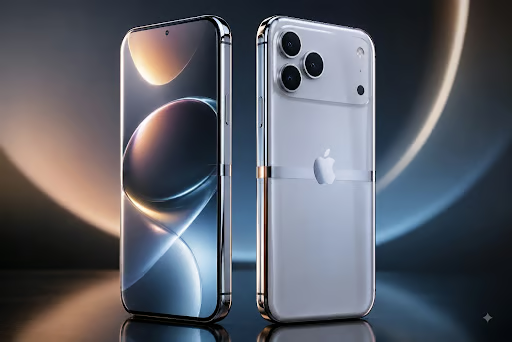
Apple is still developing a glass-centric overhaul of the iPhone for 2027, according to new reporting from Bloomberg, contradicting an analyst report that suggested the project had been canceled. The planned Pro models reportedly feature glass that curves from the front and back toward the sides, separated by a metal band.
That distinction matters. According to Bloomberg, Apple scrapped an earlier, more radical glass-heavy concept, but its broader anniversary redesign remains in development. The gap between those two concepts offers a revealing look at the challenge facing Apple as it tries to make the iPhone feel genuinely new again.
Apple’s ‘all-glass’ iPhone may have been too ambitious to manufacture
The confusion stems from two different versions of Apple’s reported plans.
Jefferies analyst Edison Lee recently downgraded Apple and argued that the company had canceled an anticipated all-glass anniversary iPhone because of poor manufacturing yields. Barron’s reported that Lee viewed the cancellation as a setback for Apple’s efforts to introduce more expensive iPhones as component costs rise.
Bloomberg’s reporting paints a more nuanced picture.
Apple reportedly explored a more extreme design that would have replaced even more of the phone’s metal structure with glass. But that version ran into problems connecting the glass panels and reportedly could not meet the requirements of large-scale production.
The 2027 iPhones still in development, reportedly known internally as V73 and V74, are less radical. Glass is expected to cover the front and back and curve toward the sides, while a metal band remains in the middle.
In other words, Apple reportedly abandoned the more futuristic prototype. The broader design direction appears to have survived.
Why Apple’s 2027 iPhone could feel different
For Apple, 2027 carries symbolism that an ordinary iPhone cycle does not.
The original iPhone debuted in 2007. Ten years later, Apple introduced the iPhone X, eliminating the Home button, introducing Face ID and pushing the screen much closer to the edges of the device.
Apple explicitly positioned that redesign as the start of something bigger. In Apple’s original iPhone X announcement, then-design chief Jony Ive described the device as the realization of Apple’s decade-long ambition to create an iPhone that was “all display.” Phil Schiller separately called the iPhone X the beginning of the next 10 years for the iPhone.
Twenty years after the original iPhone, Apple faces a similar challenge: finding a visual and functional idea big enough to define another era.
Incremental improvements to cameras, chips and battery life can give existing customers reasons to upgrade, but they do less to change how consumers perceive the device itself. A dramatically different physical design could give Apple something increasingly difficult to create in a mature smartphone market: obvious novelty.
There is also a financial dimension. Apple reported a March-quarter record for iPhone revenue earlier this year. Apple’s fiscal second-quarter results show that the franchise remains enormously valuable even without a radical redesign. But that scale makes successful experimentation more difficult, not less.
A design that works beautifully in a prototype has to survive drops, heat, repairs, cases, wireless charging and years of everyday use. More importantly, Apple must be able to manufacture it reliably at extraordinary volume.
That may explain why the surviving design is more interesting than the reportedly scrapped one. Apple appears to be searching for a balance between the visual simplicity of an almost uninterrupted glass device and a design its supply chain can reliably produce at iPhone scale.
What the glass redesign could mean for users
Previous reports have suggested Apple wants the 2027 model to appear almost borderless, with a display that curves around all four edges. Reports have also pointed to thinner OLED technology and techniques intended to minimize the visibility of the bezels.
If those reports prove accurate, Apple could achieve the visual effect of an uninterrupted slab of glass without literally constructing the phone that way. It would be a familiar Apple maneuver: make complicated engineering disappear behind a simpler physical experience.
And that may ultimately matter more than whether analysts can accurately describe the device as “all glass.”
The iPhone X was transformative not because its chassis contained a particular percentage of glass, but because its display, Face ID and gesture-based interface worked together to make the old Home-button design suddenly look dated.
Apple will need a similarly convincing trick in 2027.
The smartphone market is far more mature than it was a decade ago, and annual upgrades increasingly revolve around refinement rather than reinvention. Better cameras, faster chips and longer battery life remain valuable, but they rarely change how people think about what a smartphone can be.
That is why the fate of Apple’s more ambitious glass prototype matters beyond one reportedly abandoned design. If Apple scaled back the concept because it could not manufacture it reliably, the decision highlights the tension at the center of modern consumer technology: breakthrough designs still have to survive the unforgiving economics of mass production.
Apple does not need to ship the most futuristic iPhone its designers can imagine. It needs to build one that looks futuristic while remaining durable and manufacturable at iPhone scale.
For a company preparing to mark 20 years of its most important product, that distinction could determine whether the anniversary iPhone feels like another upgrade or the beginning of Apple’s next smartphone era.
Related reading: Thinking about upgrading before 2027? See how much your current iPhone, Mac, or iPad could be worth with Apple’s latest trade-in values.