


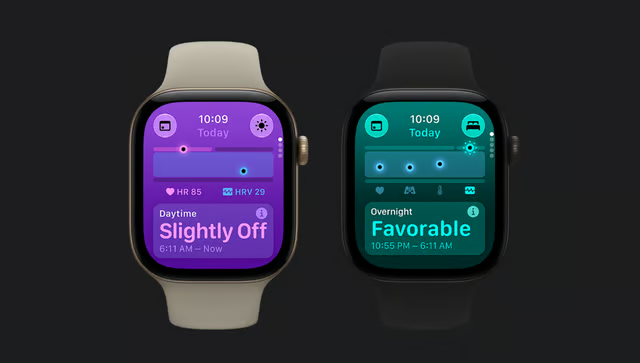
Apple Watch Series 12 keeps the familiar design, but the bigger changes are in health tracking, AI features, charging, and everyday wear.
The differences become noticeable during a workout, through a workday, or overnight. Some affect the information you get from the watch, and others affect how long you can keep wearing it before reaching for the charger.
Our Apple Watch Series 12 cheat sheet covers the key updates, current pricing, available configurations, and what to consider before choosing one.
Apple Watch Series 12 at a glance
| Launch | September 18, 2026 |
| Starting price | $399 |
| Case sizes | 42mm and 46mm |
| Case materials | Aluminum, titanium, or ceramic |
| Display | Always-On Retina display, wide-angle OLED, LTPO3, 1 to 2,000 nits |
| Processor | S11 with 64-bit dual-core processor and 4-core Neural Engine |
| Storage | 64GB |
| Battery | Up to 24 hours normal use, up to 38 hours in Low Power Mode, up to 10 hours of workout tracking |
| Charging | Up to 80% in about 30 minutes, 15 minutes for up to 12 hours of normal use |
| Health features | Health Sensing System, high-frequency heart-rate tracking, Recovery HRV, daytime and overnight Vitals, readiness |
| AI | Siri AI and Audio Intelligence |
| Water and dust resistance | Water resistant to 50 meters, IP6X dust resistant |
| Connectivity | Wi-Fi 4, Bluetooth 5.3, Precision L1 GPS, second-generation Ultra Wideband, 5G RedCap and LTE on cellular models |
| Compatibility | iPhone 11 or later, including iPhone SE 2nd generation or later, with iOS 27 or later |
Source: Apple Watch Series 12 technical specifications
What are the key features of Apple Watch Series 12?
Apple’s latest smartwatch concentrates its biggest updates in health sensing, AI, battery and charging, physical design, and connectivity. Each area affects a different part of daily wear, from how often the watch checks your heart rate to how long you can stay away from a charger.
Health, fitness, and readiness
Series 12 keeps many existing Apple Watch health tracking tools across health, sleep, fitness, safety, cycle tracking, and water activities.
| Heart and health | ECG, Blood Oxygen where available, high and low heart-rate notifications, irregular rhythm notifications, hypertension notifications, wrist temperature sensing |
| Sleep | Sleep stages, sleep score, sleep apnea notifications, overnight Vitals |
| Fitness | Activity tracking, Training Load, Heart Rate Zones, running metrics, cycling metrics, swimming, custom workouts |
| Cycle tracking | Period tracking, fertile-window estimates, retrospective ovulation estimates, perimenopause and menopause tools |
| Safety | Emergency SOS, international emergency calling, Fall Detection, Crash Detection, Check In, Backtrack |
| Water activities | Pool and open-water swimming, depth sensing to 6 meters, water-temperature sensing |
Series 12 changes how frequently some health data is collected and adds new ways to interpret recovery.
The redesigned Health Sensing System can take heart-rate readings as often as every five seconds, while HRV is measured more frequently than before. Recovery HRV focuses on shorter-term recovery, and Daytime Vitals brings resting heart rate and HRV into daytime tracking.
Readiness combines activity, Training Load, Vitals, and sleep into a score from 0 to 10. It requires at least seven nights of overnight Vitals data and is intended as a general wellness indicator rather than medical guidance.
A readiness score needs at least seven nights of overnight Vitals data, Sleep enabled, and the watch worn the previous night. It is a general wellness feature and should not be used by itself to decide if exercising is medically safe. Apple’s readiness guide has the setup details and limitations.
Siri AI and Audio Intelligence
Siri AI can use personal context from apps including Messages, Mail, Calendar, Notes, and Reminders, answer general questions, understand content on screen, and take actions across compatible apps. Conversation history can sync through the dedicated Siri app so someone can continue a conversation started on another Apple device.
Basic compatibility starts with iPhone 11 or later, but Siri AI needs an Apple Intelligence-capable iPhone. The feature remains in beta and is available in English, with regional limits in some markets.
Audio Intelligence is limited to Series 12 and Ultra 4.
| Sound Recognition | Detects sounds including alarms, sirens, and doorbells | Alerts you to an important sound even when your iPhone is not nearby |
| Music Recognition | Uses Shazam to identify music automatically | Displays a song and artist in the Smart Stack without opening Shazam manually |
| Live Rewind | Retrieves a text snippet from the previous 15 seconds of conversation | Lets you catch a sentence or instruction you just missed |
| Siri Recap | Creates high-level AI summaries of conversations | Offers a short reminder of what was discussed without writing notes yourself |
Privacy becomes more important once a watch listens for nearby sounds. Audio Intelligence privacy controls keep raw audio inside a protected buffer in the S11 chip’s Secure Exclave and delete it after processing. Saved Live Rewind snippets and Siri Recap summaries can sync through iCloud with end-to-end encryption.
Live Rewind and Siri Recap have stricter iPhone eligibility than the other Audio Intelligence features. Apple warns that generated snippets and summaries can be incomplete or inaccurate, so important details still need to be checked.
Battery, charging, and wearing it overnight
Series 12 is rated for up to 24 hours of normal use or 38 hours in Low Power Mode. Regular charging remains part of ownership, though fast charging creates several short windows for topping it up.
- During a normal day. A 15-minute charge provides up to 12 hours of normal use. A short charging session during breakfast, a shower, or another break can cover a large part of the day.
- If you wear it to sleep. Five minutes can provide enough power for up to 10 hours of sleep tracking. Anyone who wants overnight health data can top up the watch before bed without taking it off for long.
- During long workouts. Workout tracking lasts up to 10 hours. Runners, cyclists, hikers, and endurance users get more time before charging becomes an issue.
A full fast-charge session can take the battery to 80% in about 30 minutes. Actual endurance varies with cellular use, display activity, apps, and settings.
Design, display, and durability
You can choose between 42mm and 46mm sizes plus aluminum, titanium, and ceramic cases.
Aluminum is the lightest material. A 42mm GPS aluminum model weighs 32.2 grams, and the 46mm version weighs 39.5 grams. Titanium adds some weight, and ceramic is heavier again, reaching 52.9 grams for the 46mm Night Blue version. Weight can be noticeable during sleep or long stretches of wear.
Display area increases from 970 square millimeters on the 42mm model to 1,196 square millimeters on the 46mm version. Both use Apple’s Always-On Retina wide-angle OLED display with LTPO3, a 1Hz minimum refresh rate, and brightness ranging from 1 nit to 2,000 nits.
Lower brightness suits darker rooms, and the 2,000-nit peak supports outdoor readability. A larger screen provides more space for messages, complications, workout data, and touch controls.
Case material also changes the front glass. Apple says Ceramic Shield 2 on aluminum versions is 60% tougher than the Ion-X glass on Series 11. Titanium and ceramic versions use sapphire front crystal.
Water resistance reaches 50 meters, with IP6X dust resistance as well. Swimming and recreational snorkeling are supported, and a depth gauge works to 6 meters. Scuba diving falls outside its intended use, though.
Connectivity and iPhone compatibility
Every model includes Wi-Fi 4, Bluetooth 5.3, Precision L1 GPS, second-generation Ultra Wideband, Apple Pay, and GymKit. Cellular versions add 5G RedCap and LTE.
Built-in GPS can record workout distance, pace, and routes without an iPhone. A GPS-only watch still relies on a nearby iPhone or Wi-Fi connection for many communication features.
GPS + Cellular models can handle calls, messages, notifications, and supported streaming without the phone nearby when an eligible carrier plan is active.
Base compatibility starts with iPhone 11 or later, including the second-generation iPhone SE or newer, running iOS 27. Owners of older Apple Watches may also need to account for watchOS 27 compatibility when deciding whether to keep an existing model or upgrade. Some AI tools need newer iPhone hardware even though the watch can pair with an older compatible model.
How much does Apple Watch Series 12 cost, and when is it available?
Apple Watch Series 12 went on sale Sept. 2026. Current US starting prices are listed below.
| 42mm aluminum | |
| 46mm aluminum | |
| Titanium | |
| Ceramic |
Final pricing varies with case size, connectivity where offered, and band choice.
Which Apple Watch Series 12 should you choose?
Once price and features are settled, choosing a Series 12 mostly comes down to fit, phone-free use, and how much you want to spend on the case.
42mm or 46mm?
Pick 42mm if you prefer a smaller watch or expect to wear it overnight often. Pick 46mm if extra screen space is more important.
Both sizes have the same core features, so trying them on is a better way to decide than comparing specifications alone.
GPS or GPS + Cellular?
GPS is the simpler choice if your iPhone is usually nearby.
GPS + Cellular is worth considering if you regularly leave your phone behind and still want calls, messages, or streaming from your wrist. Factor in any recurring carrier charge before paying extra for it.
Aluminum, titanium, or ceramic?
Aluminum keeps the price and weight down. Titanium and ceramic are mainly choices for users who want different materials, finishes, and front glass.
Health sensing, performance, and battery ratings stay the same regardless of case material, so paying more does not unlock a more capable Series 12.
Who should consider Apple Watch Series 12?
First-time Apple Watch buyers
If you’re buying your first Apple Watch and want richer health tracking than SE 3 offers, you may find Series 12 to be the best middle option in Apple’s lineup. It brings the new Health Sensing System, readiness, Audio Intelligence, premium materials, and a brighter display without moving to the larger Ultra 4 case.
Existing Apple Watch owners
People moving from an older Apple Watch can pick up several generations of updates at once. Improvements in health tracking, software support, display quality, charging, and watchOS features can add up to a noticeably different experience.
Series 11 owners have less reason to upgrade after only one generation. Readiness, higher-frequency health readings, Audio Intelligence, and the new material options need to matter enough to justify the cost.
Buyers comparing SE 3 and Ultra 4
SE 3 remains the lower-cost route into Apple Watch. Ultra 4 suits users who want longer battery life, dual-frequency GPS, satellite capabilities, scuba support, or a rugged 49mm case. Series 12 fits between them with the standard Apple Watch form and a more advanced feature set than SE 3.
Must-read Apple coverage
- Nearly 7 in 10 iPhone Owners Plan iPhone 17 Upgrade
- Apple Prepares AI-Powered Siri Upgrade With Google Search Integration
- Apple’s Xcode 26 Beta Now Supports GPT-5 and Claude
- Apple’s Vision Pro Adoption Stalled As Content Released ‘Drip by Drip’
What’s next for Apple Watch Series 12?
Some software announced with the watch is still on the way.
Live Rewind and Siri Recap are scheduled to enter beta later in 2026, beginning in English. Additional languages are planned afterward.
A redesigned Health app is also expected later in 2026. A Longevity tab will include Health Age, which compares selected health metrics with chronological age. An Insights tab will bring heart health, sleep, readiness, fitness, Vitals, and cycle tracking into one place. Rollout details are available in Apple’s health and fitness announcement.
Future software can expand the Apple Watch experience, but a purchase decision is better based on the features available today.
Improve the way you prompt AI with our free six-minute How to Talk to AI course from The Neuron Academy. Learn simple techniques for getting more useful responses, then explore other AI courses free for seven days. Check out all the lessons here →