


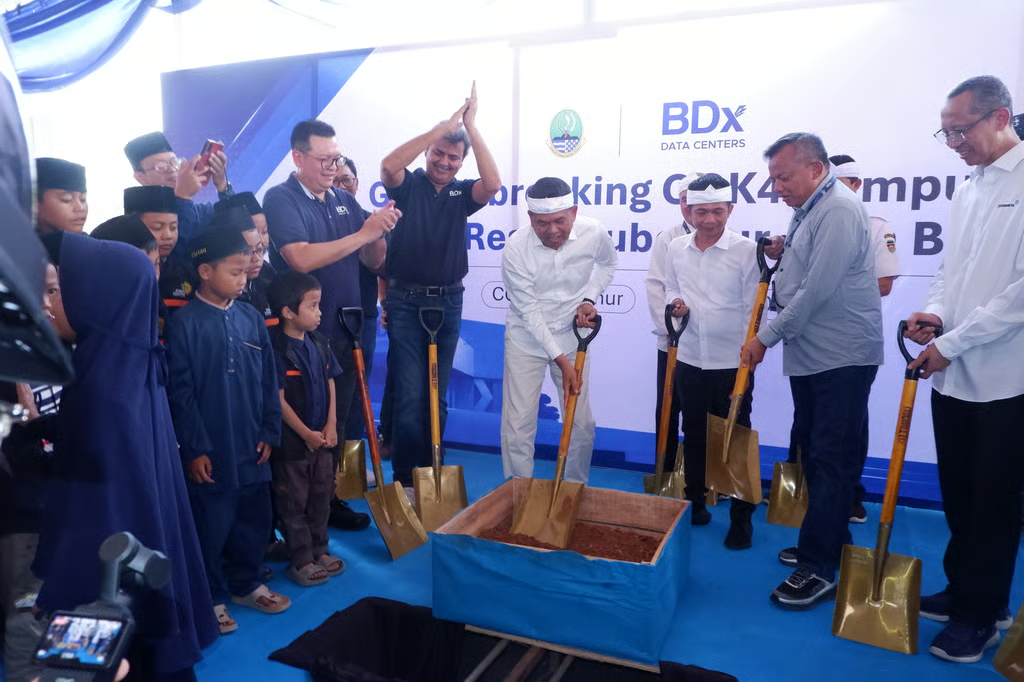
A planned 640-megawatt AI data center in Indonesia remains on hold as authorities scrutinize its water requirements and outstanding permits.
West Java officials are reviewing water requirements for BDx Data Centers’ proposed AI campus near Jatiluhur Reservoir, where construction was suspended in September over incomplete environmental and building approvals. Independent specialists have been consulted to examine the project’s potential impact on local water resources.
The review comes as Indonesia attracts investment in domestic AI computing capacity. Permitting delays could affect when that infrastructure becomes available to enterprises planning regional deployments.
Water review tests reservoir capacity
The six-building campus, known as AI Campus 2 or CGK4, could eventually require approximately 384 liters of water per second, or 33,000 cubic meters daily, according to the Institute for Essential Services Reform (IESR). The figure represents projected full-scale demand, not current consumption.
Jatiluhur Reservoir supplies water for communities and agricultural irrigation in West Java, making the proposed withdrawal particularly sensitive.
In an October 1 provincial government statement, Governor Dedi Mulyadi said Purwakarta’s municipal water utility has an allocation of 3,000 liters per second. He estimated BDx would require about 380 liters per second, which officials believe could be accommodated without disrupting existing supplies.
However, an October 5 environmental review discussion cited a smaller operational requirement of 27 liters per second. Officials described a nearby water-supply system with 120 liters per second of permitted capacity, of which approximately 70 liters per second was already being used.
The figures appear to concern different supply arrangements or development stages, but their relationship has not been fully clarified. The environmental assessment must establish projected withdrawals and potential effects on existing users, including during dry periods. Similar concerns have prompted operators such as Google to consider alternatives to water-intensive cooling.
The provincial government has consulted a University of Indonesia professor and researchers from Indonesia’s National Research and Innovation Agency to help evaluate the environmental assessment.
Construction began in September but was suspended after Mulyadi identified missing approvals. The West Java government confirmed that the environmental impact assessment (AMDAL) and building approval (PBG) had not been issued.
Permits complicate Indonesia’s AI expansion
BDx has secured 845 megavolt-amperes of grid capacity from state utility PLN, according to its September 22 announcement. The first building is designed for 120 MW of IT capacity in phases, using direct-to-chip liquid cooling.
The announcement does not detail the campus’s complete water-reuse arrangements. IESR has also requested greater transparency about electricity sourcing and grid reliability.
Indonesia continues attracting AI infrastructure investment. Zankore secured financing of up to $3.1 billion for Nvidia-powered AI infrastructure beginning in Indonesia. Neighboring Malaysia has also attracted commitments, including OpenAI’s agreement for capacity at two Firmus facilities.
Communications and Digital Minister Meutya Hafid called for cross-sector assessment of data center locations on October 7, including electricity and water availability, according to Katadata.
BDx still targets early 2027 for its first contracted phase, subject to approvals, The Straits Times reported. Purwakarta’s permitting decisions will determine when construction can resume and whether that timetable remains achievable.
Want to learn more AI tips, tricks, and prompting techniques? Let us teach you How to Talk to AI for free! Try our six-minute course at The Neuron Academy, our practical learning platform designed to help professionals use AI more confidently at work.
Learn a few simple ways to write better prompts and get more useful results from AI, or browse our other AI course for free for seven days. eWeek readers get free 7-day access. Check out all the lessons here →