
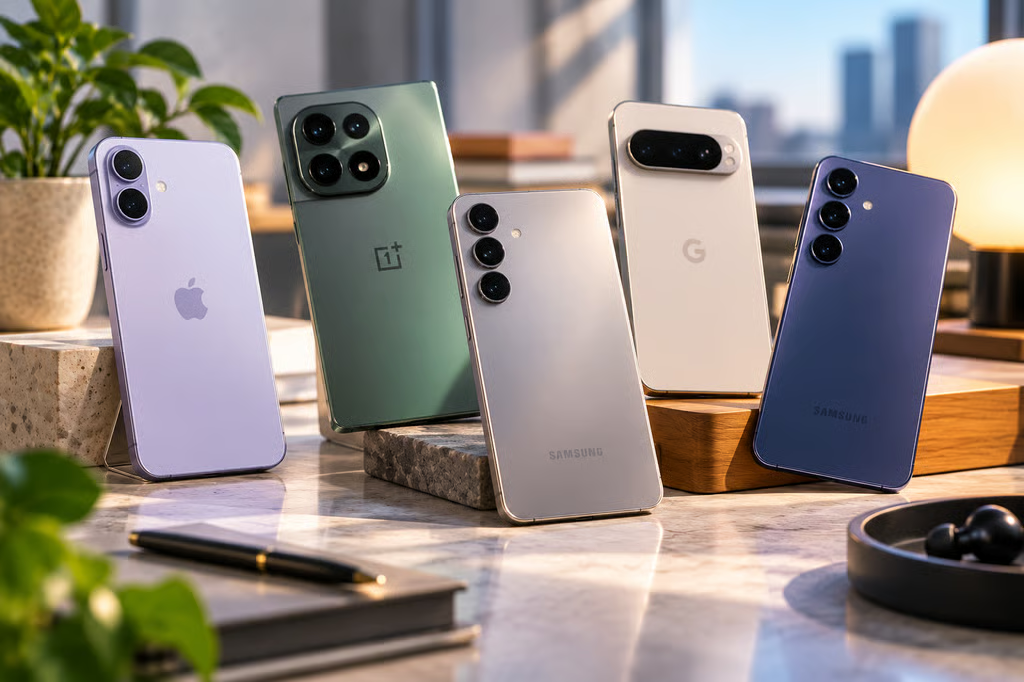


Apple’s iPhone 18 Pro starts at $1,199, pushing its latest Pro phone well beyond a $1,000 budget before accessories, AppleCare+, or carrier service enter the picture.
Spending less does not mean dropping to an entry-level phone. Current models below $1,000 include Apple’s previous-generation iPhone, Android flagships with 256GB of storage, a phone with exceptional battery life, and lower-cost Samsung hardware with long software support.
The five picks below all have manufacturer pricing below $1,000 in the US before trade-ins or carrier promotions.
- Best iPhone 18 Pro alternatives under $1,000 at a glance
- How we chose the best iPhone 18 Pro alternatives
- 1. Apple iPhone 17: Best for staying with iOS
- 2. OnePlus 15: Best for battery life
- 3. Samsung Galaxy S26: Best compact Android flagship
- 4. Google Pixel 11: Best for AI and long software support
- 5. Samsung Galaxy S26 FE: Best lower-cost Samsung option
- Which iPhone 18 Pro alternative should you buy?
Best iPhone 18 Pro alternatives under $1,000 at a glance
| Phone | Price | Display | Base storage | Processor |
|---|---|---|---|---|
| Apple iPhone 17 | $899 | 6.3-inch OLED, up to 120Hz | 256GB | A19 |
| OnePlus 15 | $899.99 | 6.78-inch LTPO, up to 165Hz | 256GB | Snapdragon 8 Elite Gen 5 |
| Samsung Galaxy S26 | $899.99 | 6.3-inch AMOLED, up to 120Hz | 256GB | Snapdragon 8 Elite Gen 5 for Galaxy |
| Google Pixel 11 | $899 | 6.3-inch OLED, up to 120Hz | 256GB | Tensor G6 |
| Samsung Galaxy S26 FE | $699.99 | 6.7-inch AMOLED, up to 120Hz | 128GB | Exynos 2500 |
Prices checked September 23, 2026. Promotions, trade-ins, and carrier offers can change.
How we chose the best iPhone 18 Pro alternatives
To qualify, a phone had to be currently available to US buyers with a manufacturer list price below $1,000. Temporary trade-in credits and carrier promotions did not determine eligibility.
The main buying criteria are:
- Performance: Processor speed, graphics performance, memory, and how well the phone handles demanding apps, games, multitasking, and longer workloads.
- Battery life: Measured runtime where comparable testing is available, plus battery capacity and charging options.
- Display: Screen size, resolution, refresh rate, brightness, and whether the phone is comfortable for work, video, reading, and outdoor use.
- Cameras: Main, ultrawide, and telephoto hardware, along with practical photo and video capabilities.
- Storage: Base capacity, available upgrades, and whether moving to more storage pushes the phone past the $1,000 limit.
- Software support: OS upgrades and security support affect how long a phone can reasonably stay in service.
- Productivity: Cross-device integration, desktop features, AI tools, connectivity, and compatibility with existing equipment can matter as much as raw specifications.
- Value: Each phone needs to offer a meaningful reason to spend less than the iPhone 18 Pro rather than simply being cheaper.
The best choice depends on which iPhone 18 Pro features you are willing to give up. None of these models reproduces Apple’s A20 Pro performance, variable-aperture camera, and Apple ecosystem integration at a lower price.
1. Apple iPhone 17: Best for staying with iOS
The Apple iPhone 17 now starts at $899 with 256GB of storage, keeping buyers in iOS while saving $300 compared with the iPhone 18 Pro.
Its 6.3-inch Super Retina XDR display includes ProMotion with an adaptive refresh rate up to 120Hz, an Always-On display, and up to 3,000 nits of rated outdoor brightness. The A19 chip pairs a six-core CPU with a five-core GPU and 16-core Neural Engine.
Apple also gives the iPhone 17 a 48MP main camera and 48MP ultrawide, along with a 2x optical-quality telephoto option from the main sensor. What it does not have is the iPhone 18 Pro’s dedicated telephoto camera, variable-aperture main camera, or A20 Pro processor.
The current $899 price is $100 higher than its original launch price. Apple raised older iPhone prices after introducing the iPhone 18 lineup, reducing the savings buyers normally expect from choosing the previous generation.
In Tom’s Guide testing, the iPhone 17 recorded 12 hours and 47 minutes of battery life and reached 71% charge after 30 minutes. Its Geekbench 6 scores of 3,701 single-core and 9,460 multi-core remain strong for everyday work, games, and creative apps.
The iPhone 17 is the simplest alternative for buyers who want to keep iMessage, FaceTime, AirDrop, Apple Watch integration, and the wider Apple ecosystem without paying for the newest Pro hardware.
2. OnePlus 15: Best for battery life
The OnePlus 15 starts at $899.99 for 12GB of RAM and 256GB of storage, while the 16GB/512GB configuration is priced at $999.99.
It uses Qualcomm’s Snapdragon 8 Elite Gen 5 processor and a 6.78-inch LTPO display that can reach 165Hz in supported games. Storage uses UFS 4.1, and the phone includes Wi-Fi 7 and Bluetooth 6.
Battery capacity is the standout specification. The 7,300mAh silicon-carbon battery supports 80W wired charging in the US and 50W wireless charging.
That large cell also delivered exceptional measured endurance. Tom’s Guide recorded 25 hours and 13 minutes in its battery test, with the phone reaching 81% after 30 minutes of wired charging.
The camera system includes three 50MP rear cameras covering main, ultrawide, and 3.5x optical telephoto shooting. OnePlus also supports 4K 120fps Dolby Vision recording.
Its software experience will be a bigger adjustment for anyone moving from an iPhone, and OnePlus does not match Google or Samsung’s seven-year Android update commitments. Buyers prioritizing battery life, fast charging, gaming performance, and hardware for the money get considerably more capacity than Apple’s Pro phones provide.
3. Samsung Galaxy S26: Best compact Android flagship
The Samsung Galaxy S26 starts at $899.99 with 256GB of storage and 12GB of RAM.
Its 6.3-inch AMOLED display keeps the phone close to the iPhone 18 Pro in physical size while providing an adaptive refresh rate up to 120Hz. Samsung uses the Snapdragon 8 Elite Gen 5 for Galaxy processor and offers 256GB and 512GB storage configurations.
The rear camera system includes a 50MP main camera, 12MP ultrawide, and 10MP telephoto with 3x optical zoom. That gives the S26 a dedicated telephoto camera without moving to Samsung’s much larger Ultra model.
Samsung also commits to seven generations of OS upgrades and seven years of security updates from the Galaxy S26 series’ global launch.
Battery life is less impressive. Tom’s Guide measured 11 hours and 28 minutes in its battery test from the 4,300mAh battery, shorter than the iPhone 17 and Pixel 11 in the same comparison.
The Galaxy S26 works well for buyers who want a compact Android flagship with long software support, a dedicated telephoto camera, Galaxy AI, and Samsung’s broader device ecosystem without paying $1,299.99 for the Galaxy S26 Ultra.
4. Google Pixel 11: Best for AI and long software support
The Google Pixel 11 has an $899 list price and starts with 256GB of storage and 12GB of RAM.
Google uses its Tensor G6 processor with a 6.3-inch OLED display that runs from 60Hz to 120Hz. The screen is rated for up to 3,000 nits of peak brightness, while the 4,985mAh battery supports wired charging and Qi2.2 wireless charging.
Google raised the Pixel 11 starting price by $100 over the Pixel 10 while also doubling the base storage from 128GB to 256GB.
Software longevity is a major advantage. Google guarantees seven years of OS and security updates for the Pixel 11, along with Pixel Drop feature updates during the support period.
The Pixel line also puts Google’s Gemini features and computational photography near the center of the experience. Buyers interested in AI tools get Google’s newest software without moving up to the $1,099 Pixel 11 Pro.
There are performance and battery trade-offs. Tom’s Guide measured 12 hours and 45 minutes of battery life and found only modest Tensor G6 performance improvements over the previous generation.
The Pixel 11 is best suited to buyers prioritizing Google’s software, AI tools, camera processing, and long update commitment over maximum gaming performance or battery endurance.
5. Samsung Galaxy S26 FE: Best lower-cost Samsung option
The Samsung Galaxy S26 FE starts at $699.99 for 128GB of storage, while the 256GB model costs $799.99.
Its 6.7-inch Dynamic AMOLED 2X display supports a 120Hz refresh rate, and the phone uses Samsung’s Exynos 2500 processor with 8GB of RAM.
The rear camera system combines a 50MP main camera, 12MP ultrawide, and 8MP telephoto with 3x optical zoom. Samsung also includes a 4,900mAh battery, 45W wired charging, IP68 water and dust resistance, and wireless charging.
Software support matches Samsung’s more expensive S26 models. The company promises seven major Android OS upgrades and up to seven years of security updates.
The lower price brings compromises. Base storage drops to 128GB, RAM falls to 8GB, and the Exynos 2500 cannot match the performance of the Snapdragon processor in the standard Galaxy S26.
At $699.99, the FE sits above the sub-$500 budget class but saves $200 compared with the Galaxy S26 and $499 compared with the iPhone 18 Pro.
The Galaxy S26 FE fits buyers who want a larger Samsung display, telephoto camera, Galaxy AI features, and long software support without spending close to $900.
Which iPhone 18 Pro alternative should you buy?
| Best for | Pick | Reason |
|---|---|---|
| Staying with iOS | Apple iPhone 17 | Keeps Apple’s ecosystem, 256GB base storage, and a 120Hz display for $300 less |
| Battery life | OnePlus 15 | 7,300mAh battery and 25-hour-plus measured runtime |
| Compact Android flagship | Samsung Galaxy S26 | 6.3-inch design, telephoto camera, and seven years of support |
| AI and software support | Google Pixel 11 | Gemini features, 256GB base storage, and seven years of updates |
| Lower-cost Samsung option | Samsung Galaxy S26 FE | $699.99 price, 6.7-inch display, telephoto camera, and long support |
Choose the iPhone 17 if staying inside Apple’s ecosystem is more important than getting the newest Pro camera and processor. The $899 price is higher than it was at launch, but it remains the only option here that keeps iOS and Apple’s cross-device features.
The OnePlus 15 provides much longer tested battery life, while the Galaxy S26 offers a smaller Android flagship with a dedicated telephoto camera. Pixel 11 puts more emphasis on Google AI and long software support, and Galaxy S26 FE cuts the price further while retaining many of Samsung’s core features.
All five stay below $1,000 at standard manufacturer pricing. The decision comes down to which iPhone 18 Pro features matter enough to pay another $200 to $500 for them.
Also read: Our iPhone 18 Pro vs Galaxy S26 Ultra comparison covers the premium flagships above this guide’s $1,000 limit.