


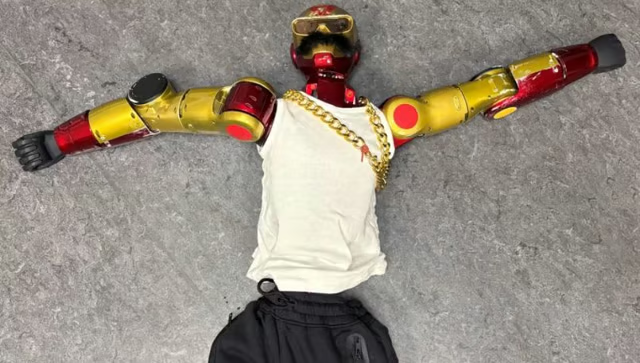
German police have seized a humanoid robot after it allegedly touched a 16-year-old girl inappropriately on a street in Cologne, raising questions about who was controlling the machine.
According to Cologne police, the incident occurred shortly before midnight on Oct. 10 outside a fast-food restaurant on Hohenzollernring. Investigators confiscated the red-and-gold robot and two mobile phones while examining whether its movements were remotely controlled.
The approximately 4-foot-tall machine allegedly approached the girl from behind outside a fast-food restaurant on Hohenzollernring, touched her buttocks and made repeated thrusting motions. The girl was with two friends, aged 17 and 18, when the incident occurred.
Investigators suspect the robot’s 16-year-old owner and his 19-year-old companion recorded and livestreamed the encounter on social media while commenting on it.
Police found the machine in the trunk of a Volkswagen after emergency services responded to the incident. The suspects have not been charged. Police are investigating on suspicion of sexual insult and examining whether the robot’s movements were remotely controlled, programmed in advance or produced without deliberate intervention.
Cologne police spokesman Christoph Bermel told The Associated Press that authorities were unfamiliar with such an incident, describing it as “new territory for us.”
The case presents an unusual legal question: how should authorities establish responsibility when a machine is used in an alleged act of sexual misconduct?
A legal problem with a mechanical twist
The investigation could expose gaps in how existing laws address misconduct involving robots. CBS News reported that German media identified the machine as a commercially available humanoid model costing around 5,000 euros, or approximately $5,600.
Under German law, sexual harassment generally requires direct physical contact between people, CBS News reported, citing legal questions raised by experts. That distinction could complicate efforts to prosecute someone for conduct carried out through a machine.
Police are instead investigating suspected sexual insult. Authorities may also examine whether publishing recordings of the encounter violated other laws.
The central question is not simply whether the robot made contact, but who controlled its actions and what evidence can establish intent. Investigators are reviewing available recordings and surveillance footage to reconstruct what happened.
What's hot at TechRepublic
- Blackpoint Cyber vs. Arctic Wolf: Which MDR Solution is Right for You?
- Why AWS Sellers Choose Deepgram Over Other Voice AI Tools
- SS&C Intralinks DealCentre AI vs. Datasite: Which platform is built for the future of dealmaking?
- SS&C Intralinks FundCentre AI vs. Juniper Square: Which platform better supports modern private markets fund managers?
- Verito vs. Rightworks: Which IT Provider Is Best for Your Firm?
Who is responsible when a robot causes harm?
This case matters because it forces courts and police to separate the machine from the human intent behind it. A robot cannot form intent; its owner or controller can.
As humanoid robots become cheaper and more common in streets, stores and events, the real safety question is not whether a robot can misbehave but who is accountable when it does.
The incident also raises broader questions about how manufacturers and operators can make robotic systems more accountable. Features such as activity logs, operator identification, and emergency controls could help investigators reconstruct incidents involving autonomous or remotely operated machines.
For now, the investigation remains focused on what happened in Cologne and whether the evidence can establish human responsibility for the robot’s actions.
Other news: Meta has blocked TikTok and ByteDance advertisements on Facebook and Instagram in seven countries, including the US, Japan, and Indonesia.