
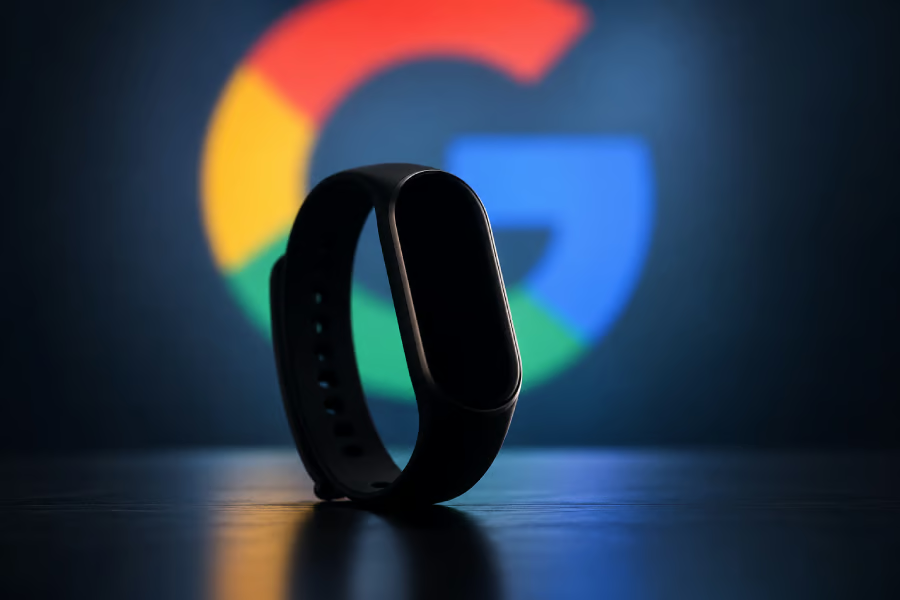


Google may have another wearable on the way, and the clues point to something different from its current Pixel Watch lineup.
A mysterious Google device with the model number G8BL6 has surfaced in regulatory filings with Bluetooth LE, satellite positioning and signs that it is designed to be worn on the wrist. The connectivity disclosed so far is more limited than what is typically found on a conventional smartwatch, raising the possibility that Google is preparing a new fitness tracker or another type of wearable.
The biggest question is where it fits. Google already has the Pixel Watch at the high end of its wearable lineup, while Fitbit has historically served users looking for simpler fitness trackers. G8BL6 could give Google something in between.
Regulatory filings reveal a strange Google wearable
The device first surfaced in an FCC filing on Sept. 10, where it is identified only as a “Wireless Device” manufactured by Weifang Goertek Electronics. The FCC documents do not identify Google, Pixel, Fitbit or Wear OS by name. However, a subsequent Singapore IMDA listing reportedly lists Google as the brand associated with G8BL6.
The regulatory documents also offer several clues about what the hardware could be.
According to a 9to5Google analysis of the FCC filing, G8BL6 supports Bluetooth Low Energy and GNSS, enabling satellite positioning. Testing documents also reference different straps, a charging base, and Android Debug Bridge, or ADB, which was used during engineering testing.
The device appears to have a display as well. Regulatory information can be accessed through Settings > System > Regulatory Information, indicating an on-device interface. Those details make a wrist-worn Android-based device plausible, but they do not confirm that G8BL6 runs Wear OS. The FCC documents also do not reveal a commercial product name.
The connectivity clues raise questions about what Google is building
One of the most interesting clues is what isn’t listed.
The currently available regulatory information shows Bluetooth LE and GNSS but does not identify Wi-Fi or cellular connectivity. That’s an unusual combination for a conventional Wear OS smartwatch.
Google explains that a Wear OS watch without cellular service or a Wi-Fi connection loses some functionality when separated from its paired phone, although basic features such as step counting, heart rate monitoring on supported hardware, and locally stored music can continue to work.
That could make more sense for a fitness-focused device designed to spend most of its time connected to a smartphone rather than operate independently.
It would also differ from Google’s current smartwatch strategy. The Pixel Watch 5 offers a much broader smartwatch experience, including LTE options, apps and deeper health functionality.
Google has not confirmed what G8BL6 is. However, the absence of Wi-Fi or cellular in the currently available FCC authorization does not necessarily establish every radio or capability that could appear in a finished product.
More Google coverage
- New Google Search AI Mode is ‘Total Reimagining,’ Says CEO Sundar Pichai
- In Major Ruling, Judge Finds Google ‘Willfully Acquired and Maintained Monopoly Power’ Over Digital Ad Market
- Google’s Big Bet on Nuclear Energy: ‘The Race to Power AI-Driven Data Centers is Accelerating’
- Computer History Museum Releases Original AlexNet Code: Why It Matters
Could this be Google’s next Fitbit?
The hardware has fueled speculation that Google could be preparing a successor to Fitbit’s Charge family or another fitness band.
There is some circumstantial evidence supporting that possibility. Google briefly showed an unidentified pill-shaped wearable in Pixel 11 promotional material, according to Android Authority. The device looked more like a fitness band than a traditional Pixel Watch. However, there is no confirmation that the wearable shown in Google’s promotional material is G8BL6.
Google also has room between its simpler fitness products and its full smartwatch lineup.
That distinction has become more important as Google expands the capabilities of its wearables. TechRepublic recently reported that Pixel Watch added insulin resistance tracking, part of Google’s broader push to turn wearable data into more useful health insights.
At the same time, some older Google, Samsung and Apple wearables are beginning to reach software support cutoffs, creating another reason for manufacturers to rethink what the next generation of wearable hardware should offer.
None of that confirms G8BL6 will carry Fitbit branding or become a Charge successor. Google has not announced a name, price, release date, or feature list for the device.
What this could mean if you’re considering a new wearable
If you’re shopping for a smartwatch or fitness tracker, G8BL6 is worth keeping an eye on because Google may be creating another option between a basic tracker and a full Pixel Watch.
Built-in satellite positioning could make a smaller device useful for recording runs, walks, or cycling routes without relying entirely on a phone for location data. Bluetooth connectivity, meanwhile, could keep the device simpler than a Pixel Watch, although the currently available regulatory information does not establish the complete connectivity package of a finished product.
The biggest unknown is what Google chooses to put behind the screen. The regulatory filings do not confirm health sensors, battery life, Fitbit integration, Gemini features, NFC payments, or even Wear OS.
For now, anyone considering a Pixel Watch or a Fitbit shouldn’t base their decision on G8BL6 alone. But if Google confirms the device, the important details won’t just be its name. Price, battery life, health sensors, and how much it can do without a phone will determine whether this mystery wearable fills a genuine gap in Google’s lineup or simply adds another wrist to the family.
Related reading: Considering a new Android wearable? See how the best Wear OS smartwatches for 2026 compare on health features, battery life and everyday use.