


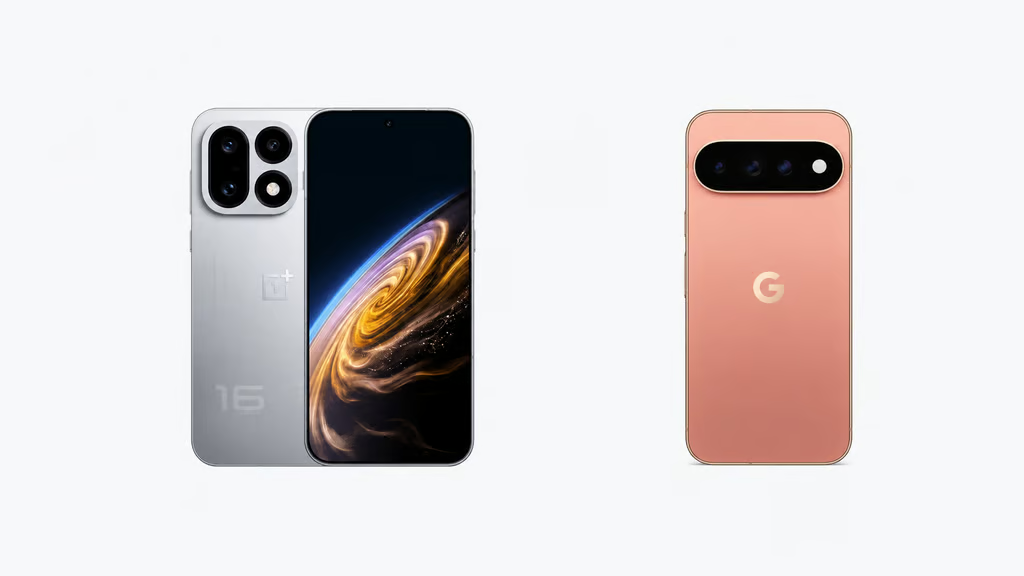
A battery nearly twice the size is hard to ignore. So is the prospect of importing a phone without official local sales or a clearly documented support timetable.
OnePlus launched the OnePlus 16 in China on October 12, 2026, with a 9,000mAh battery and 100W wired charging. That’s roughly 86% more capacity than Google’s Pixel 11 Pro, which launched in August with a 4,850mAh battery.
Google counters with seven years of software updates and official US availability. With OnePlus no longer introducing new phones in North America or Europe, buyers face a choice between greater battery capacity and more predictable long-term support.
Battery and hardware: Where OnePlus pulls ahead
The OnePlus 16 specifications list a typical 9,000mAh battery capacity and 100W wired charging, while launch reporting also documents 50W wireless charging. Google’s Pixel 11 Pro specifications list a typical 4,850mAh battery capacity and charging to approximately 55% in 30 minutes using a compatible 30W USB-C PPS adapter or higher, sold separately.
| Specification | OnePlus 16 | Pixel 11 Pro |
|---|---|---|
| Processor | Snapdragon 8 Elite Extreme Gen 6 | Tensor G6 |
| Display | 6.78-inch OLED | 6.3-inch OLED |
| Refresh rate | Up to 185Hz in supported games | Up to 120Hz |
| Battery | 9,000mAh (typical) | 4,850mAh (typical) |
| Wired charging | Up to 100W | 30W-class PPS |
| Wireless charging | Up to 50W | Up to 25W |
| Main camera | 200MP | 50MP |
| Optical zoom | 3x | 5x |
| Software | ColorOS 17 | Android 17 |
| Starting price | 5,999 yuan (about $896) | $1,099 (US launch) |
How we compared: We assessed published specifications, charging capabilities, software-update commitments, launch prices and regional availability, alongside independent Pixel battery testing.
The OnePlus 16 builds on the OnePlus 15’s hardware with a larger battery, newer processor and 200MP main camera. Google’s smaller display and 5x optical zoom offer alternatives for buyers prioritizing portability and telephoto photography.
Battery capacity does not guarantee proportionally longer runtime. In GIGAZINE’s independent testing, the Pixel 11 Pro lasted 17 hours and 56 minutes playing video over Wi-Fi at maximum brightness. It fully recharged in 100 minutes using Google’s separately sold 45W adapter. No directly comparable OnePlus 16 endurance test was identified among the sources reviewed.
Software support and the cost of importing
Google guarantees seven years of operating system and security updates through approximately August 2033, with eligible devices also receiving Pixel Drop features. Its Tensor G6 processor and Titan M3 security chip support the Pixel 11’s software and security capabilities.
An equally clear, model-specific update timetable for the OnePlus 16 could not be established from the official materials reviewed. Buyers planning to keep the phone for several years should confirm its update policy before purchasing.
OnePlus announced in July 2026 that it would stop launching new products in North America and Europe, as detailed in reporting on its regional withdrawal. Previously promised software updates and after-sales support continue for existing devices, but those commitments do not automatically establish coverage for imported OnePlus 16 units.
Importers should verify network bands, carrier certification, ColorOS compatibility, warranty terms and repair arrangements. Shipping, taxes and reseller charges can also increase the final cost beyond China’s advertised price.
The OnePlus 16 leads on battery capacity and advertised charging speeds, but its real-world endurance advantage remains unproven in a direct comparison. For US buyers prioritizing documented software support and local availability, the Pixel 11 Pro is the more practical choice.
Read more: Longer update guarantees can extend a phone’s useful life, but support policies vary; see how Samsung and Google compare on Android software longevity.