


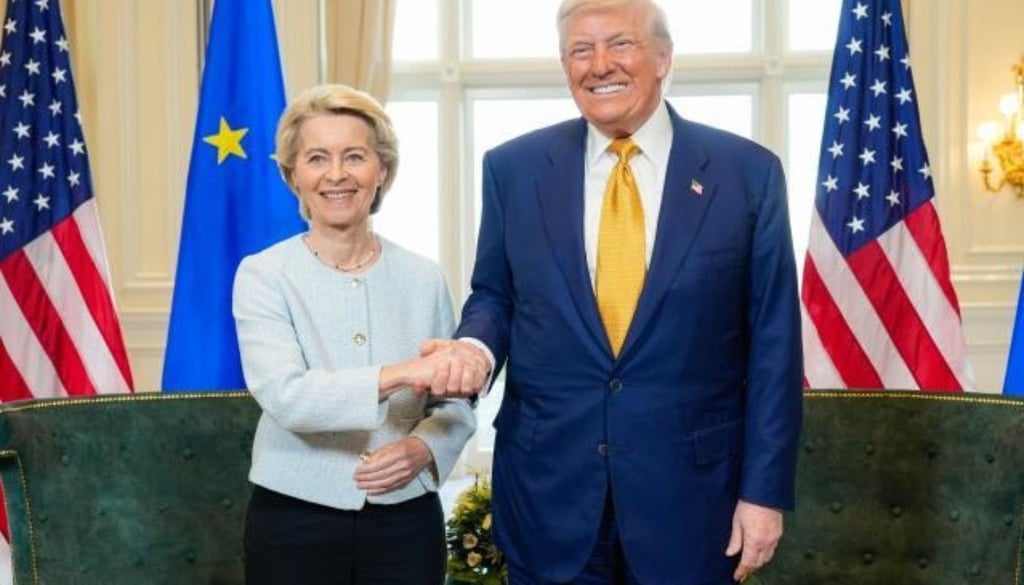
US President Donald Trump plans to increase the baseline tariff applied to all of America’s trading partners that have not struck dedicated trade agreements to between 15% and 20%. The rate will apply in addition to individual “reciprocal” tariffs based on the trade deficit with each country, many of which have been updated this month.
“For the world, I would say it’ll be somewhere in the 15% to 20% range,” Trump announced during a meeting with UK Prime Minister Keir Starmer in Turnberry, Scotland, on Monday. “Probably one of those two numbers.”
This marks a significant increase from the original 10% baseline tariff announced on April 2. This, plus the reciprocal tariffs, aims to promote domestic manufacturing and address perceived trade imbalances. However, just a week later, he suspended them for 90 days to allow time for trade negotiations that would ease the market turmoil.
Those negotiations have not gone as smoothly as planned, leading Trump to extend the tariffs deadline again to Aug. 1. So far, deals have been struck with Vietnam, the UK, Japan, the Philippines, Indonesia, and, as of Sunday, the European Union, with a trade truce in place with China. Trump has also been announcing finalised reciprocal rates with 21 nations via letters to their leaders, the latest being Canada.
Increasing the baseline tariff, even to 15%, would render large portions of the trade agreements with the EU and Japan effectively moot, since both arrangements already levy a baseline tariff of roughly 15% on most exports.
EU’s trade deal sees 15% tariff on most exports, including chips
On Sunday, Trump and European Commission President Ursula von der Leyen announced the terms of the trade deal between the US and the EU at Turnberry. The majority of exports, including semiconductors, cars, and pharmaceuticals, will be subject to a 15% tariff.
The deal spares the EU from the 30% tariff Trump threatened earlier this month if a trade deal was not reached by Aug. 1. However, the new rate still represents a significant increase, more than tripling the 4.8% average tariff currently applied to EU goods.
French Prime Minister François Bayrou described the signing as a “dark day” on which the EU has “resign(ed) itself to submission,” in a post on X. German Chancellor Friedrich Merz said that, while the rate places a “serious burden” on Germany’s economy, “more simply wasn’t achievable,” according to Reuters. European trade commissioner Maroš Šefčovič said in a statement that it was a “breakthrough” that brings “renewed stability.”
In addition to the 15% tariff, Trump and von der Leyen agreed to zero-for-zero rates on a number of strategic products, some of which were suggested in a trade proposal from the EU back in May. These include all aircraft and aircraft parts, certain chemicals, certain agricultural products, critical raw materials, and semiconductor equipment.
“US AI chips will help power our AI gigafactories and help the US to maintain their technological edge,” von der Leyen said in a statement. She also said she is working to add more products to the list.
The tariff on steel and aluminium imports from all countries, doubled to 50% on June 3, still applies to the EU for now. However, von der Leyen stated that the two nations will aim to draw up a new quota-based deal that will “ensure fair global competition.”
What's hot at TechRepublic
- Blackpoint Cyber vs. Arctic Wolf: Which MDR Solution is Right for You?
- Why AWS Sellers Choose Deepgram Over Other Voice AI Tools
- SS&C Intralinks DealCentre AI vs. Datasite: Which platform is built for the future of dealmaking?
- SS&C Intralinks FundCentre AI vs. Juniper Square: Which platform better supports modern private markets fund managers?
- Verito vs. Rightworks: Which IT Provider Is Best for Your Firm?
The EU has agreed to buy $750 billion of US energy, including liquefied natural gas, oil, and nuclear, replacing Russian sources, as well as “hundreds of billions of dollars” of military equipment. It will have invested $600 billion in the US by 2028, in addition to the existing annual investments of over $100 billion.
Finally, the EU will work to reduce EU “red tape” for US exporters of industrial and agricultural goods, and “address unjustified digital trade barriers,” such as by eliminating customs duties on electric transmissions and network usage fees.
The Trump administration has been openly disparaging of the EU’s pro-regulation stance, describing its ongoing regulatory battles and fines against tech companies as “a form of taxation” at the World Economic Forum in January.
Find out how the US tariffs could impact the price of an iPhone and other tech products.