


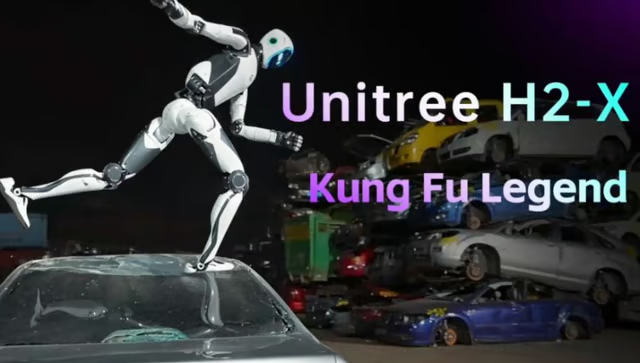
Unitree’s latest humanoid robot can kick cars, perform backflips and leap from a four-meter-high platform. Now, the Chinese robotics company is presenting it as a potential security and rescue machine.
Chinese robotics maker Unitree Robotics introduced the H2-X Kung Fu Legend Guardian in a promotional video released Wednesday, presenting its latest full-size humanoid as a potential tool for security and rescue operations.
The footage shows the robot performing backflips, aerial kicks and forceful punches against vehicles in a scrapyard. It also jumps from a platform marked four meters high, lands on its feet and regains its balance.
The second half shifts from stunts to simulated emergencies. The H2-X intervenes in a staged confrontation with an armed intruder, pushes a child-sized mannequin away from an approaching car and raises the front of a vehicle to help free a trapped dummy.
Unitree says the footage is real and has not been sped up. However, neither the video nor the company’s announcement establishes how much of the performance involves autonomous decision-making, remote operation or preprogrammed movements.
Unitree Introducing: H2-X Kung Fu Legend Guardian 🤖
Powerful performance to serve and guard you,
with a maximum endurance of approximately 8 hours.
Please use the robot safely and in a friendly manner.— Unitree (@UnitreeRobotics)
October 21, 2026
Eight hours of endurance, with a catch
Unitree advertises approximately eight hours of endurance for the H2-X, but the figure applies to standing operation, not continuous walking, fighting or rescue work.
The robot builds on the company’s existing H2 humanoid platform, which stands about 182 centimeters (6 feet) tall and weighs roughly 70 kilograms (154 pounds). The standard H2 has 31 degrees of freedom and leg joints capable of delivering up to 360 newton-meters of torque.
Unitree has not confirmed whether the H2-X retains those specifications. It also has not announced pricing, a release date or a complete technical specification sheet. For comparison, the standard H2 is listed at about $29,900. That price offers a reference point, not an estimate of what the specialized H2-X will cost.
The hard part starts outside the demonstration
The H2-X arrives as Unitree faces pressure to turn viral robot demonstrations into commercially viable products. The South China Morning Post reported that investors are increasingly looking for evidence that robotics companies can generate sustainable revenue from real-world deployments.
That makes the Guardian branding significant, but also raises questions the video does not answer. A robot that can knock down an attacker in a choreographed scene is not necessarily capable of identifying a genuine threat, distinguishing an aggressor from a bystander or choosing an appropriate response in a crowded public space.
The same limitations apply to rescue work. Lifting a vehicle in a controlled demonstration does not establish whether the robot could safely stabilize damaged equipment, navigate debris or assist injured people in unpredictable conditions.
Unitree’s guidance to maintain a two-to-three-meter safety distance, if applicable to the H2-X, also raises questions about how such powerful movements could be managed around people during emergencies.
What the H2-X could mean for security and rescue teams
If Unitree can turn the H2-X’s physical capabilities into reliable, supervised operations, the robot could eventually interest organizations that need machines to enter hazardous environments or assist with emergency response.
Security operators, industrial site managers and rescue teams would need more than athletic performance, however. They would need evidence of dependable threat detection, predictable behavior around people, safe remote intervention and sufficient battery life during demanding tasks.
Another consideration is accountability when robots operate around people. Security and rescue organizations would need clear procedures defining when a human operator must approve an action, how the robot can be stopped during an emergency and who is responsible if it makes a dangerous decision.
Those safeguards would be particularly important for machines capable of applying significant physical force.
More about Innovation
- Sovereign AI Explained
- The Rise of the AI-Native Factory
- Why Data Determines AI Success
- SS&C Intralinks DealCentre AI vs. Datasite: Which platform is built for the future of dealmaking?
What users should know before getting excited
For consumers, the H2-X is not yet a demonstrated household assistant. Its announcement focuses on security and rescue scenarios, and Unitree has not confirmed commercial availability or a price.
For businesses, the demonstration offers a glimpse of what powerful humanoid robots might eventually accomplish, but it is not proof of a deployment-ready security or rescue system.
Organizations considering humanoid robots for security or emergency response would also need to evaluate how they perform outside controlled environments. Uneven terrain, poor visibility, crowded spaces and unexpected obstacles could present challenges that are difficult to reproduce in promotional demonstrations.
Consistent performance under these conditions would be essential before deploying robots in situations where people depend on them.
Cost is another unanswered question. Beyond the robot’s purchase price, businesses would need to account for maintenance, repairs, operator training, software support and potential infrastructure upgrades. Without those details, it is difficult to determine whether the H2-X could offer a practical alternative to existing security equipment or specialized rescue robots.
Until Unitree provides independent performance data, verified safety controls and clear details about autonomy, the H2-X remains a promising demonstration rather than a proven operational solution.
Other news: Electric vehicle maker Faraday Future is expanding its ambitions into humanoid robotics with its FF Nova lineup.