


Xiaomi is rolling out HyperOS 4 to more than 80 smartphones and tablets, bringing a redesigned interface, AI-powered features, and performance improvements to devices across its Xiaomi, Redmi, and Poco brands.
The company began its global stable rollout on Tuesday, with 82 devices scheduled to receive the update across three waves running through December 2026. The release follows an earlier beta program and includes both newer flagship models and older devices.
For Xiaomi owners, the biggest questions are whether their devices qualify, when the update will arrive, and which features will actually be available outside China.
Three waves bring HyperOS 4 to older and newer devices
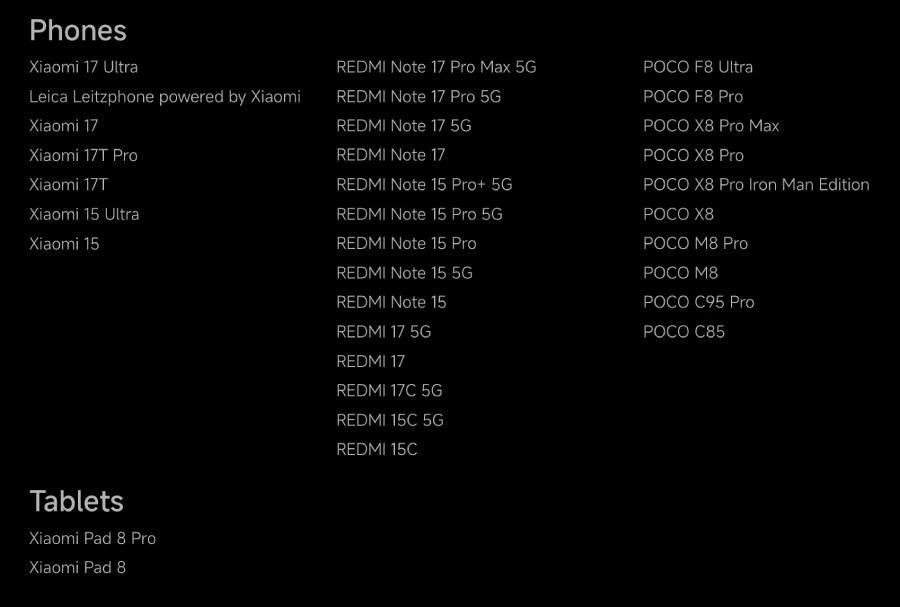
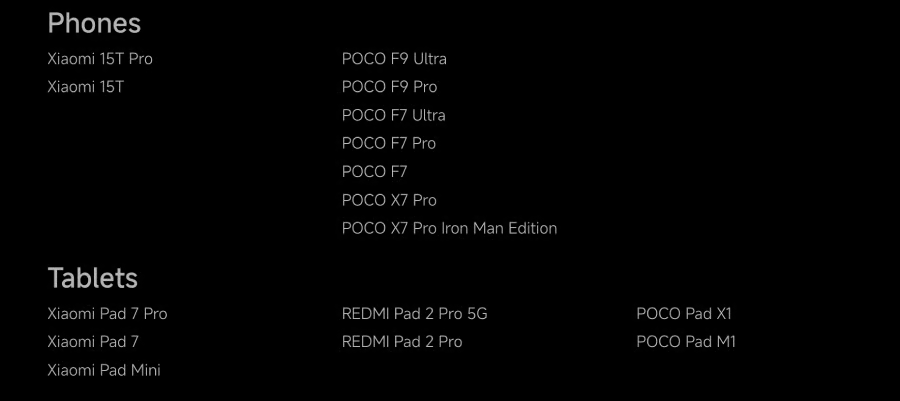
The first wave, scheduled for early November, includes the Xiaomi 17 and 15 series, Redmi Note 17 and Note 15 families, Poco F8 and X8 lineups, and Xiaomi Pad 8 tablets. A second batch is expected in mid-November. It covers the Xiaomi 15T series, Poco F7 and F9 families, Xiaomi Pad 7 models, Pad Mini, and several Redmi and Poco tablets.
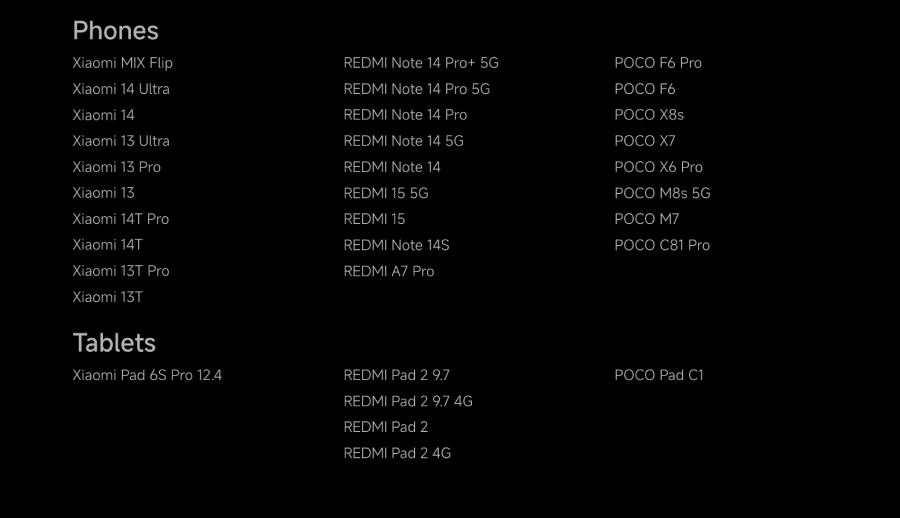
The December wave extends support to older hardware, including the Xiaomi 13 and 14 series, Xiaomi 13T lineup, MIX Flip, Redmi Note 14 family and Poco F6 series. The inclusion of the Xiaomi 13T, released in 2023, is particularly notable for owners who might otherwise expect their devices to miss another major software upgrade.
These are scheduled rollout windows, not guaranteed installation dates. Availability will depend on device models and regional software distribution.
A glass-inspired interface and faster app launches
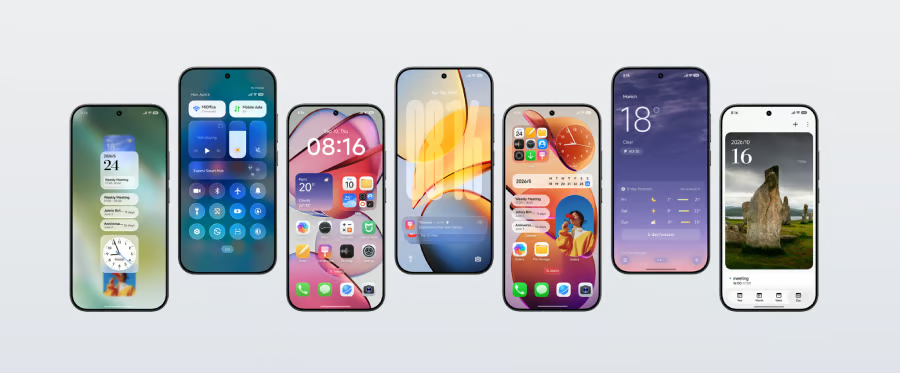
HyperOS 4 introduces Xiaomi’s Soft Light Glass design, featuring translucent interface panels, redesigned notifications, customizable lock screens, larger clock widgets, and more flexible home screen layouts.
The update also improves floating-window support and app orientation handling, particularly for multitasking on tablets.
Performance improvements are another focus. According to Xiaomi’s internal testing, the time needed to launch 30 apps after nine hours of use decreased from 40.3 seconds on HyperOS 3 to 36.8 seconds on HyperOS 4, an improvement of approximately 8.7%.
Xiaomi also reported faster HDR photo processing, with capture times falling from 313.38 milliseconds to 240.16 milliseconds, a reduction of about 23.4%.
However, these results come from Xiaomi’s own testing and may not reflect performance across every supported device. Some features and improvements will also depend on hardware capabilities and regional software versions.
Xiaomi gives its AI assistant more responsibilities
HyperOS 4 also expands Xiaomi’s AI ambitions through Super XiaoAi 2.0, powered by the company’s MiMo large language model.
The assistant can handle tasks such as searching photo libraries, organizing schedules, controlling compatible smart home devices and identifying products displayed on a phone’s screen. Xiaomi is also introducing additional privacy safeguards, including confirmation prompts before sensitive actions such as deleting or sharing information. Its Super Island feature now supports more than 130 services.
Some of these capabilities remain restricted to supported devices and China-specific software versions, so international users may not get the full feature set.
Mobility must-reads
- Big Apple OS Makeover: Here’s What to Expect & When
- MWC 2025: Nothing Shows Off (3A) Phones With AI Organization Tool
- Bad News for App Developers: Most Apps Fail to Hit $1,000 Monthly Revenue Within Two Years
- Mobile Device Computing Policy
Xiaomi HyperOS 4 release schedule: Full list of devices
Starting from early November 2026
Starting from mid-November 2026
Starting from December 2026
What the expansion means for Xiaomi users
The rollout gives Xiaomi owners another reason to hold on to their existing phones rather than immediately consider an upgrade. Extending HyperOS 4 eligibility to devices such as the Xiaomi 13T demonstrates that the company is continuing to bring newer software experiences to older hardware.
For budget-conscious Redmi and Poco customers, access to refreshed interfaces and performance improvements could also make their devices feel more current without additional spending.
There are still practical considerations. The rollout is staggered, and users may wait beyond the advertised starting windows before receiving an installation notification. HyperOS 4 is also a substantial download, with Notebookcheck reporting that the Poco F8 Pro’s update exceeds 8GB when installed over stable HyperOS 3.
Users can check for available updates through their device’s system settings, although the exact menu may vary by model and software version. Because Xiaomi is releasing HyperOS 4 in stages, an eligible device may not receive the update immediately.
Eligibility for HyperOS 4 does not guarantee access to every advertised feature or necessarily confirm an Android 17 upgrade. Users should check the software version and feature availability for their specific device before installing the update.
Other news: Samsung is reportedly developing a 17-inch foldable tablet that could shrink to an 8-inch form factor when closed, potentially offering a larger workspace in a portable design, although the company has yet to confirm the device, its specifications, or a release timeline.