This\r\ngallery is a supplement to a TechRepublic article.
Just keeping a mailing\r\nlist current can be a chore. “Between 2011 and 2012, 12 percent of people\r\nin the country over the age of 1 moved at least once,” according to a December 2012\r\npost at the official U.S. Census Bureau blog. That means that the address of one out of eight of your contacts need\r\nto be updated each year.
\r\n\r\n
Mass mailers update\r\ntheir address lists with services. For example, in the U.S., the NCOALink\r\n(National Change of Address) service identifies address changes, and improves\r\naddress accuracy (e.g., updating five digit postal codes to more\r\nlocation-specific nine digit codes). The mailer pays a fee for the service and\r\nends up with a more accurate address list.
\r\n\r\nBut your Google Contacts list contains more than just\r\npeople’s mailing addresses. It contains phone numbers and email addresses. For\r\nprofessional contacts, it contains company names and job titles. All of this\r\ninformation can change without an\r\naddress change. And it takes time to maintain.
\r\n\r\n
That’s pretty much\r\nwhat Scrubly is: a\r\nweb-based updating service for Google Contacts. With your permission, Scrubly\r\nupdates your contact list with information drawn from Facebook, LinkedIn, and\r\nTwitter. It also consolidates duplicate contact information and deletes blank\r\ncontacts. (You may manually modify Scrubly’s recommendations any time.) Scrubly\r\nwrites the updated information back to your Google Contacts list.
\r\n\r\n
Scrubly charges a\r\nfee of $19.95 for a “one-time scrub” of your contacts, or $39.95 per\r\nyear for an unlimited number of “scrubs” during the year. If you have\r\nfewer than 250 contacts, Scrubly is free.
\r\n\r\nIn addition to updating Google Contacts lists, Scrubly\r\nalso works with Outlook and Mac contact lists. With Google Contacts, Scrubly\r\nimports and export the data via the web. When using Scrubly to update Outlook\r\nor Mac address book contacts, you’ll need to install a bit of software on your\r\nsystem to help with the import and export process.
\r\n\r\n
Credit: Image by Andy\r\nWolber for TechRepublic
\r\n\r\nHere’s a look at the Scrubly contact update process\r\nfor Google Contacts. The steps below assume you’ve created a Scrubly account,\r\nlogged in, and started the six-step “scrub” process.
\r\n\r\n
Credit: Image by Andy\r\nWolber for TechRepublic
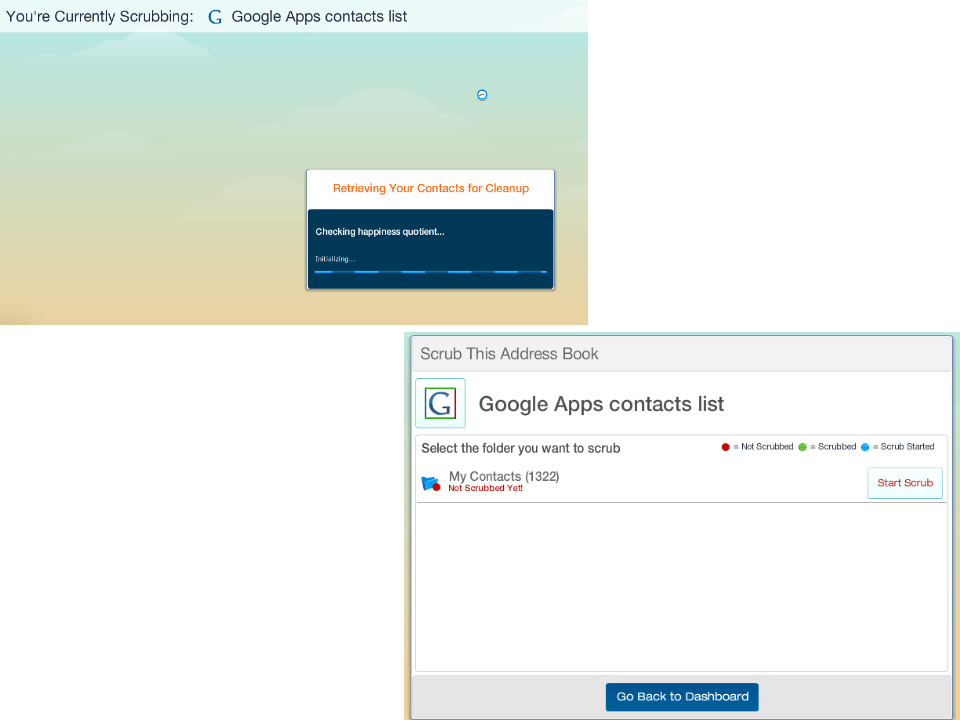
\r\n\r\nFirst, you need to give Scrubly permission to access\r\nyour Google Contacts. Scrubly then imports these contacts. In my case, Scrubly\r\nretrieved all 1,322 of my contacts.
\r\n\r\n
Credit: Image by Andy\r\nWolber for TechRepublic
(During the import process – and throughout the\r\nscrub – you’ll see various messages suggestive of the “reticulating\r\nsplines” message you might remember from SimCity. Messages like “Loading\r\nworld maps…”, “Checking with Strunk & White”, and “Rhythmically\r\napplying the bubbles”.)
\r\n\r\n
Credit: Image by Andy\r\nWolber for TechRepublic
\r\n\r\n
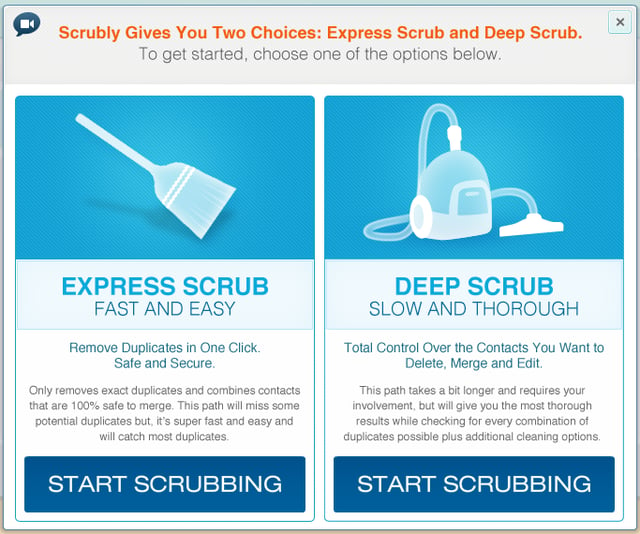
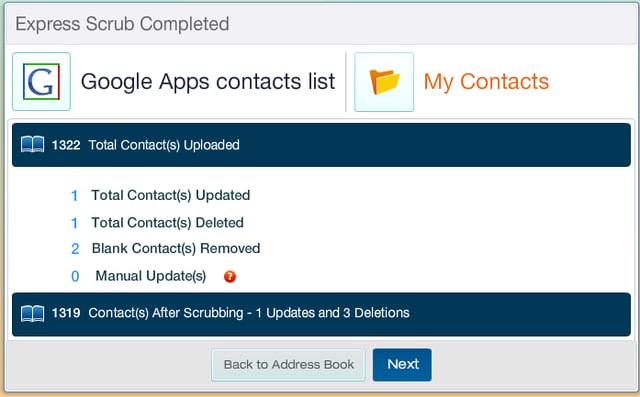
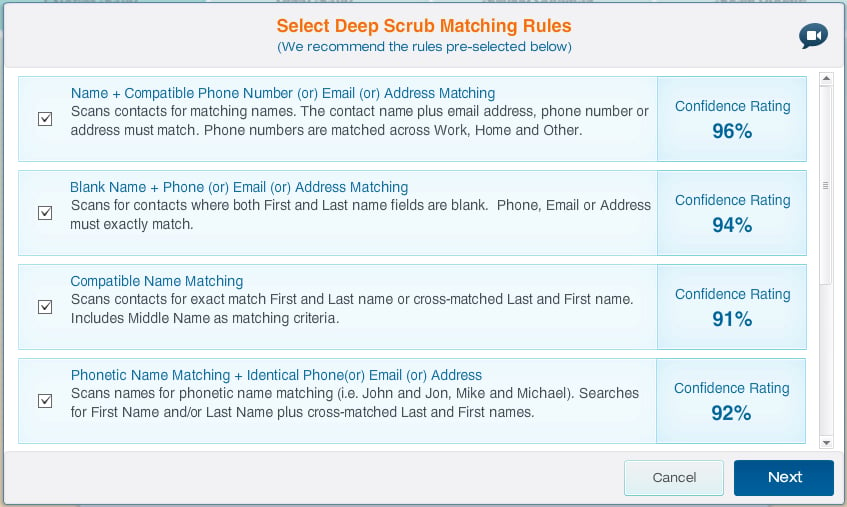
Next, you have the\r\nchoice of an Express Scrub or Deep Scrub. The Express Scrub consolidates\r\nduplicate contacts, and removes blank and “system default” contacts\r\n(i.e., the sample contact records that often come with new systems). The Deep\r\nScrub takes more time, but identifies more potential duplicates by comparing\r\ndata in more fields. A Deep Scrub includes an Express Scrub.
\r\n\r\nWhen duplicates are identified, you have complete\r\ncontrol over how each record is handled. Scrubly prefers to preserve data, so\r\nwhen duplicate records are consolidated no data is lost. Of course, you can\r\nalways choose to preserve records. You can also edit individual fields in\r\nrecords identified as duplicates. Scrubly works to make sure you don’t lose any\r\nuseful data in the cleaning process.
\r\n\r\n
Credit: Image by Andy\r\nWolber for TechRepublic
\r\n\r\n
Before a Deep Scrub\r\nbegins, you select rules for Scrubly to use. For example, one rule looks for: “Scans\r\nfor matching names. The contact name plus email address, phone number or\r\naddress must match. Phone numbers are matched across Work, Home and Other.”
\r\n\r\nPotential duplicates are identified and presented for\r\nyour review. The review process may take some time, as you really should look\r\nat each individual case. The Deep Scrub sometimes identifies contacts as\r\nduplicates when they are not. For example, I have two contacts named “Holly\r\nRoss”. Scrubly identifies these as possible duplicates, yet I’m confident\r\nthat they are two distinct people. The review process lets me keep both\r\nrecords.
\r\n\r\n
Credit: Image by Andy\r\nWolber for TechRepublic
In this phase,\r\nScrubly removes duplicate data within contact\r\nrecords. This eliminates the problem of having the same email address or phone\r\nnumber listed in multiple fields within a contact record.
\r\n\r\n
Scrubly also\r\nstandardizes all your phone number fields to a format you specify. I choose\r\nXXX-XXX-XXXX, but you might also select several other standard phone number\r\nformats (e.g., XXX.XXX.XXX, (XXX) XXX-XXXX, etc.).
\r\n\r\n
\r\n\r\n
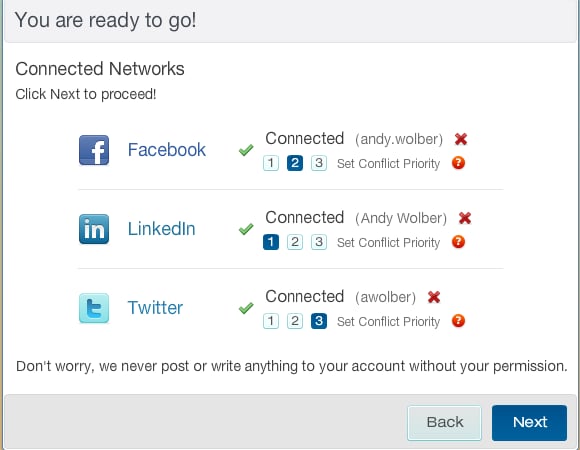
Next, Scrubly can\r\npull information from social networks you use to update your contact list. This\r\nlets you add more current information to your contacts list. A colleague might\r\nhave updated their job title on LinkedIn or Facebook. This process lets you add\r\nthat information to their contact record.
\r\n\r\n
If you use multiple\r\nsocial networks, you’ll need to prioritize the information. For example,\r\nScrubly can import a contact’s photo from any of the three networks to which it\r\nconnects: LinkedIn, Facebook, or Twitter. You need to decide which photo to\r\nuse. Since I use my contact list primarily for business purposes, I prioritize\r\nthe networks in exactly that order (LinkedIn first, Facebook second, and\r\nTwitter last).
\r\n\r\nDuring this step you may choose to allow Scrubly to\r\nOverwrite your existing information. If your contact list is quite out of date,\r\nit may be smart to select the “Overwrite” box for fields likely to be\r\nout of date, such as Job Title and Company Name. Similarly, if you don’t have\r\nphotos of most of your contacts, you might allow the Photo field to “Overwrite”\r\nexisting data. (I ran Scrubly once without Overwrite selected on most of these fields,\r\nthen re-ran it with Overwrite\r\nselected. I was happier with the results with Overwrite selected. My contacts\r\ntended to have provided more accurate information on social networks than I had\r\nin my contacts list.)
\r\n\r\n
Credit: Image by Andy\r\nWolber for TechRepublic
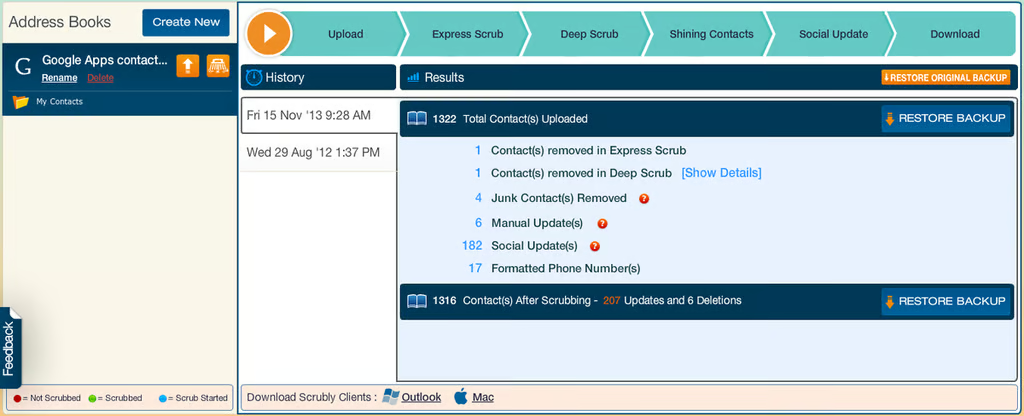
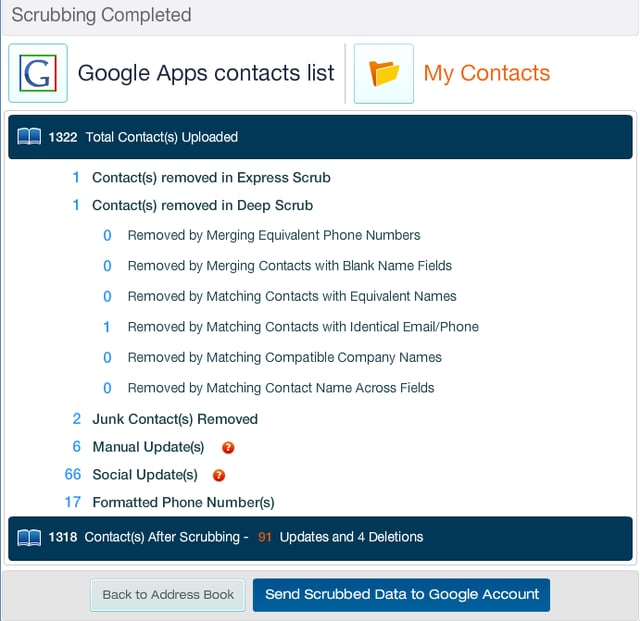
\r\n\r\nFinally, Scrubly provides a full report of changes\r\nbefore sending the scrubbed contacts list back to your account. The final\r\nprocess deletes all of your existing contacts, and then replaces them with the\r\nscrubbed data. Importantly, Scrubly saves your original data. Should you\r\nrealize later that the scrubbed data was somehow faulty you can always return\r\nto Scrubly and choose to restore your original data.
\r\n\r\n
Credit: Image by Andy\r\nWolber for TechRepublic

\r\n\r\n
I’ve found Scrubly\r\nuseful in two different scenarios. In one, Scrubly helped me quickly\r\nconsolidate multiple digital contact lists: I could import lists from several\r\nsources to Google Contacts, then rely on Scrubly to help me consolidate and\r\ndelete duplicates. In the other case, I rely on Scrubly about once a year to\r\nupdate contact information for my contacts from social networks. I like having\r\ncurrent photos and job contact information right in my contact list.
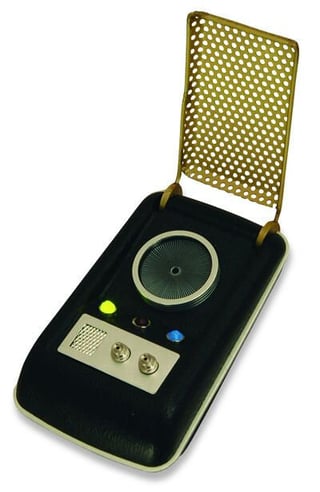
\r\n\r\nIn an ideal world, communication would be like Star Trek: we would simply speak a contact name and a\r\ncommunication channel would automatically open. In the meantime, I’ll rely on\r\nScrubly to clean up and update my Google Contacts with information from social\r\nnetworks.