
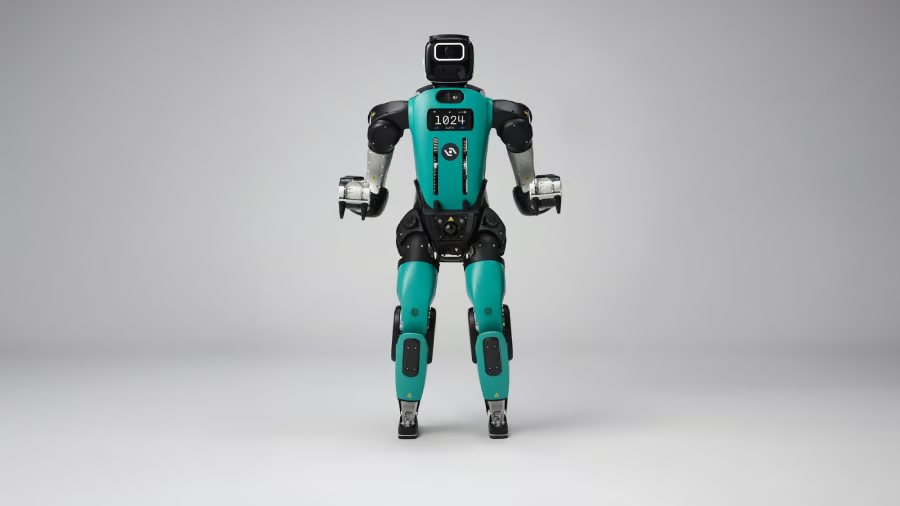


Humanoid robots are moving closer to sharing the factory floor with people instead of operating behind protective barriers.
Agility Robotics unveiled Digit 5 on Tuesday, a 5-foot-11-inch, 284-pound humanoid designed to work alongside employees in manufacturing and warehouse environments. The company says it already has more than $300 million in multi-year orders, with early access planned for the first half of 2027.
The bigger test is whether Digit 5 can deliver that promise at commercial scale. Securities filings show the headline order figure is heavily concentrated in one customer agreement, while Agility is still operating at a substantial loss and international safety standards for industrial humanoids are continuing to develop.
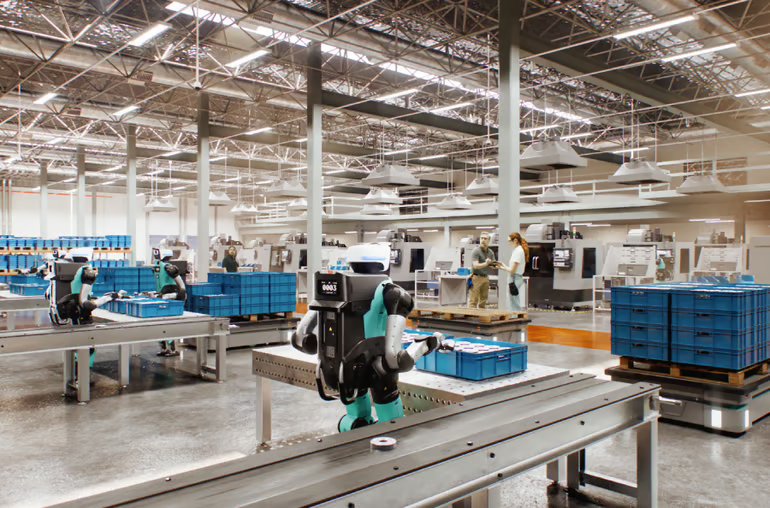
“You cannot put 150 robots into a warehouse where every one of them has to be surrounded by a 10-by-20 plexiglass set of walls,” Daniel Diez, Agility’s chief business officer, told Bloomberg.
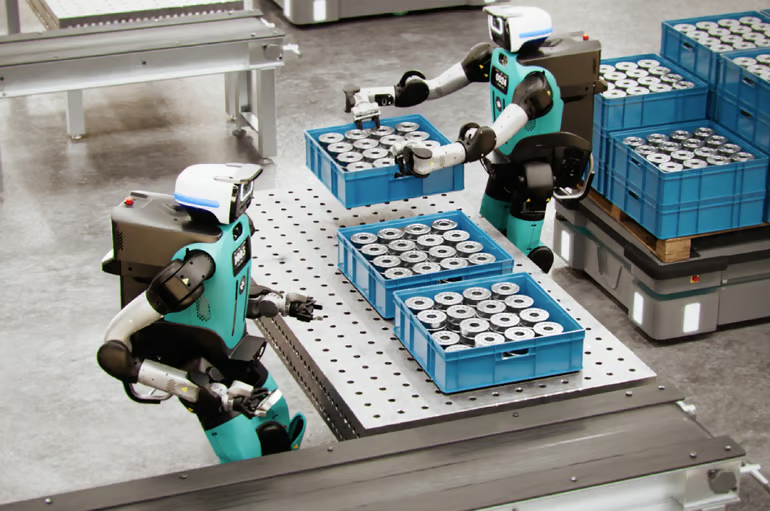
Peggy Johnson, CEO of Agility Robotics, framed the hardware shift around hard commercial feedback gathered from more than 65,000 operational hours with Digit 4 across companies like Amazon, GXO Logistics, and Toyota Motor Manufacturing Canada.
“Digit 5 is removing a major barrier to scaling humanoid robots in industrial environments,” Johnson said. “We built it to the exact requirements our customers gave us after three years of Digit 4 working on their production floors.”
A ground-up industrial redesign
Agility discarded the ostrich-like, backward-bending knees of previous models for forward-facing legs powered by proprietary cycloidal actuators. The design allows the robot to squat lower and repeatedly lift up to 50 pounds, matching OSHA single-person lift limits.
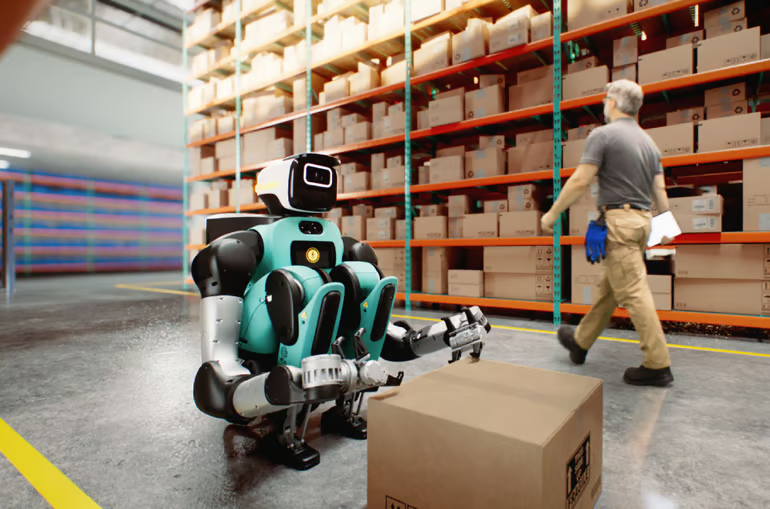
Safety is built around multiple layers. The company says multimodal sensors monitor for people around the robot, visual and audio signals communicate its intended movements, and an independent safety controller runs separately from the main compute system.
If someone enters its path unexpectedly, Digit 5 can stop, lower itself into a seated position, and power down its motors to reduce the risk of a fall.
The machine also addresses operational downtime through a sharp charging shift: a 90-minute operating battery charges in nine minutes, enabling more than 20 hours of daily uptime.
More must-read AI coverage
- SS&C Intralinks DealCentre AI vs. Datasite: Which platform is built for the future of dealmaking?
- SS&C Intralinks FundCentre AI vs. Juniper Square: Which platform better supports modern private markets fund managers?
- Why Data, Not Models, Determines AI Success
- The Rise of the AI-Native Factory: How Physical AI Is Transforming Manufacturing
Agility still has to prove the economics
While Agility positions Digit 5 for early access in the first half of 2027 and general availability by late 2027, the company faces steep financial hurdles. Agility is going public via a merger with Churchill Capital Corp. XI at a $2.5 billion valuation, yet regulatory filings reveal it generated just $1.78 million in net sales in 2025 alongside a $140.2 million operating loss.
Competition is also accelerating. Boston Dynamics is developing its electric Atlas for industrial work, while Tesla and Figure AI are pursuing their own commercial humanoid programs.
For customers, that makes Digit 5 more than a robotics technology bet. Buyers also have to judge whether Agility can manufacture, deploy, service, and support fleets at the scale implied by its order book.
The realities behind the order book
Agility’s headline $300 million backlog represents a watershed validation for enterprise robotics, but securities disclosures reveal critical nuances IT leaders and operations executives must weigh:
- Customer concentration: S-4 filings disclose that the $300 million figure stems from a single customer agreement for 1,000 robots over three years, categorized as a “related party” transaction tied to an entity with close corporate links.
- The cost-per-floor equation: An illustrative five-year total cost of ownership approaches $400,000 per robot—covering a $200,000 unit cost, $20,000 deployment fee, and $36,000 annual maintenance fee. Operating under a Robots-as-a-Service (RaaS) model at roughly $8,500 monthly, Digit 5 must reliably replace roughly 2.5 human shifts each day to justify its capital expense against legacy, fixed automation.
- Regulatory lag: While Digit 5 leverages ANSI and ISO draft frameworks, official international safety standards (ISO 25785-1) remain unratified, meaning early adopters will shoulder initial site-by-site compliance burdens.
Digit 5’s biggest advance may ultimately be less about walking, lifting or battery life than whether humanoid robots can safely move out from behind barriers and become ordinary pieces of industrial equipment.
For prospective buyers, however, the decision is not simply whether the robot can do the work. Agility still has to demonstrate that Digit 5 can deliver its promised uptime and safety performance at fleet scale. At the same time, customers need to compare its deployment and service costs against human labor and established automation.
The $300 million order book gives Agility a significant commercial test. What happens when those robots reach real production floors will show whether Digit 5 can turn humanoid robotics from a pilot project into repeatable industrial infrastructure.
Other news: China’s GEAIR 2.0 humanoid robot can pollinate tomato flowers in under 10 seconds, combining AI, robotics, and gene editing to automate labor-intensive crop breeding.