


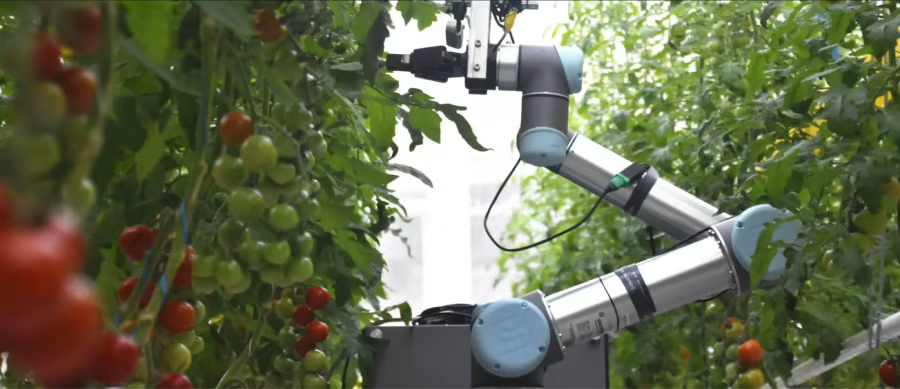
China has built a two-armed humanoid robot that can gently pollinate crops around the clock.
Unveiled at the 33rd China Beijing Seed Industry Conference, GEAIR 2.0 is billed by its creators as the world’s first embodied-AI humanoid developed specifically for crop breeding.
Designed by a team led by Xu Cao at the Chinese Academy of Sciences’ Institute of Genetics and Developmental Biology, the machine is built entirely with domestically produced components.
Unlike its single-arm predecessor, GEAIR 2.0 features two robotic arms designed for delicate greenhouse work. In a demonstration covered by China Central Television, the robot held a pollen tube in one hand and swept a fine brush with the other to pollinate tomato blossoms in under 10 seconds apiece. Each dip into the pollen supply coats the brush enough to service 50 flowers, while its visual recognition system achieves 92.8% accuracy in identifying each flower’s needle-thin stigma, or female reproductive structure, according to China Daily.
For agricultural technology teams, GEAIR 2.0 offers an early test of whether computer vision, robotics and gene editing can work together to automate labor-intensive breeding. Its commercial value, however, will depend on reliability, cost and performance outside controlled demonstrations.
Rewriting the plant to fit the machine
The hardware represents only half of the equation. GEAIR stands for “Genome Editing combined with AI-based Robotics,” relying on a strategy researchers call “crop-robot co-design,” detailed in the journal Cell in 2025.
Instead of requiring the robot to manipulate petals, researchers used gene editing to create male-sterile tomatoes with exposed stigmas that are easier for the machine to reach. They also reproduced the relevant floral traits in soybeans. By reshaping the crop to fit the mechanical hands, the bot easily slips past dense foliage without harming the plant.
“Cross-pollination is repetitive labor,” Xu told the Global Times. “It has to be done bent over within a very short time window, and it is exhausting. But this robot can work as soon as it is charged, and its operating window is much longer. What’s more, it can operate autonomously in heat or cold, day or night. This way, farmers can get the job done better by managing the robot.”
More must-read AI coverage
- SS&C Intralinks DealCentre AI vs. Datasite: Which platform is built for the future of dealmaking?
- SS&C Intralinks FundCentre AI vs. Juniper Square: Which platform better supports modern private markets fund managers?
- Why Data, Not Models, Determines AI Success
- The Rise of the AI-Native Factory: How Physical AI Is Transforming Manufacturing
The limits of crop-robot co-design
Tailoring plants to robotic systems could make automated pollination more efficient, but it may also limit where the technology can initially be deployed. Growers would need compatible crop varieties and controlled environments capable of supporting the robot.
The researchers have not disclosed pricing, operating costs or large-scale performance results for GEAIR 2.0. It also remains unclear how reliably the machine would operate outside greenhouse conditions, making the system a promising breeding platform rather than a ready-to-deploy replacement for agricultural workers.
Targeting food security
The innovation arrives as Beijing leans heavily on advanced technology to strengthen domestic food supplies, although a recent crop-loss case involving AI advice shows why agricultural systems still require careful testing and human oversight. Chinese grain production reached a record 715 million metric tons in 2025, while national plans call for increasing annual production capacity to roughly 725 million metric tons by 2030, according to the Global Times.
If commercialized, GEAIR 2.0 could help seed producers reduce the manual labor and costs associated with hybrid breeding. However, agricultural technology teams will need evidence of reliable performance, competitive operating costs and compatibility with more crops before treating it as more than a controlled demonstration.
The next test will be whether researchers can move beyond greenhouse tomatoes and adapt the system for larger-scale breeding programs involving soybeans and other crops.