


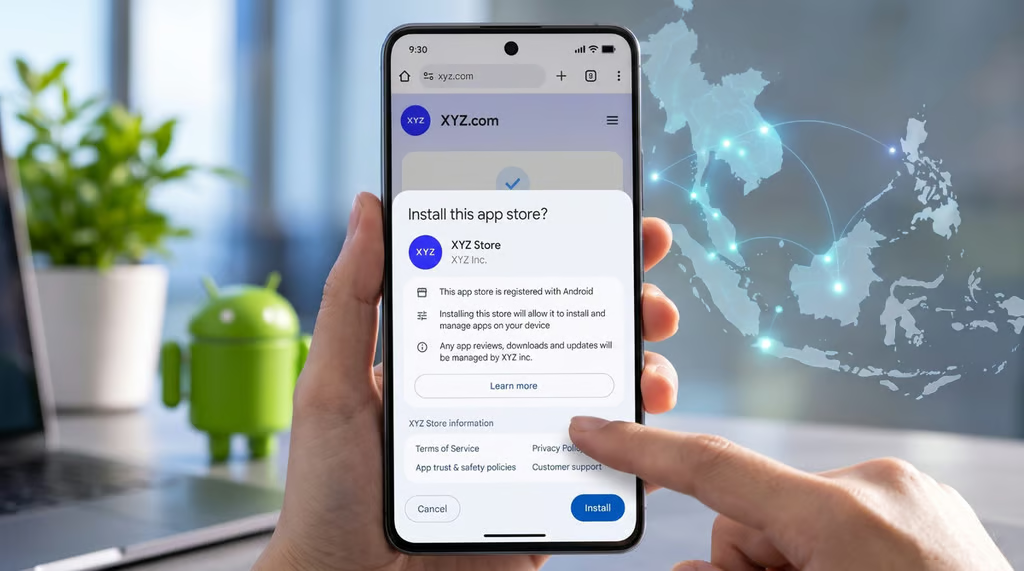
Android users in several Southeast Asian countries will soon have a simpler way to install apps outside Google Play. But the December 1 rollout comes with restrictions that could leave many phones waiting.
Google opened enrollment for its Registered App Stores program on October 27, ahead of a launch that will let approved third-party marketplaces offer one-tap installations and automatic updates. The change could make alternative app stores more convenient, although availability will vary by country, device, and marketplace.
Users will need Android 17 QPR2 or later, an eligible home account country, and access to an approved marketplace. Even in supported markets, the feature will not reach every device immediately.
Which Southeast Asian Android users qualify?
Google’s supported-country list explicitly includes Cambodia, Indonesia, Laos, Malaysia, Myanmar, the Philippines, Singapore, Thailand, and Vietnam. Brunei and Timor-Leste are not individually named, leaving their inclusion unconfirmed.
Users also need Android 17 QPR2 or later. Phones running Android 16 or earlier will not qualify, while devices already on Android 17 still require the specified quarterly update.
Because Android updates vary across manufacturers, availability will depend on individual devices and rollout schedules. Samsung’s Android 17 eligibility remains uncertain for some older Galaxy models, while the availability of Android 17 across Galaxy devices is still being clarified.
The user’s home account country determines regional eligibility. Temporary travel abroad does not automatically remove existing access, although permanently changing account countries may affect availability. People moving between Southeast Asian countries should therefore check their account settings rather than relying solely on their current location.
What changes for Android users and app stores?
Under the Registered App Stores program, approved marketplaces can install apps without the additional confirmation screens normally required for third-party stores. They can also deliver automatic background updates, subject to user controls.
Currently, installing apps through independent marketplaces typically involves authorizing the installation source and confirming individual installations. The new process removes extra installation prompts, but stores must still obtain users’ consent before installing apps. Automatic updates also remain subject to user controls.
Participation is voluntary. Stores seeking approval must pay a $10,000 annual fee, verify their organization, and submit their app catalogs for ongoing malware scanning. They must also meet security and privacy requirements, although registration does not guarantee every app is safe.
The US follows a separate distribution arrangement. In August, Aptoide Games became available through Google Play in the US following changes arising from Google’s legal dispute with Epic Games. That arrangement is distinct from the December international rollout.
The program is also separate from Google’s developer-verification policy, which began enforcement on September 30, 2026, through participating stores on certified devices in Indonesia, Singapore, Thailand, and Brazil. That policy concerns developer identities, with broader enforcement planned for 2027.
For now, users should check whether their phones can receive Android 17 QPR2 and whether their preferred marketplaces join the program. Google also allows IT administrators to block registered stores on managed devices. December 1 is the starting date, but compatible software and approved marketplaces will determine when the easier installation experience reaches individual phones.
Also read: For another Android security consideration, see how Samsung’s October security update addresses critical vulnerabilities across Galaxy devices.