


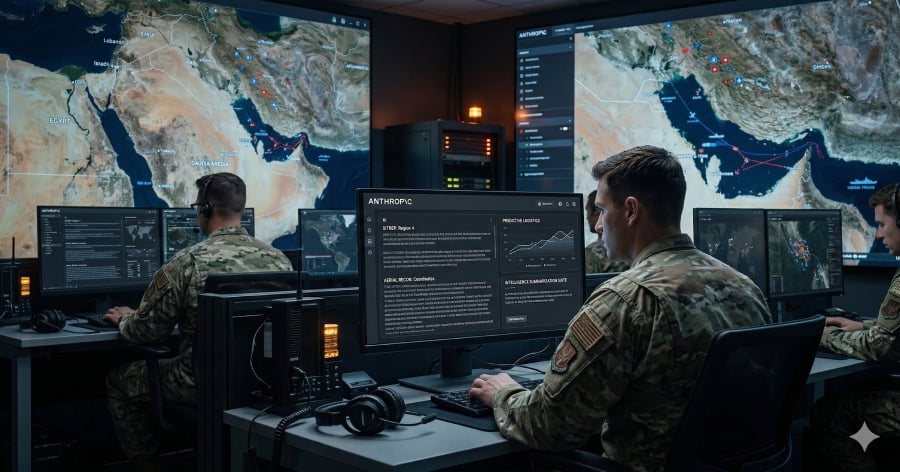
A federal ban is supposed to shut doors, not show up on the battlefield. Yet Anthropic’s Claude reportedly surfaced in the Iran war anyway.
Sources say the Pentagon deployed the system in recent US military operations tied to the conflict, placing a blacklisted AI model at the center of a fast-moving national security story.
According to CBS News, the activity comes after the Trump administration ordered a phase-out of Anthropic’s technology across federal agencies following a dispute with the Pentagon over how the AI could be used.
Inside the Pentagon’s use of Claude
Pentagon officials said Claude has been used to help process large volumes of information, turning dense reports and documents into summaries that analysts can review more quickly. The system has also supported planning and coordination tasks by helping teams organize logistics data and identify supply chain gaps across military operations.
Emil Michael, the Pentagon’s chief technology officer, told CBS News the department has relied on Claude for tasks such as synthesizing documents and improving logistics and supply chain efficiency. Those capabilities have made the model a useful tool for handling the complex administrative and analytical work that sits behind modern military operations.
The clash that got Anthropic banned
The breakdown traces back to a dispute over how the military should be allowed to use advanced AI systems. Anthropic had sought firm guardrails in its agreements with the government, asking for explicit limits that would prevent its models from being used for mass surveillance of Americans or to power fully autonomous weapons.
Defense officials pushed back, arguing the military needed flexibility to deploy the technology for “all lawful purposes.” When talks failed to produce a compromise, the standoff escalated into a policy rupture, with Defense Secretary Pete Hegseth labeling Anthropic a “supply chain risk” and the administration ordering federal agencies to phase out the company’s technology.
Replacing AI in the middle of a war
Officials said replacing the system will not be immediate. According to Defense One, it could take three months or longer for the Defense Department to find and deploy another AI platform capable of handling the same workloads.
Part of the challenge is how deeply the technology has already been integrated into day-to-day operations. Tools like these are embedded in operational planning and analysis, meaning removing them requires reworking the workflows that rely on them, a complicated task while military operations are ongoing.
More must-read AI coverage
- SS&C Intralinks DealCentre AI vs. Datasite: Which platform is built for the future of dealmaking?
- SS&C Intralinks FundCentre AI vs. Juniper Square: Which platform better supports modern private markets fund managers?
- Why Data, Not Models, Determines AI Success
- The Rise of the AI-Native Factory: How Physical AI Is Transforming Manufacturing
Who decides how military AI is used
The dispute has also exposed a broader divide over who ultimately controls the deployment of artificial intelligence in national security settings. Speaking to OpenAI employees during a recent all-hands meeting, CEO Sam Altman said companies building the technology do not get the final say once governments adopt it.
“So maybe you think the Iran strike was good and the Venezuela invasion was bad,” Altman told staff, according to a partial transcript reviewed by CNBC. “You don’t get to weigh in on that.” He said operational decisions about how the technology is used ultimately rest with government officials, not the companies developing the systems.
The comments come as OpenAI deepens its work with the Defense Department, which has been expanding the use of advanced AI tools across military and intelligence operations.
Competing visions for AI on the battlefield
The dispute is also revealing a widening split among AI companies as governments move to integrate the technology into defense systems. Anthropic has tried to set clear limits on how its models should be used, even if that stance risks losing government contracts.
Others are taking a different path. OpenAI has continued expanding its work with the Defense Department, while Elon Musk’s xAI has also agreed to deploy its models across classified government environments.
As military demand for advanced AI grows, where should companies draw the line?
A new CrowdStrike warning suggests cyberattacks across APAC are becoming faster, stealthier, and harder to detect.