


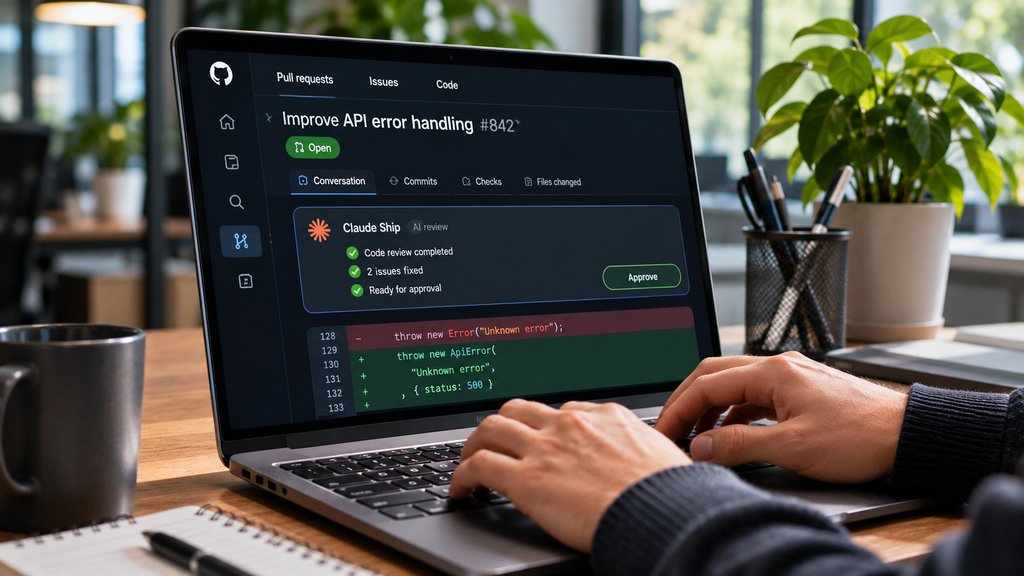
Writing the code is often only half the battle. A pull request can spend hours waiting for someone to review it, fix a failing test, resolve a merge conflict, or give the final approval.
Anthropic wants Claude to handle more of that work. On Nov. 23, the company introduced Claude Ship, a set of three AI agents that can review GitHub pull requests, address problems, and approve changes under rules set by the development team.
The feature is available to organizations on Claude Team and Enterprise plans. Code Review is already generally available, while PR Steward and Claude Approvals are in beta. Teams can decide which repositories use the agents and which changes still require human approval.
How Claude Ship reviews, fixes, and approves code
According to Anthropic’s announcement, Claude Ship divides the work that follows a pull request into three stages.
Code Review: Find problems before merging
Code Review uses multiple specialized AI agents to examine a pull request and its surrounding codebase. They look for logic errors, security vulnerabilities, broken edge cases, and potential regressions.
The agents check their findings before posting comments directly on the affected lines of code.
Reviews distinguish between problems that should be fixed, minor suggestions, and bugs that existed before the pull request.
Importantly, Code Review doesn’t approve or block a merge on its own. It provides findings that developers and existing approval workflows can act on.
Anthropic says reviews take approximately 20 minutes on average, although timing depends on the size and complexity of the code.
PR Steward: Keep the pull request moving
PR Steward takes over some of the follow-up work that normally sends developers back to code they’ve already finished.
If continuous integration (CI) checks fail, a merge conflict appears, or a reviewer requests changes, the agent can investigate and push a proposed fix.
After each push, it posts a comment explaining what changed and how to undo the modification.
Developers can give it further instructions using @claude or tell it to stop using @claude stop.
PR Steward is designed not to approve or merge pull requests. Those decisions remain subject to the team’s review process and repository rules.
Claude Approvals: Apply the team’s approval policy
Claude Approvals takes a different approach to code approval. Instead of requiring the same review process for every change, teams write rules describing when Claude may approve a pull request and when a person must sign off.
Those rules live in a repository policy file, .claude/approvals.yml.
For example, a team could allow Claude to approve a routine documentation correction while requiring a human reviewer for changes to authentication, billing, or deployment infrastructure.
Claude’s approval counts as a real GitHub approval. Depending on the repository’s branch-protection rules, that approval could be enough to satisfy a merge requirement.
Anthropic recommends starting in observe-only mode, where Claude reports the decision it would make without issuing an approval.
That gives teams a chance to compare its decisions with human reviewers before granting the agent authority.
How developers and administrators can get started
Developers don’t have to wait for their organization to enable the full suite.
Anthropic has introduced a /ship command in Claude Code that lets developers try the workflow on their own pull requests.
Running /ship can create a pull request, perform a review, address issues, and watch for subsequent feedback.
However, this developer-controlled workflow isn’t identical to the organization’s cloud-based PR Steward service.
The local /ship command operates within the developer’s session. Monitoring stops when the session ends or the computer goes to sleep. On Windows, the command can open and review a pull request, but its watch function doesn’t start.
It can also commit pending changes in eligible private repositories, so developers should check git status before running it.
For organizations, administrators can enable Claude Ship one GitHub repository at a time.
They can configure:
- Review depth: Quick, Standard, or Deep.
- Review triggers: When a pull request opens, after every push, or through a manual request.
- Spending limits: Monthly caps to control review and remediation costs.
- Approval rules: Which changes Claude can approve and which require human reviewers.
Anthropic’s Code Review documentation estimates a typical review costs $15 to $25.
Those charges are based on token usage and billed separately from the plan’s included allowance. Running a review after every push can therefore cost considerably more than reviewing once.
PR Steward also uses token-based billing. Claude Approvals has no base charge, but its classifiers can incur token costs, and policies that invoke Code Review trigger billed reviews even in observe-only mode.
Eligible Enterprise organizations can claim at least $10,000 in Claude Ship credits through Jan. 15, 2027. The credits must be used within 30 days of claiming them, subject to Anthropic’s terms.
Claude Ship isn’t available to organizations using Zero Data Retention, Anthropic’s HIPAA configuration, or customer-managed encryption keys.
What teams should check before giving Claude approval authority
The appeal is straightforward: Developers spend less time revisiting pull requests and more time writing code.
But letting an AI agent approve changes introduces a different responsibility from using AI coding tools to generate software.
Teams need to decide which decisions can be automated and which still require a person who understands the system.
Four checks are especially useful before expanding Claude Ship beyond a pilot.
1. Protect changes that require human judgment.
Start with one repository and keep existing branch protections in place.
Require human approval for sensitive areas such as authentication, payment processing, CI configuration, and access controls.
Check how Claude’s approval interacts with GitHub’s required-review settings. If one approval is enough to merge, an automated approval may satisfy that requirement unless additional restrictions are configured.
2. Test against real review feedback.
Run Claude Approvals in observe-only mode and compare its decisions with those of experienced reviewers.
Look closely at cases where Claude would approve a change but a human requests revisions.
Those disagreements are opportunities to improve the policy before enforcement.
Anthropic’s own AI-assisted Rust migration provides a useful warning: Its rewritten API passed approximately 98% of integration tests while initially matching the original system on only about a quarter of production inputs.
Passing automated checks doesn’t guarantee that code behaves correctly.
3. Keep automated fixes within clear boundaries.
PR Steward can act on review comments, including text written by other people. Anthropic warns that agents interpreting those comments can be manipulated.
Start with repositories where collaborators are trusted. Review changes made in response to unfamiliar comments, especially when they affect configuration files or security-sensitive code.
Keep required tests in CI rather than relying solely on local development checks.
Existing AI agent access controls remain relevant when an automated system can modify code and interact with development infrastructure.
4. Measure the actual time and cost saved.
Track how many issues Claude catches, how often developers reject its suggestions, and whether fixes introduce additional review cycles.
Compare those results with the cost of running reviews and PR Steward.
Anthropic reports that merged pull requests on its Claude Code team more than doubled between June and September 2026, while the share subsequently reverted fell by more than 40%.
Those are company-reported results from Anthropic’s own team, not an independent benchmark or a guarantee of similar improvements elsewhere.
A successful pilot should leave developers with fewer routine interruptions without making mistakes harder to catch.
Claude Ship extends AI coding beyond generating changes to helping teams decide when those changes are ready. Its usefulness will depend on how carefully organizations set approval rules, measure review quality, and preserve human accountability for what reaches production.
Also read: Anthropic’s latest MCP updates let Claude use server-provided skills, handle longer-running tasks, and request approvals during connected workflows.