


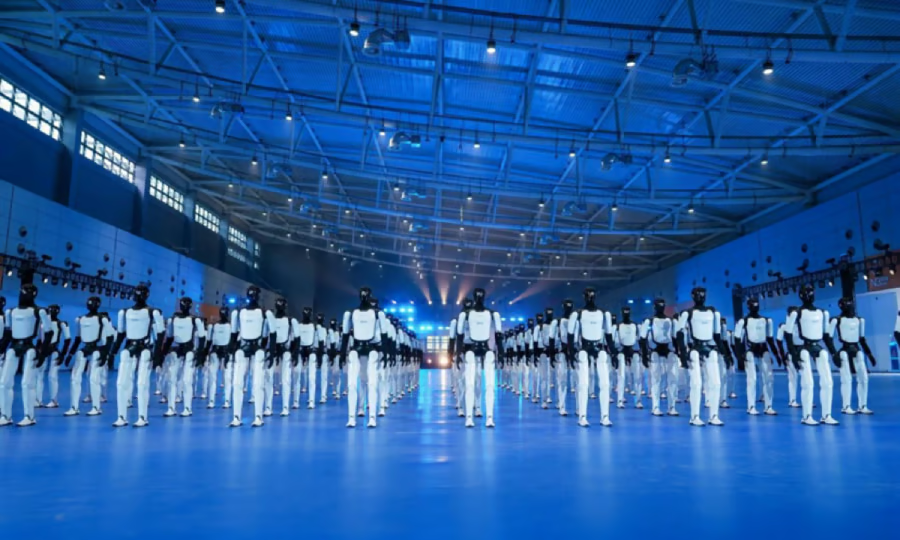
China just put 110 humanoid robots on the dance floor… and they moved in sync well enough to earn a Guinness World Records title.
The performance, organized by Chinese robotics company AGIBOT, took place Oct. 24 at the Yellow River International Convention and Exhibition Center in Jinan, Shandong province. The company’s full-size Expedition A3 robots danced, jumped and switched formations, even arranging themselves to display the number 2026.
A Guinness World Records adjudicator verified the 110 participants and presented an official certificate for the record for the most humanoid robots dancing simultaneously.
AGIBOT puts its robot fleet through a coordination test
Beyond the unusual spectacle, the performance demonstrated AGIBOT’s ability to coordinate a large fleet of humanoid machines.
According to the company, all 110 Expedition A3 units were standard production models rather than specially modified robots prepared for the event. Their movements were managed through LinkBots, AGIBOT’s platform for coordinating multiple robots.
LinkBots combines swarm scheduling, cluster control, and positioning technology to organize group movements. It uses ultra-wideband (UWB) positioning to track robots with centimeter-level accuracy under suitable conditions, while 5G and Wi-Fi connections carry instructions and coordination data.
The system is designed to help robots maintain spacing, change formations and move around obstacles without requiring operators to direct every machine individually.
China wants humanoid robots working beyond the stage
The record comes as China pushes to move humanoid robotics from demonstrations into commercial environments.
According to figures from China’s Ministry of Industry and Information Technology, domestic companies developed more than 400 humanoid robot models and produced over 40,000 units in the first half of 2026. Annual production is expected to exceed 100,000 units. AGIBOT is also expanding its market presence. Data attributed to research firm IDC puts its first-half shipments above 8,600 units, representing approximately 35% of global humanoid robot shipments.
The company says the 110 robots involved in the record performance will be deployed in cultural and tourism activities, public services, research and education. Other Chinese robotics companies are already testing machines in warehouses and factories, including parcel sorting and mobile device packaging.
More must-read AI coverage
- SS&C Intralinks DealCentre AI vs. Datasite: Which platform is built for the future of dealmaking?
- SS&C Intralinks FundCentre AI vs. Juniper Square: Which platform better supports modern private markets fund managers?
- Why Data, Not Models, Determines AI Success
- The Rise of the AI-Native Factory: How Physical AI Is Transforming Manufacturing
The commercial test starts after the applause
Coordinating 110 humanoid robots through a choreographed routine is an impressive engineering exercise, but it does not automatically make them reliable workers.
A prepared performance follows programmed movements in a controlled environment. Commercial operations are less predictable. Robots must deal with uneven floors, unexpected obstacles, changing instructions, connectivity problems and mechanical faults.
The available data does not establish LinkBots’ failure rates, recovery capabilities or long-term performance when coordinating large fleets outside demonstrations. These details matter because businesses evaluating humanoid robots need more than impressive demonstrations. They need evidence that machines can complete repetitive tasks consistently, operate safely and justify their purchase and maintenance costs.
What this means for users and businesses
For consumers, the achievement points toward a future in which humanoid robots could become more visible in shopping centers, exhibition venues, hotels and tourist attractions. AGIBOT’s stated deployment plans suggest that public-facing services could become an early application.
Businesses could eventually benefit from coordinated robot fleets that handle visitor guidance, entertainment, and certain repetitive operations. However, the economics will depend on how much human supervision these machines still require and how reliably they operate over extended periods.
AGIBOT has demonstrated that 110 production-model humanoid robots can perform together in a synchronized public event. The next milestone is proving they can deliver the same consistency when there is actual work to do.
Also read: For a closer look at humanoid robots moving beyond demonstrations and into real workplaces, read TechRepublic’s Humanoid Robots in 2027: Tesla, Figure AI, and Agility Race to Deploy.