
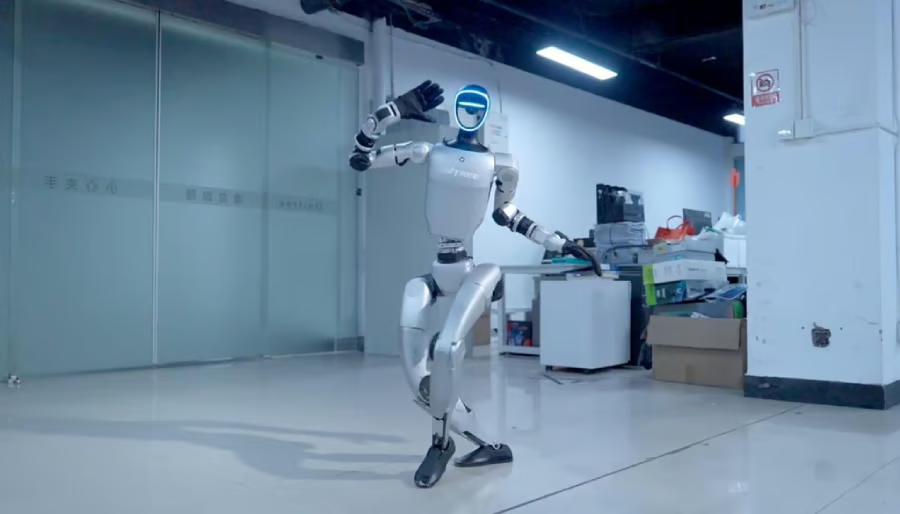


Humanoid robots can already dance and backflip. Getting one to reliably understand a spoken request and complete several unfamiliar physical steps may be the harder breakthrough.
Spirit AI co-founder and chief scientist Gao Yang believes the next major leap in humanoid robotics could arrive by mid-2027, when robots may be able to take natural-language instructions and carry out a sequence of physical actions.
“We anticipate reaching the GPT-3.0 milestone by mid-2027. You will be able to speak to a robot in natural language, and it will execute a series of reasonable physical actions to attempt the task,” Gao told Reuters.
Gao compared the expected advance with the breakthrough created by GPT-3, the language model associated with the rise of ChatGPT.
The comparison is not that humanoid robots are about to become the physical equivalent of ChatGPT. Rather, Gao expects their software to become better at connecting spoken instructions with multiple physical actions instead of relying on tightly predefined routines.
“The brain is indeed the weakest link in the complete robotics stack,” Gao said.
Factories before living rooms
Spirit AI already has tens of its Moz1 wheeled humanoid robots deployed on production lines at battery maker CATL and retailer JD.com, which is also an investor. Gao expects industrial uses to develop first, followed by simpler commercial-service work.
“The next one to two years mark the initial window for industrial applications. Two years from now, we’ll see robots deployed in commercial service settings doing simpler tasks. Entering homes is far harder than both,” he said.
That gap matters because factory floors are comparatively controlled. Homes contain unfamiliar objects, changing layouts, people, pets and situations that are far harder for robots to predict.
Spirit says its robots reach a 90% success rate on simple tasks in structured living-room environments, but that result does not show how reliably they would perform across ordinary homes or with tasks they have not encountered before.
The data problem behind the robot brain
Spirit is attacking the software problem with a large human-data operation. Reuters reports that about 1,000 contractors use wearable equipment in homes and factories to capture how people interact with their surroundings.
At a Beijing training center, workers wearing sensors repeated tasks including opening refrigerators, unlocking safes and cutting vegetables.
Spirit also favors real-world data over virtual simulations. Gao said simulations struggle with flexible objects such as cables, while the company found that varied “dirty data” could help its models improve faster than highly polished demonstrations. The approach comes with a practical cost: collecting physical-world data requires people, equipment and repeated interactions with real objects.
What could change for businesses
If robots can reliably turn spoken instructions into multi-step physical actions, the first impact is likely to appear in factories, warehouses, retail operations and other controlled workplaces.
Factories, warehouses, retailers and service businesses could gain machines capable of handling a wider range of tasks without being programmed separately for every movement. That could make humanoid robots more useful because their value would depend less on performing one fixed job repeatedly.
But reliability will determine whether that promise becomes an actual business case. A robot that understands a request but struggles with a bottle cap, unfamiliar object or unexpected situation still requires human intervention.
More about Innovation
- Sovereign AI Explained
- The Rise of the AI-Native Factory
- Why Data Determines AI Success
- SS&C Intralinks DealCentre AI vs. Datasite: Which platform is built for the future of dealmaking?
What this means for users
For consumers, Gao’s forecast does not mean humanoid robots will suddenly be ready to cook, clean and manage a home in 2027. The nearer-term opportunity remains in controlled workplaces where tasks and environments are easier to constrain.
The more important change may be how people instruct robots. If the software progresses as Spirit expects, workers could increasingly describe a goal in ordinary language instead of programming every movement step by step.
Whether that becomes a true “ChatGPT moment” will depend less on impressive demonstrations and more on reliability: robots will have to perform unfamiliar physical tasks consistently enough that businesses can trust them without constant human intervention.
Other news: Huawei is accelerating its AI chip roadmap, moving the Ascend 960DT launch to the first quarter of 2027 as it builds a domestic AI computing stack around China’s restricted access to advanced Nvidia hardware.