
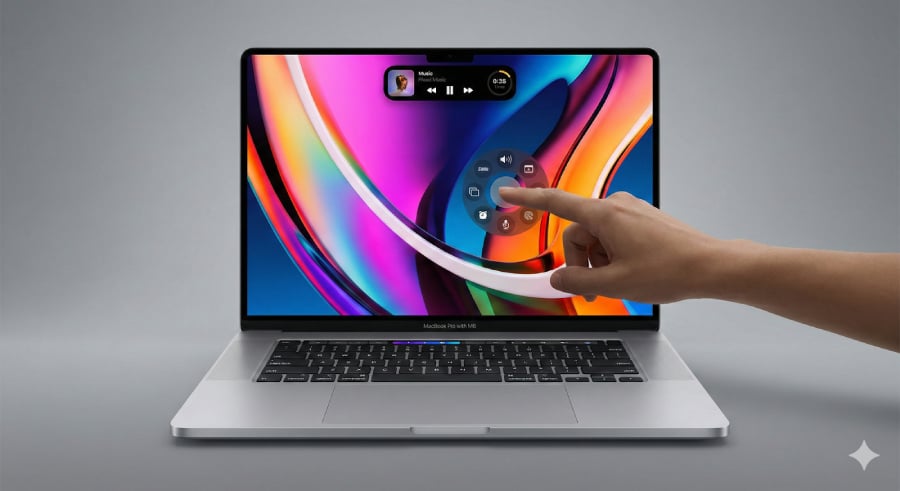


Apple’s next high-end MacBook may be more than another chip refresh.
Recent reports suggest Apple is preparing a major redesign of its premium MacBook Pro line, potentially with OLED displays, touch support, thinner hardware, and a new top-tier “MacBook Ultra” label. The device has not been confirmed, and timing remains unclear: some reports point to late 2026, while Bloomberg’s Mark Gurman suggests early 2027 may be more likely due to supply chain constraints.
If introduced, the Ultra line would sit at the very top of Apple’s laptop hierarchy, targeting professionals who need maximum performance and are willing to pay a premium. The timing is not fully settled. While some reports suggest a late 2026 window, Bloomberg’s Mark Gurman has indicated that supply chain pressures, especially a global memory chip shortage, make early 2027 more likely.
- A major redesign after years of incremental updates
- OLED display: the biggest visual leap yet
- Touchscreen support arrives on the Mac
- Dynamic Island-style redesign replaces the notch
- Next-generation M6 Pro and M6 Max chips
- Built-in cellular connectivity could finally arrive
- Why this matters
- What it means for buyers and the market
A major redesign after years of incremental updates
Apple last significantly redesigned the MacBook Pro in 2021 with the M1 Pro and M1 Max generation. The rumored MacBook Ultra would mark its first full redesign in roughly five years.
Across multiple reports, the device is described as thinner and lighter than the current MacBook Pro. The shift to OLED display technology is expected to play a key role in that design change, potentially allowing Apple to reduce chassis thickness while improving efficiency.
There is no firm confirmation that Apple will remove ports such as HDMI, MagSafe, or the SD card slot, but analysts note that Apple’s history of “thin-first” design decisions makes that possibility a real concern.
OLED display: the biggest visual leap yet
One of the most consistent rumors is that the MacBook Ultra will adopt OLED display technology for the first time on a Mac.
Current MacBook Pro models rely on mini-LED LCD panels, but OLED would deliver deeper blacks, higher contrast, and more vibrant colors. It could also improve power efficiency in certain use cases. OLED is already widely used across Apple’s product ecosystem, including the iPhone, Apple Watch, and iPad Pro, making the Mac the last major product category to transition.
Some reports also suggest advanced OLED structures, including tandem-style panels, could be used to balance brightness, durability, and battery performance.
Touchscreen support arrives on the Mac
Perhaps the most controversial change is the rumored addition of a touchscreen. Reports indicate that Apple is preparing touch input as a secondary interaction method, not a replacement for the keyboard and trackpad. This would mark a major philosophical shift for the Mac line, which has historically avoided touchscreens.
Software changes are also expected to support this transition, with macOS reportedly gaining more touch-friendly interactions such as improved gestures and redesigned controls. Apple’s past concerns about arm fatigue from touch-based laptops have long been cited as a reason for avoiding this move, making this one of the most surprising rumored upgrades.
Dynamic Island-style redesign replaces the notch
The MacBook Pro’s notch could also be on its way out. Leaks suggest Apple may switch to a hole-punch camera design, paired with a software-driven “Dynamic Island” system similar to what is used on the iPhone.
This would allow macOS to integrate system alerts, background activities, and connectivity indicators into a unified interactive space at the top of the display, while also moving closer to a full edge-to-edge screen design.
Next-generation M6 Pro and M6 Max chips
Performance is expected to take a major leap with the introduction of Apple’s M6 Pro and M6 Max chips. These processors are reportedly built on TSMC’s advanced 2nm manufacturing process, which could deliver meaningful gains in speed and efficiency compared to the current 3nm M5 generation.
However, the chip roadmap is not entirely stable. Some reports indicate Apple has shifted its focus to the M7 generation for AI-focused performance improvements, raising questions about whether the M6 Pro and M6 Max will arrive as originally planned. This uncertainty could affect both the timing and configuration of the MacBook Ultra itself.
Built-in cellular connectivity could finally arrive
Another long-rumored feature is native cellular support. Instead of relying on iPhone hotspot connections, the MacBook Ultra could include built-in 5G connectivity using Apple’s own modem technology. If implemented, it would allow users to stay connected without depending on external devices or Wi-Fi networks. While Apple has explored this idea for years, reports suggest it remains uncertain whether it will ship in this generation.
Why this matters
If even half of these rumored features arrive, the MacBook Ultra would represent one of the biggest shifts in Apple’s laptop strategy in over a decade.
The move to OLED, touchscreen input, and redesigned silicon could reshape how professionals interact with macOS hardware. It also signals Apple’s growing push toward tighter integration between hardware, software, and AI-optimized chips. However, the uncertainty around chip availability, especially the reported changes to the M6 and M7 roadmap, introduces real risk of delays or scaled-back features.
What it means for buyers and the market
For consumers, the MacBook Ultra could become Apple’s new flagship workstation-class laptop, but likely at a significantly higher price point than today’s MacBook Pro lineup.
That positioning may make it appealing mainly to creative professionals, developers, and enterprise users, while pushing mainstream buyers toward lower-tier MacBook models. For competitors, especially high-end Windows laptop makers, Apple’s move into OLED touchscreen laptops with custom silicon could raise the bar again in premium computing design and efficiency.
The MacBook Ultra is still firmly in the rumor stage, but the consistency of leaks across multiple analysts suggests Apple is actively exploring a major reset of its top-end laptop line. What remains unclear is not whether Apple is aiming for a bigger leap, but whether supply chain constraints and chip roadmap changes will let it arrive on schedule.
Also read: Apple’s OLED ambitions extend beyond Macs, as the company is also reportedly moving ahead with its long-rumored foldable iPhone featuring Samsung-made displays.