
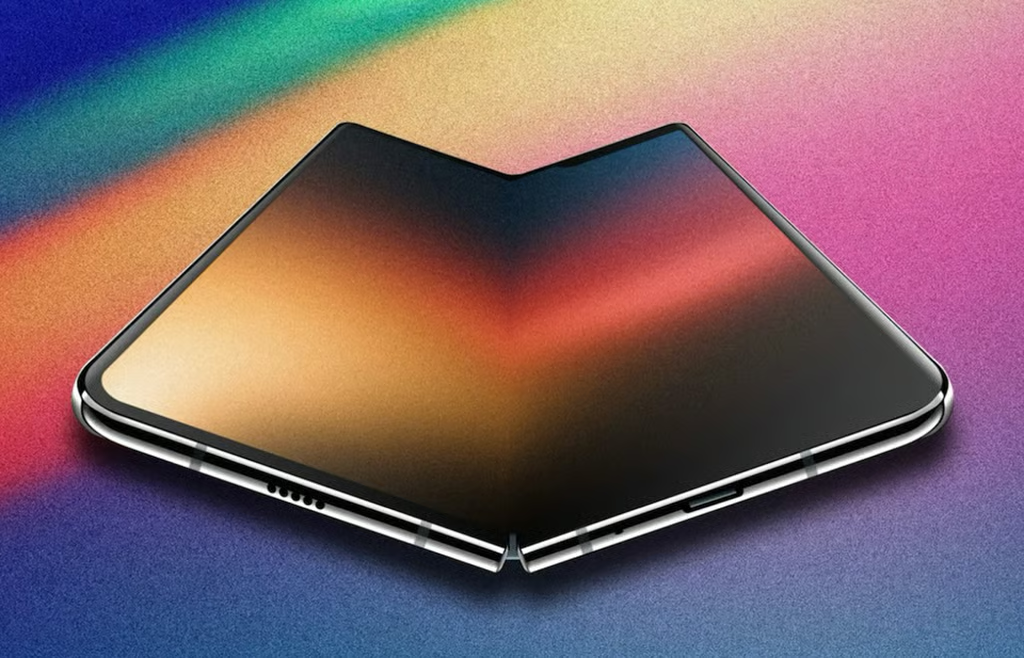


Samsung Display has received Apple’s approval to begin manufacturing OLED display modules for the company’s first foldable iPhone, according to a report from The Elec.
The approval follows a qualification process that requires suppliers to prove display quality, production stability, and manufacturing consistency before components can be shipped for device assembly. Industry sources cited by The Elec said Apple typically requires suppliers to achieve yields of at least 70%. Samsung Display reportedly exceeded that threshold, reaching yields above 80%.
Following approval, Samsung has begun operating part of its back-end production lines in Vietnam to fulfill an initial order of roughly 3 million foldable OLED panels, expected to be delivered this year. The development marks one of the clearest indications yet that Apple’s foldable smartphone project is moving beyond the planning stage and into active component production.
Samsung remains Apple’s exclusive supplier
Samsung Display is expected to be the sole supplier of foldable OLED panels for Apple’s first foldable handset under a three-year exclusive agreement between the two companies.
The arrangement highlights Samsung’s lead in foldable display manufacturing, a segment that remains technically demanding due to strict durability and quality requirements. Foldable displays must withstand repeated bending while minimizing visible creasing and maintaining thinness, brightness, and reliability.
The panels are reportedly being produced at Samsung Display’s Vietnam facility, where around 50 production lines are currently operating. The site has a total capacity of approximately 80 lines, leaving room for future production increases if demand grows.
Advanced display technology planned
Apple’s foldable device is expected to use Samsung Display’s latest OLED material set, known as M16. According to reports, the technology delivers improvements in brightness, color performance, lifespan, and power efficiency compared with previous OLED generations.
The display is also expected to incorporate Color Filter on Encapsulation (CoE) technology. The approach removes the traditional polarizer layer and places a color filter directly on top of the encapsulation layer, thereby reducing thickness and potentially improving efficiency and display performance.
Several reports also suggest Apple is pursuing a display design that prioritizes crease reduction, one of the most persistent challenges facing foldable smartphones.
The hinge remains a potential obstacle
While the display program appears to be progressing smoothly, reports indicate another critical component could still affect the device’s launch timeline.
According to The Elec, Apple’s foldable iPhone is expected to use a hinge module manufactured using 3D printing technology. Industry sources claim the component has experienced unwanted noise issues during assembly, creating uncertainty around production readiness.
“Apple appears to be facing challenges in stabilizing production of the hinge module for its first foldable smartphone,” an industry source told The Elec. “There are no issues on Samsung Display’s side. The launch schedule will ultimately depend on Apple’s readiness for device components, particularly the hinge.”
Panel production moves the iPhone Fold closer
Apple’s entry into the foldable smartphone market could become one of the industry’s most significant product launches in years.
Unlike many early foldable devices that launched in limited quantities to test consumer demand, Apple is reportedly preparing an initial order of around 3 million display panels. That suggests the company sees meaningful demand potential despite the premium pricing typically associated with foldable devices.
For Samsung Display, the deal further strengthens its position as the dominant supplier of advanced OLED technology. For Apple, securing an exclusive supply agreement helps ensure access to mature foldable display technology as it enters a category already populated by competitors from Samsung, Huawei, Google, Honor, OPPO, and Vivo.
The remaining challenge is execution. Display production may now be underway, but the success of Apple’s first foldable device will ultimately depend on whether the company can solve the durability, hinge, and user experience challenges that have defined the foldable market since its inception.
Also read: Apple’s iPhone 18 Pro rumors point to AI upgrades, a 2nm A20 Pro chip, camera changes, and possible pricing shifts.