


Singapore and Thailand already have a cross-border payment link. Across Southeast Asia, however, businesses still face different rules for moving money and data between countries.
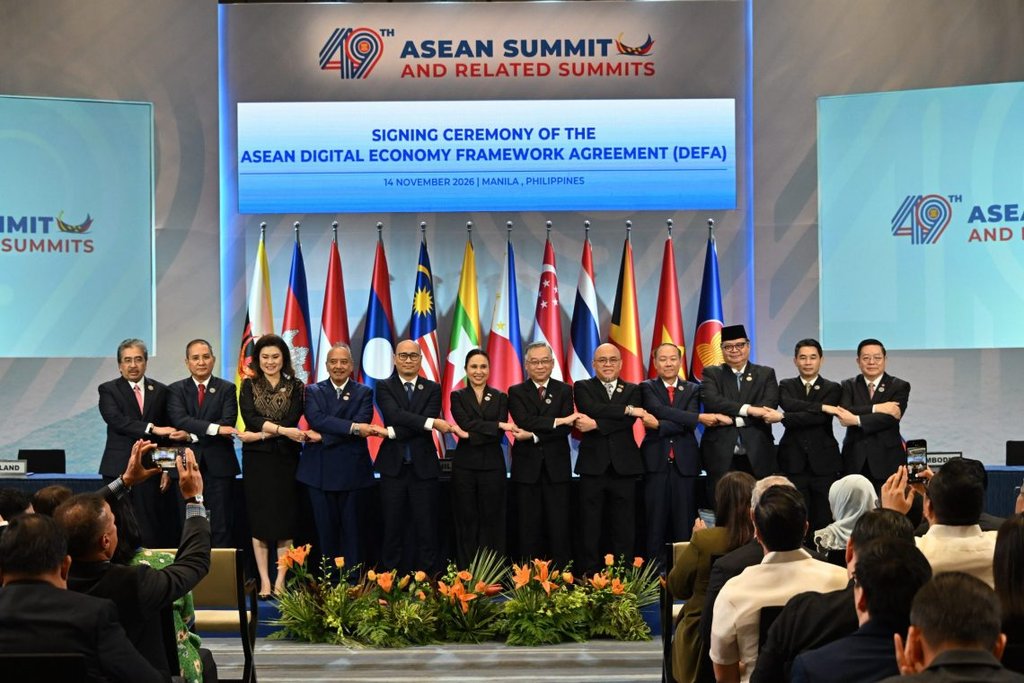
ASEAN representatives signed the Digital Economy Framework Agreement (DEFA) in Manila on November 14, establishing legally binding commitments on electronic payments, commercial data transfers, and digital trade. The agreement aims to reduce barriers for businesses operating across Southeast Asian markets, where national regulations and payment networks remain fragmented.
Implementation discussions are underway. Philippine Trade Secretary Cristina Roque said on November 16 that officials had begun discussions with the Bangko Sentral ng Pilipinas about the agreement’s cross-border payment provisions. National regulators must now determine how to put the regional commitments into practice.
Cross-border payments and data rules
Singapore’s Ministry of Energy, Trade and Industry describes DEFA as ASEAN’s first standalone, legally binding digital economy agreement. It promotes interoperability between electronic payment and digital identity systems, alongside common commitments on commercial data transfers and cybersecurity.
For banks, fintech providers, and merchants, greater interoperability could simplify regional transactions. DEFA does not create a single ASEAN-wide payment network or guarantee lower fees.
Singapore’s PayNow and Thailand’s PromptPay have supported cross-border transfers since 2021, while the countries have expanded digital trade and payments cooperation. Availability still depends on participating banks, supported networks, and local regulations.
DEFA also supports commercial cross-border data transfers, including financial data, while addressing requirements to store information locally.
For regional cloud operators, clearer transfer rules could reduce the need to design separate data-hosting arrangements solely to satisfy localization requirements. However, companies handling data across Singapore, Indonesia, and Vietnam must still assess applicable national privacy, security, and sector-specific rules.
Singapore Deputy Prime Minister Gan Kim Yong acknowledged that ASEAN countries have different levels of digital readiness, complicating implementation.
The agreement also addresses mandatory source-code disclosure, cybersecurity cooperation, and electronic trade documentation.
For exporters, digital verification could reduce paperwork. A planned Singapore-Vietnam digital credentials pilot aims to simplify letter-of-credit checks, although no participating banks or operational rollout have been announced.
Existing barriers remain substantial. A September 2026 report citing a 2024 survey found that more than 80% of 700 small businesses across six ASEAN economies encountered cross-border e-commerce challenges.
What changes when DEFA takes effect
DEFA negotiations concluded in May 2026 after starting in September 2023. Singapore’s government says the agreement is expected to enter into force 180 days after signing and replace ASEAN’s 2019 e-commerce agreement. The precise effective date remains subject to the agreement’s formal requirements.
The complete treaty text is expected to be published in early 2027. Singapore, which assumes ASEAN’s chairmanship that year, has identified digital payments, digital identities, and electronic trade documentation as possible early implementation priorities.
National measures will be necessary because ASEAN economies have different payment infrastructure, technology capabilities, and regulatory requirements. Entry into force will not mean every digital payment service or data-transfer arrangement changes immediately.
IT and compliance teams should review their existing payment connections and data-hosting requirements before changing infrastructure or contracts. The first meaningful results will be interoperable services and national rules that businesses can actually use.
Read more: As ASEAN pursues payment interoperability, the Philippines’ proposed tighter rules for payment operators illustrate how national licensing and transaction-tracing requirements could shape regional services.