


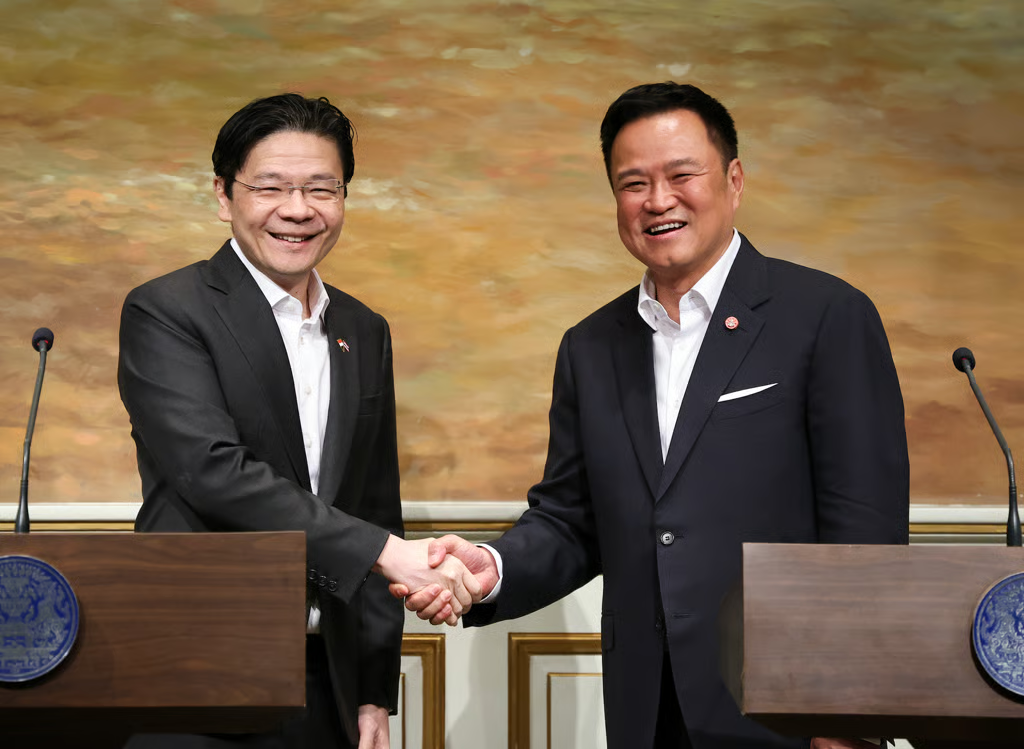
Singapore and Thailand are widening their digital partnership, putting AI, cross-border payments, and regional digital integration higher on the bilateral agenda.
At their Sept. 2 Leaders’ Retreat in Bangkok, Prime Ministers Lawrence Wong and Anutin Charnvirakul agreed to pursue renewal of an existing digital-economy pact and deepen practical AI cooperation spanning governance, adoption, talent development, and research. The meeting also reinforced broader work on digital trade and payments as both countries prepare for successive ASEAN chairmanships in 2027 and 2028.
The governments’ Sept. 2 joint statement builds on programs already underway while giving them fresh political backing. Wong separately identified manufacturing, healthcare, and tourism as areas for practical AI applications, alongside cooperation on safe and responsible deployment.
The push comes as APAC companies increase AI spending faster than many can demonstrate measurable returns. Singapore is also seeing AI demand feed into its economy, with AI-linked exports and manufacturing contributing to its stronger 2026 growth outlook.
Existing pacts underpin the new AI push
The clearest new step is the plan to refresh the countries’ digital-economy framework. Their 2021 digital-economy MOU already covered digital connectivity, cross-border data flows, technology talent, AI, 5G and cybersecurity, so the Sept. 2 announcement expands an existing relationship rather than establishing bilateral AI cooperation from scratch.
Thailand’s proposed accession to the Digital Economy Partnership Agreement is also an existing process. Singapore’s Ministry of Trade and Industry listed Thailand among nine economies that had applied to join DEPA as of October 2025, making the retreat a reaffirmation of Singaporean support rather than a new accession bid.
Payments follow the same pattern. PromptPay-PayNow has linked the countries’ real-time payment systems since 2021, while the latest statement backed further regionalization through Nexus. Five central-bank partners incorporated Nexus Global Payments in April 2025 to operationalize a multilateral instant cross-border payments scheme.
Similar interoperability work is emerging elsewhere in Southeast Asia. A Singapore-Vietnam digital credentials pilot is testing verifiable credentials for cross-border trade finance, another effort to reduce friction between national digital systems.
ASEAN integration gives the pact wider stakes
ASEAN officials concluded DEFA negotiations in May 2026 after resolving outstanding issues at meetings in Manila. Singapore and Thailand welcomed its planned signing at the upcoming ASEAN Summit.
DEFA is intended to support regional integration across digital trade, payments, data flows and emerging technologies. ASEAN estimates that successful implementation could help its digital economy reach as much as $2 trillion by 2030.
Signing the agreement would not immediately create a new compliance calendar. Regional and national implementation steps would still have to turn its provisions into rules affecting companies.
Singapore’s strengths in digital policy, finance and infrastructure intersect with Thailand’s manufacturing and tourism sectors, creating cross-border use cases for AI, payments and digital trade. Greater interoperability could reduce technical and regulatory friction for companies operating across Southeast Asian markets.
Singapore will chair ASEAN in 2027, followed by Thailand in 2028. Both governments agreed to develop a multi-year agenda spanning those successive chairmanships, giving longer-running work on AI, digital trade and payments an opportunity to continue across two ASEAN leadership cycles.
The Sept. 2 retreat set priorities rather than launching new technology infrastructure. Concrete AI projects, additional Nexus participants and DEFA implementation measures will show how much of the agenda moves from diplomacy into operations.
Read more: Singapore’s digital ambitions are also being backed by infrastructure investment: five Singapore firms account for 98% of Southeast Asia’s data-center equity funding, even as new cloud and AI capacity spreads across neighboring markets.
Want to learn more AI tips, tricks, and prompting techniques? eWeek readers get free 7-day access to The Neuron Academy, our practical learning platform designed to help professionals use AI more confidently at work. Browse all lessons →