


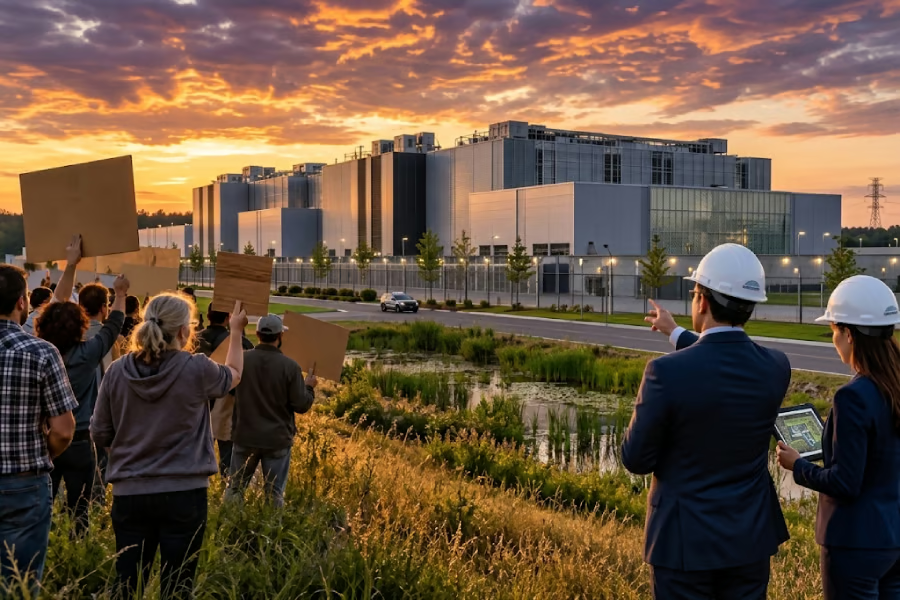
As data center development accelerates to meet surging demand for AI infrastructure, developers are facing a growing challenge beyond securing enough power: winning over the communities where they want to build.
That challenge was a major topic at Data Center World Power, held this month in Dallas. The event, a spinoff of the annual Data Center World conference, brought industry leaders together to discuss the rapidly changing power demands of data centers and the obstacles developers face in pursuing new projects.
TechRepublic covered several sessions throughout the event. In a panel moderated by Matt Bailey, chief operating officer of Calvert Street Group, several speakers laid out what developers need to do to become more effective and better engaged with local groups opposing data center expansion.
A key factor is to see things from others’ perspectives, said Rob Cleveland, president & CEO of Grow NELA (Northeast Louisiana Regional Economic Development Authority). His organization is focused on driving economic growth through investments and workforce initiatives.
One way his organization attracts more development interest and investment is through speed and transparency of the permitting process. Hence, his region is attracting considerable interest in data center development.
“Some people we deal with from other states have been waiting more than a year on a permit, whereas the permitting time in Northeast Louisiana is only 15 days,” said Cleveland.
Data center opposition may be less widespread than headlines suggest
The media makes it appear that citizens across the entire nation have risen up to prevent any and all data centers from ever breaking ground. Certainly, there are specific areas where local protest groups have created quite a stir — and there are valid concerns in some of them that must be tackled properly.
But overall, this view of all-out opposition is a distortion from reality.
There are, in fact, many areas of the country where there is plenty of acceptance of the jobs, tax revenues, and economic benefits that data centers can bring. In those areas, the pace of AI data center development is not slowing down.
“Our local elected officials continue to be supportive because they’re seeing every day the real impacts that are coming into our region,” said Cleveland. “The questions we get locally about water and power are being answered relatively easily.”
He stressed that data center development is more responsible today than it was a few years ago. Some community concerns are based on older projects where water consumption was very high and in areas where power rates have increased sharply, sometimes related to a data center’s presence and sometimes not.
More must-read AI coverage
- SS&C Intralinks DealCentre AI vs. Datasite: Which platform is built for the future of dealmaking?
- SS&C Intralinks FundCentre AI vs. Juniper Square: Which platform better supports modern private markets fund managers?
- Why Data, Not Models, Determines AI Success
- The Rise of the AI-Native Factory: How Physical AI Is Transforming Manufacturing
Developers face questions over rising electricity costs
There has been quite a commotion in the news recently about AI data centers being the reason why electricity rates have shot upwards in certain regions. Data centers are an easy target, but in most cases, they are not the reason. The US Energy Information Administration expects US electricity consumption to reach record levels in 2026, with data center development and manufacturing activity helping drive the increase.
However, data center operators are becoming proactive about this objection. That issue has already drawn attention from Washington, with policymakers and technology companies debating how to prevent AI infrastructure costs from being passed on to consumers. Few developers object to paying their share. In fact, many are happy to build an entire power plant and provide some of that power to the local community.
Diane Sullivan, chief development officer of Hecate Energy, a Chicago‑based US developer of utility‑scale energy parks, is a veteran of many community engagement projects. Earlier in her career, she faced communities concerned about the impact of planned wind farms.
“A mistake that has been made in the past was to go into a rural community with a project that’s going to benefit them greatly, but it was done under the radar to cultivate a project with the town supervisor and obtain permits before letting the public know about it,” said Sillivan. “This is a terrible idea these days. We must be open and transparent.”
Modern projects are so large and so currently controversial that transparency and upfront engagement are essential. There is always going to be criticism. Developers must be willing to listen to concerns about power, water, electricity rates, jobs, noise, and whatever other worries are being voiced.
These days, few large data center developers can come to a project without also bringing a solution for power delivery. In many cases, this necessitates on-site power generation built at the developer’s expense, as grid capacity struggles to keep pace with new AI infrastructure.
According to Sullivan, if a project proposal doesn’t include a power generation solution, you are usually wasting your time trying to develop one.
Also read: TechRepublic looks at how AI’s growing energy demands are putting new pressure on the US power grid.