


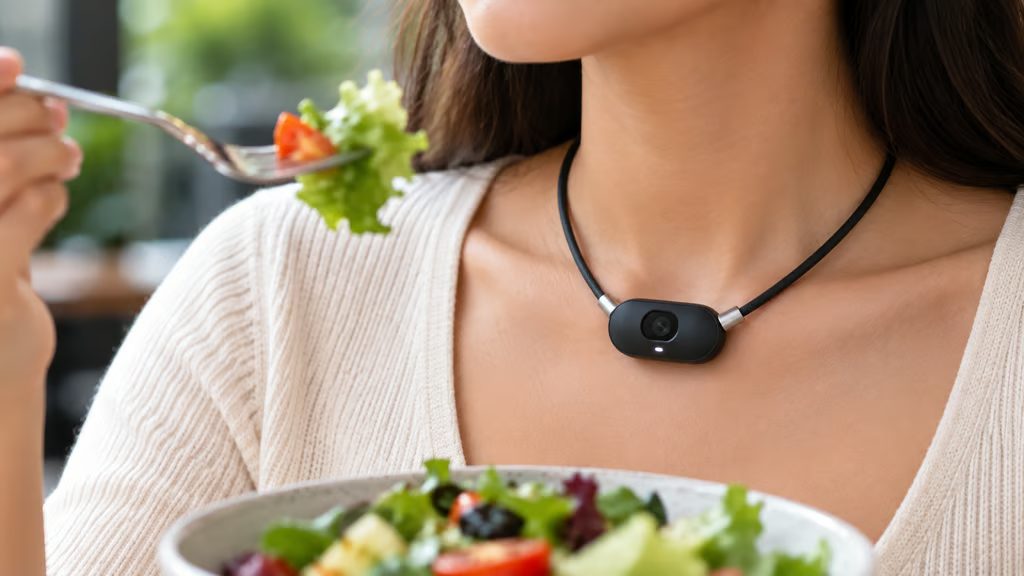
ODYSS wants to eliminate manual food logging with the N1, a camera-equipped AI necklace designed to recognize meals, estimate nutrition, and build a dietary record while you eat.
The N1 carries a $299 MSRP, while early customers can reserve a $199 VIP price with lifetime access to its AI features. ODYSS plans to begin mass production in late October and start global shipments in December 2026.
The company unveiled the wearable at IFA on Sept. 4. Unlike conventional screen-free fitness trackers that focus on activity, sleep, or recovery, the N1 is built around food: what you eat, when you eat, and how those habits change over time.
How the ODYSS N1 tracks meals
According to ODYSS, the N1 combines a 120-degree wide-angle camera, G-sensor, dual microphones, and other sensors to detect eating events.
The necklace sits near the collarbone, giving its camera a view of meals and hand-to-mouth movement. ODYSS says the system uses visual, audio, and motion signals together to determine when someone is eating and identify food.
The company claims greater than 99% accuracy for detecting eating events, but that figure comes from internal testing of pre-production hardware under controlled conditions. ODYSS warns that performance can vary with the type of food, environment, and how the device is worn.
That claim also refers to detecting an eating event, not necessarily identifying every ingredient or estimating calories with the same accuracy.
During a hands-on demonstration, The Gadgeteer confirmed that a coffee entry shown in the companion app had been automatically recognized. The demonstration also showed noodles in the meal history, although the report did not establish whether that entry had been automatically detected or manually added.
ODYSS combines open food databases with its own product-image and ingredient data for recognition. A company co-founder told The Gadgeteer that packaged foods can be identified precisely, but that statement was not backed by published independent testing.
The system can also estimate food size and calorie content using visual and depth information, according to the company demonstration.
Users can manually correct entries or add meals the necklace missed. That means the N1 may reduce food logging rather than eliminate manual input completely, particularly when it is not being worn or cannot identify a meal confidently.
Food recognition accuracy still needs independent testing
ODYSS has not published independent validation showing how accurately the N1 identifies foods, estimates portions, or calculates calories across everyday meals.
That distinction is important because recognizing that someone is eating is a different task from identifying everything on the plate and estimating its nutritional content.
Independent research into image-based dietary assessment suggests the broader technology can work, but accuracy varies considerably. A 2025 systematic review examined 47 studies covering 22 image-based dietary applications and found an average per-meal calorie error of 18.7% across 31 studies with usable data.
Wearable health products increasingly combine multiple measurements to produce broader insights. Oura, for example, can connect meal records with glucose patterns collected through a separate Dexcom sensor. ODYSS is approaching the problem from the opposite direction by trying to automate the meal record itself.
The N1 organizes its results into three scores: Quality, which looks at nutritional balance; Energy, which compares intake against targets; and Rhythm, which considers factors including meal timing and eating speed.
ODYSS says it can also import Apple Health data to provide additional context for recommendations.
The N1 is not a medical device. ODYSS says its nutritional analyses, scores, and AI-generated guidance are intended for general wellness and should not replace medical or professional dietary advice.
Privacy is a major part of the N1 proposition
Putting a camera on a necklace creates an obvious privacy problem, especially around restaurants, offices, and other people.
ODYSS says the N1 only captures still images during detected eating or drinking events or when the wearer manually triggers a capture. A physical Privacy Mode button can disable image capture, with the device using an LED, vibration, and app status to confirm that mode is active.
The company’s current privacy policy says captured images are briefly stored on the device and uploaded using encryption to ODYSS’s cloud servers.
The server screens images for faces and non-food scenes before food recognition and nutritional analysis. ODYSS says original images are then automatically deleted after processing, while the extracted nutritional information remains associated with the user’s account.
That policy is more specific than some of ODYSS’s earlier descriptions of the product, which described more processing as happening locally on the device.
ODYSS says food photos are not used to train general-purpose AI models by default and that separate consent would be required before user content could be used for model training or optimization.
Those controls matter because dietary information joins an expanding set of sensitive health data that wearable platforms can collect and analyze.
The camera also makes the N1 part of a broader privacy debate around camera-equipped wearables, where capturing useful context can also mean recording information about nearby people and environments.
Price and availability
ODYSS lists the N1 at a $299 MSRP.
A current early-access offer lets customers place a $1 non-refundable deposit to secure a $199 VIP price. ODYSS says that package includes lifetime access to its AI features, compared with planned regular subscription prices of $8.99 per month for Basic and $12.99 per month for Premium.
The company plans to begin mass production in late October, followed by global shipments in December. Actual availability will depend on country, regulations, device compatibility, and logistics.
The current prototype weighs about 25g and includes 64GB of storage, Bluetooth 6.1, 2.4GHz Wi-Fi, and a 300mAh battery rated for up to 18 hours. ODYSS says the companion app will support iOS 16 or later and Android 13 or later.
For now, the strongest case for the N1 is convenience rather than proven dietary precision. The necklace may be able to remove much of the routine work from food logging, but buyers will have to wait for independent testing to learn how reliably it identifies meals, estimates portions, and calculates nutrition outside controlled demonstrations.
Also read: Apple is reportedly developing a screen-free fitness tracker that could bring another major company into the growing market for wearables designed to disappear into everyday routines.